

Half-Life

Presentation
•
Science
•
9th Grade
•
Practice Problem
•
Hard
Standards-aligned

Jan Davis
FREE Resource
13 Slides • 17 Questions
1
2
3
Open Ended
How do you think the concept of half-life can be applied to real-world problems or discoveries?
4
5
Multiple Choice
Which of the following best describes why radioactive decay is considered both random and predictable?
Each atom decays at a fixed time.
All atoms decay simultaneously.
Individual atoms decay randomly, but large groups decay predictably.
Decay only happens in certain elements.
6
7
Multiple Choice
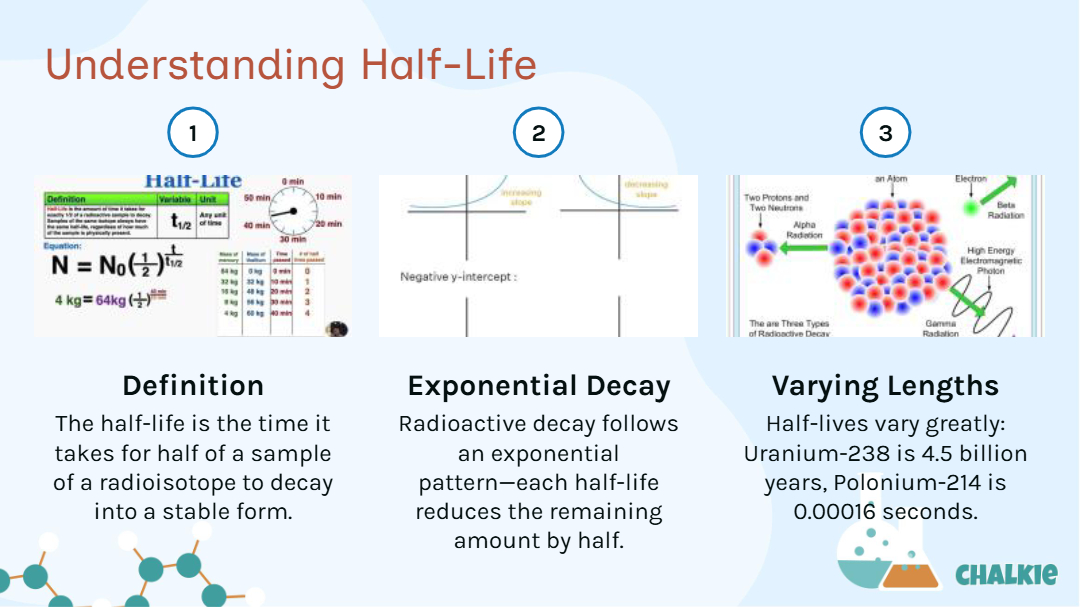
Which of the following isotopes has the shortest half-life?
Uranium-238
Carbon-14
Polonium-214
Nitrogen-14
8
Multiple Choice
Which of the following statements about half-life is correct?
Half-life is the time it takes for all of a sample to decay.
Half-life is the time it takes for half of a sample to decay.
Half-life is the time it takes for a sample to double in size.
Half-life is unrelated to radioactive decay.
9
10
11
12
Fill in the Blanks
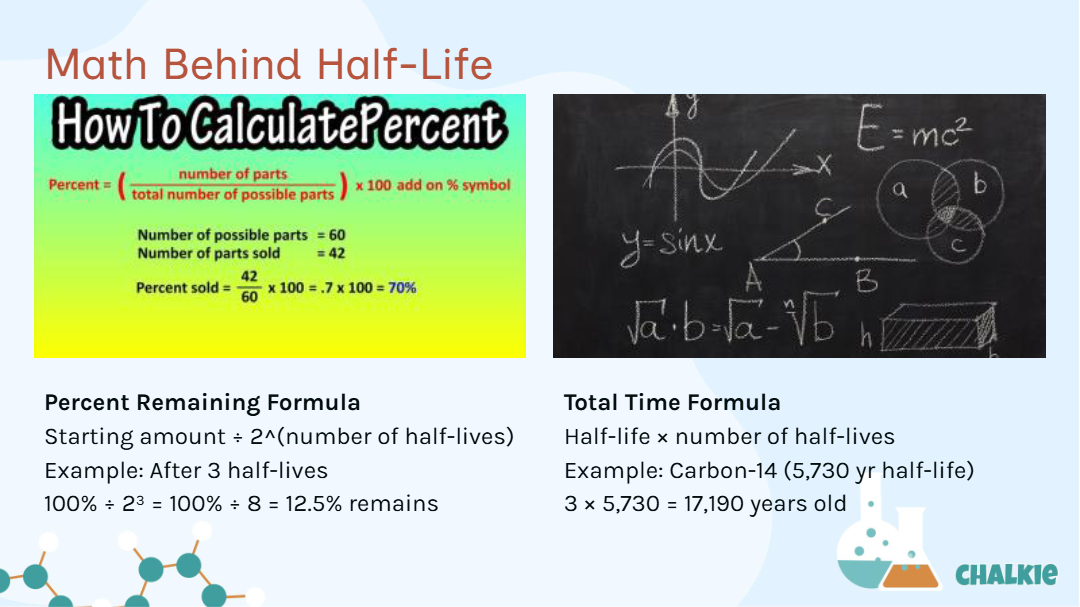
The formula to calculate the percent remaining after a certain number of half-lives is starting amount divided by
Type answer...
13
Open Ended
Explain how the concept of half-life helps scientists estimate the age of ancient objects.
14

15
Multiple Choice
After 24 years, 8g of an original 128g sample remains. What is the half-life of the sample?
3 years
6 years
8 years
12 years
16
17
Multiple Choice
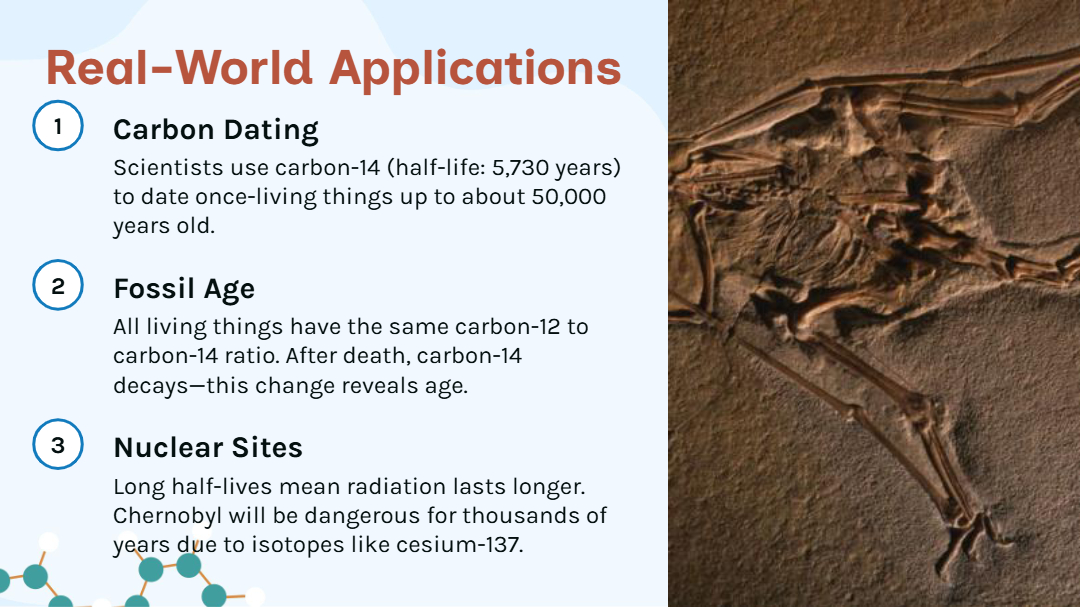
Which of the following is a real-world application of carbon-14 dating?
Dating ancient rocks
Dating once-living things up to about 50,000 years old
Measuring radiation at nuclear sites
Determining the age of the universe
18
Multiple Choice
Why is understanding radioactive decay important for scientists studying the past?
It helps scientists predict the weather
It allows scientists to date ancient artifacts and fossils
It is used to create new elements
It helps scientists grow plants faster
19
20
Multiple Select
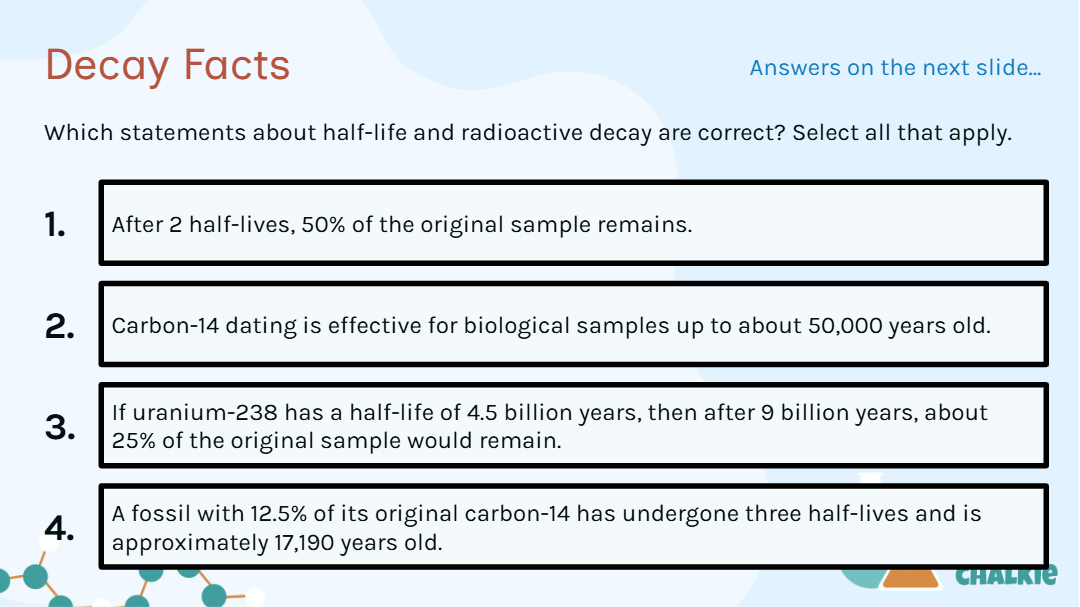
Which statements about half-life and radioactive decay are correct? Select all that apply.
After 2 half-lives, 50% of the original sample remains.
Carbon-14 dating is effective for biological samples up to about 50,000 years old.
If uranium-238 has a half-life of 4.5 billion years, then after 9 billion years, about 25% of the original sample would remain.
A fossil with 12.5% of its original carbon-14 has undergone three half-lives and is approximately 17,190 years old.
21
22
Multiple Choice
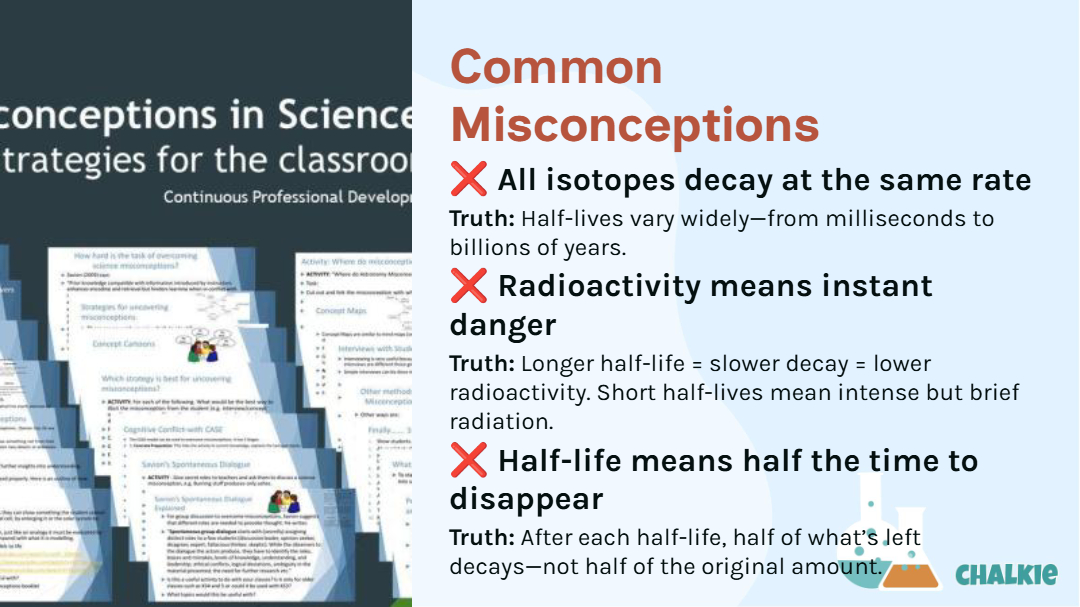
Which of the following is NOT a misconception about half-life or radioactivity?
All isotopes decay at the same rate
Radioactivity means instant danger
Half-life means half the time to disappear
Longer half-life means slower decay and lower radioactivity
23
Open Ended
Explain why radioactivity does not always mean instant danger, using the concept of half-life.
24
25
Fill in the Blanks
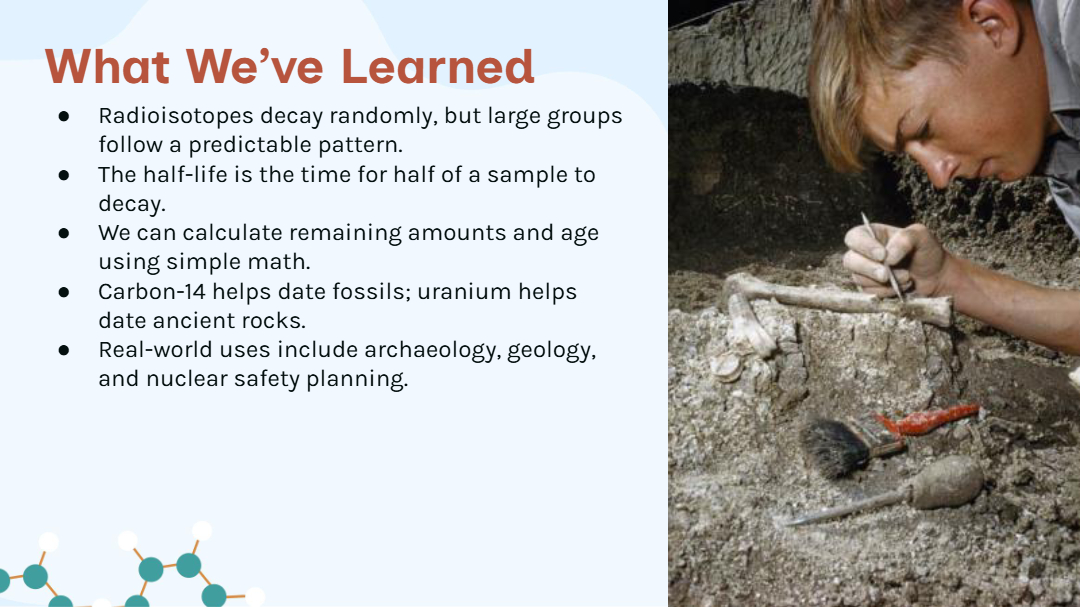
Fill in the blank: The half-life is the time for
26
Fill in the Blanks
The half-life of a radioactive isotope is the time it takes for half of the original amount to
27
Open Ended
What is one real-world application of the concept of half-life that you found most interesting, and why?
28

29
Multiple Choice

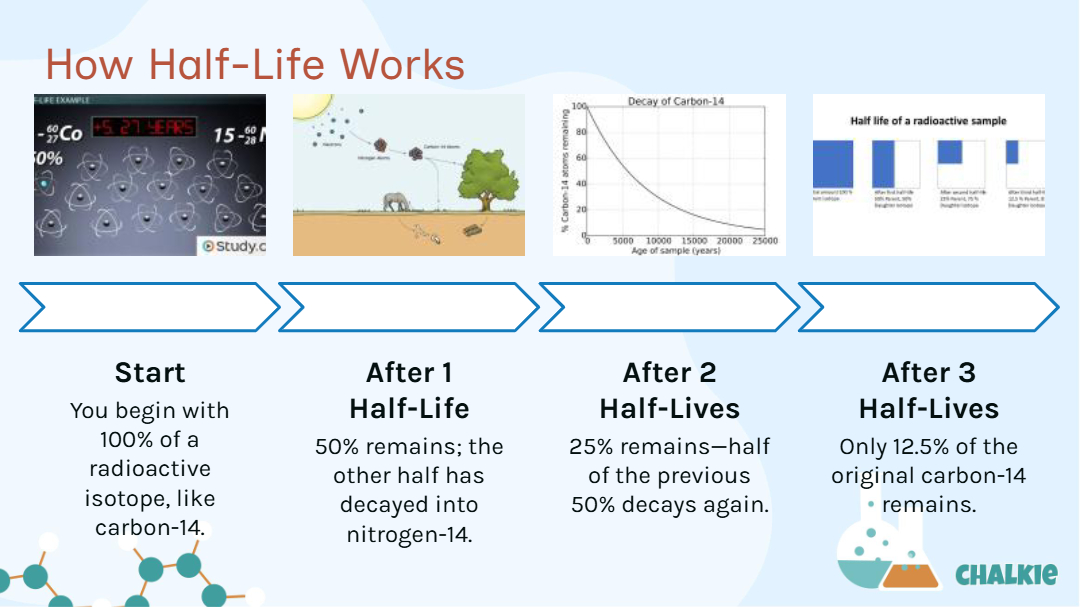
How many half-lives have passed if 12.5% 14C remains?
1 Half-life
2 Half-lives
3 Half-lives
4 Half-lives
30
Multiple Choice

Show answer
Auto Play
Slide 1 / 30
SLIDE
Similar Resources on Wayground

22 questions
Newton's laws of motion
Presentation
•
9th Grade
22 questions
Scientific Method review
Presentation
•
9th Grade
23 questions
Scientific Method
Presentation
•
9th - 10th Grade
21 questions
CARBON AND ITS COMPOUNDS
Presentation
•
9th - 10th Grade
21 questions
The Moon Part 2
Presentation
•
9th Grade
25 questions
Expansion and Extinction of Species
Presentation
•
9th Grade
23 questions
Ecosystems & Energy Flow Practice
Presentation
•
9th Grade
24 questions
Periodic Table Introduction
Presentation
•
9th Grade
Popular Resources on Wayground
10 questions
Safety Day 2026 – Student Review

Quiz
•
9th Grade
21 questions
Continents and Oceans
Quiz
•
6th Grade
20 questions
Parts of Speech
Quiz
•
5th Grade
16 questions
Subject & Predicate
Quiz
•
5th Grade
25 questions
Multiplication Facts
Quiz
•
5th Grade
12 questions
Map Skills
Quiz
•
3rd Grade
22 questions
Continents and Oceans
Quiz
•
5th Grade
15 questions
Rounding Decimals
Quiz
•
5th Grade
Discover more resources for Science
10 questions
Exploring Chemical and Physical Changes

Interactive video
•
6th - 10th Grade
20 questions
Atomic Structure
Quiz
•
9th Grade
10 questions
Exploring the Electromagnetic Spectrum for Middle School Science
Interactive video
•
6th - 10th Grade
10 questions
Exploring Force and Motion Concepts
Interactive video
•
6th - 10th Grade
10 questions
Exploring Air Masses and Weather Fronts
Interactive video
•
6th - 10th Grade
10 questions
Exploring the States of Matter
Interactive video
•
6th - 10th Grade
10 questions
Exploring Forces: Net Force, Normal Force, Gravity, and Friction
Interactive video
•
6th - 10th Grade
10 questions
Differentiating Thermal Energy and Temperature
Interactive video
•
6th - 10th Grade