IReady Lesson 19 Session 1 (Equivalent Expressions)
Presentation
•
Mathematics
•
6th Grade
•
Practice Problem
•
Medium
+4
Standards-aligned
Chantele Quenard
Used 1+ times
FREE Resource
8 Slides • 12 Questions
1
Explore
Learning Targets
•Apply the properties of operations to
generate equivalent expressions.
•Identify when two expressions
are equivalent.
•Use the distributive property to express a
sum of two whole numbers 1–100 with a
common factor as a multiple of a sum of
two whole numbers with no common factor.
SESSION 1
Equivalent Expressions
LESSON 19 • Write and Identify Equivalent Expressions
2
Equivalent Expressions
Learning Targets
• Apply the properties of operations to generate equivalent expressions.
• Identify when two expressions are equivalent.
• Use the distributive property to express a sum of two whole numbers 1–100 with a
common factor as a multiple of a sum of two whole numbers with no common factor.
3
Categorize
6(8)
6(5+1)
4(3+6)
4(14-2)
Put the expressions under the correct column.
4
©Curriculum Associates, LLC Copying is permitted.
• What is the problem about?
• What questions can you ask
that mathematics can answer?
Make sense of the problem
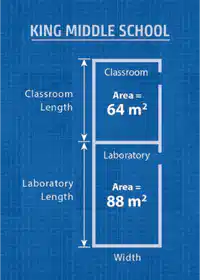
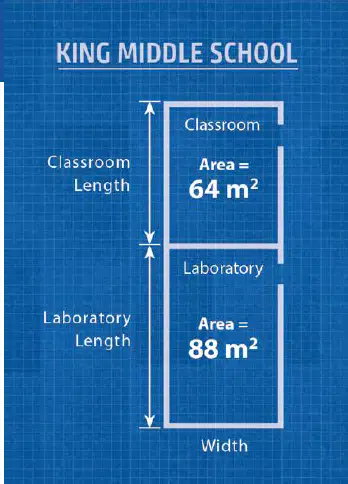
In the design for a new school, a classroom
needs to have the same width as a laboratory.
The architect wants the width to be as great as
possible. The length and width of each room
should be a whole number of meters.
5
In the design for a new school, a classroom needs to have the same width as a laboratory. The architect wants the width to be as great as possible. The length and width of each room should be a whole number of meters.
What's the gist?
Try It!
6
In the design for a new school, a classroom needs to have the same width as a laboratory. The architect wants the width to be as great as possible. The length and width of each room should be a whole number of meters.
What length and width should the architect use for each room?
Try It!
7
How can you determine the greatest
possible width of the rooms?
Discuss!
8
Open Ended
How will you find the greatest possible width for the rooms. Explain.
9
Draw
In the design for a new school, a classroom needs to have the same width as a laboratory. The architect wants the width to be as great as possible. The length and width of each room should be a whole number of meters.
10
Open Ended
What length and width should the architect use for the classroom and the laboratory? Explain how you know.
11
Open Ended
Look at this picture. What can you tell me as much as you know about it. You may discuss as a group to help.
12
Fill in the Blanks
When two rectangles share a common side, the areas of the rectangles have a common factor. What is it? You can discuss.
13
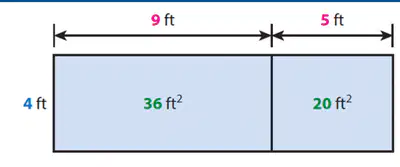
The expressions 36+ 20and 4(9+ 5) both represent the area, in square feet, of the outer rectangle. They are equivalent expressions because they name the same value. Discuss what this means and how it makes sense, with your group.
Let's connect it!
14
15
Fill in the Blanks
Show that these expressions are equivalent by finding the value of each expression.
36 + 20 = _____. and
4(9 + 5) = 4 x _____=_____
16
Fill in the Blanks
You can also use the distributive property to show that the sum 36 + 20 is equivalent to the product 4(9 + 5).
To rewrite 36 + 20 as a product, you can use the greatest common factor (GCF) of 36 and 20 as one of the factors.
Rewrite the sum 42 + 35 as a product. Use the GCF of 42 and 35 as one of the factors. Use a sum as the other factor.
The GCF of 36 and 20 is _____.
Rewrite each term using GCF as a factor. _____ x 9 + _____ x 5
Use the distributive property. _____ (_____ + _____) Keep the number in order as shown.
17
Fill in the Blanks
Rewrite the sum 42 + 35 as a product.
Use the GCF of 42 and 35 as one of the factors. Use a sum as the other factor.
18
Open Ended
Reflect How can you use the distributive property to rewrite a sum of two terms as a product of two factors?
19
Draw
Fill in this graphic organizer of your knowledge of these terms. Let's put it in your notes.
20
Fill in the Blanks
Exit Ticket:
Rewrite the sum 15 + 45 as a product using the distributive property.
Explore
Learning Targets
•Apply the properties of operations to
generate equivalent expressions.
•Identify when two expressions
are equivalent.
•Use the distributive property to express a
sum of two whole numbers 1–100 with a
common factor as a multiple of a sum of
two whole numbers with no common factor.
SESSION 1
Equivalent Expressions
LESSON 19 • Write and Identify Equivalent Expressions
Show answer
Auto Play
Slide 1 / 20
SLIDE

Similar Resources on Wayground
16 questions
6.8A Triangles Lesson
Presentation
•
6th Grade
15 questions
Multiply with Decimals
Presentation
•
6th Grade
16 questions
Percent
Presentation
•
6th Grade
16 questions
RATIOS AND PROPORTIONS
Presentation
•
6th Grade
14 questions
One Step Inequalities
Presentation
•
6th Grade
16 questions
6th RtI - Evaluating Expressions
Presentation
•
6th Grade
14 questions
Rates and Unit rate
Presentation
•
6th Grade
14 questions
One-Step Equations (Multiplication/Division)
Presentation
•
6th Grade
Popular Resources on Wayground
10 questions
Safety Day 2026 – Student Review
Quiz
•
9th Grade
21 questions
Continents and Oceans
Quiz
•
6th Grade
20 questions
Parts of Speech
Quiz
•
5th Grade
16 questions
Subject & Predicate
Quiz
•
5th Grade
25 questions
Multiplication Facts
Quiz
•
5th Grade
12 questions
Map Skills
Quiz
•
3rd Grade
22 questions
Continents and Oceans
Quiz
•
5th Grade
15 questions
Rounding Decimals
Quiz
•
5th Grade
Discover more resources for Mathematics
20 questions
Add and Subtract Integers
Quiz
•
6th - 8th Grade
14 questions
Explore Integers and Rational Numbers
Quiz
•
6th Grade
22 questions
Ratios and Ratio Tables
Quiz
•
6th Grade
12 questions
Calculate with Positive Rational Numbers
Quiz
•
6th Grade
15 questions
Adding and Subtracting Integers
Quiz
•
6th - 8th Grade
70 questions
Multiplication Facts
Quiz
•
3rd - 6th Grade
16 questions
Exponents and Powers
Quiz
•
6th Grade
20 questions
Multiplication Facts
Quiz
•
6th Grade