

Freshwater Mussels (Anacostia Watershed)

Presentation
•
Science
•
9th Grade
•
Practice Problem
•
Easy
+18
Standards-aligned

Ferdinand Estrella
Used 8+ times
FREE Resource
12 Slides • 5 Questions
1

2


3
Open Ended
What is watershed?
4
5
Definition: Freshwater mussels are bivalve mollusks with soft, unsegmented bodies and hard, hinged shells.
Habitat: Found in river and stream bottoms, buried in sediment, using a muscular foot to anchor themselves.
Mobility: Unlike saltwater mussels, freshwater mussels can move but only short distances.
Image: Diagram of a freshwater mussel with labeled parts
6
Multiple Choice
What defines freshwater mussels?
7
8
Open Ended

What is your observation when mussels are submerged in murky or cloudy water in murky or cloudy water in a few hours?
9
10
Life Cycle of Freshwater Mussels
Stage 1: Eggs grow into glochidia in the mother’s gills.
Stage 2: Glochidia attach to fish gills, where they grow into juvenile mussels.
Stage 3: Juveniles drop off and settle in a new location.
Fun Fact: Freshwater mussels can live over 100 years!
11
Reorder

Reorder the following: life cycle of a freshwater mussel.
Eggs grow into glochidia in the mother’s gills.
Glochidia attach to fish gills, where they grow into juvenile mussels.
juveniles drop off and settle in a new location.
12
Water Quality Improvement: Filter 10-18 gallons of water daily.
Habitat Creation: Mussel beds provide homes for algae, insects, and small fish.
Food Source: Prey for otters, raccoons, and herons.

13
Current Conditions in the Anacostia River
Species Present: Eight species, including the alewife floater and eastern pondmussel.
Challenges: Decline due to habitat destruction, invasive species, and pollution.
Restoration Efforts: Anacostia Watershed Society (AWS) is restoring populations of alewife floater and eastern pondmussel.

14
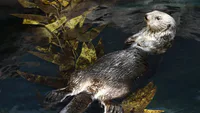
Threats to Freshwater Mussels
Human Activities: Overharvesting, pollution, and habitat destruction.
Natural Challenges: Invasive species and changes to river hydrology.



15
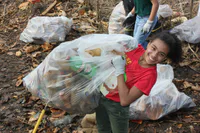
AWS Restoration Initiatives
Goal: Increase populations of alewife floater and eastern pondmussel.
Methods: Monitoring water quality, raising awareness, and reintroducing mussels.
16
Ecosystem Health: Mussels improve water quality and provide critical habitats.
Biodiversity: Supporting diverse life in rivers and streams.
Sustainability: Indicating the overall health of aquatic ecosystems.

17
Open Ended

How can humans help restore and protect freshwater mussels?
Show answer
Auto Play
Slide 1 / 17
SLIDE
Similar Resources on Wayground

16 questions
Ecological Stability: Cause and Effect
Presentation
•
9th Grade
14 questions
Density
Presentation
•
9th Grade
12 questions
Changing Ecosystems
Presentation
•
8th Grade
11 questions
Hydrosphere
Presentation
•
8th Grade
12 questions
Molluscs
Presentation
•
8th Grade
16 questions
10.7 Climate Change Reflection
Presentation
•
8th Grade
8 questions
6.2 Using Resources Wisely
Presentation
•
10th Grade
12 questions
Physical Geography of East Africa
Presentation
•
8th - 11th Grade
Popular Resources on Wayground
10 questions
Safety Day 2026 – Student Review

Quiz
•
9th Grade
21 questions
Continents and Oceans
Quiz
•
6th Grade
20 questions
Parts of Speech
Quiz
•
5th Grade
16 questions
Subject & Predicate
Quiz
•
5th Grade
25 questions
Multiplication Facts
Quiz
•
5th Grade
12 questions
Map Skills
Quiz
•
3rd Grade
22 questions
Continents and Oceans
Quiz
•
5th Grade
15 questions
Rounding Decimals
Quiz
•
5th Grade
Discover more resources for Science
10 questions
Exploring Chemical and Physical Changes

Interactive video
•
6th - 10th Grade
20 questions
Atomic Structure
Quiz
•
9th Grade
10 questions
Exploring the Electromagnetic Spectrum for Middle School Science
Interactive video
•
6th - 10th Grade
10 questions
Exploring Force and Motion Concepts
Interactive video
•
6th - 10th Grade
10 questions
Exploring Air Masses and Weather Fronts
Interactive video
•
6th - 10th Grade
10 questions
Exploring the States of Matter
Interactive video
•
6th - 10th Grade
10 questions
Exploring Forces: Net Force, Normal Force, Gravity, and Friction
Interactive video
•
6th - 10th Grade
10 questions
Differentiating Thermal Energy and Temperature
Interactive video
•
6th - 10th Grade