Bio Checkpoint 1
Presentation
•
Biology
•
9th Grade
•
Easy
+6
Standards-aligned
Nancy Stockton
Used 25+ times
FREE Resource
6 Slides • 16 Questions
1
Bio Check Pt 1
by Nancy Stockton
Checkpoint 1
2
3
Multiple Choice
Which of the following answers links a biomolecule with one of its proper functions?
Lipids - Store genetic information
Carbohydrates - short term energy storage
Nucleic Acids - Catalyze reactions
Proteins - long term energy storage
4
Multiple Choice
Which biomolecule helps form muscles?
Nucleic Acid
Carbohydrate
Protein
Lipids
5
Multiple Choice
Which biomolecule is made of nucleotides and contain you DNA?
Carbohydrate
Lipids
Protein
Nucleic Acid
6
Multiple Choice
Which biomolecule is your main source of energy?
Nucleic Acid
Protein
Lipid
Carbohydrate
7
8
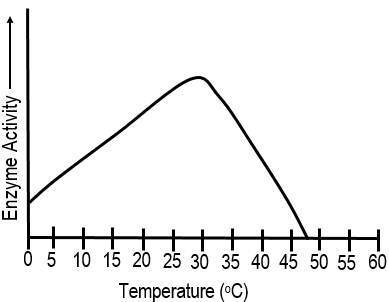
Multiple Choice
Based on the graph, what temperature does this enzyme work best?
15 C
40 C
30 C
47 C
9
Multiple Choice
Which of the following conclusions can be drawn from this graph?
The optimum pH of the enzyme is 6.6.
The optimum pH of the enzyme is 5.8
The enzyme’s activity increases as pH increases 5.0 to 9.0
The enzyme’s activity is greater around pH of 8.0 .
10
Multiple Choice
What happens when enzymes are heated to a high temperature?
The enzymes die.
The shapes of the enzyme are altered denature
The enzymes' amino acid sequence changes.
The enzymes remain the same
11
Multiple Choice
Cells can only work if their enzymes are functioning. What can you infer from the graph?
Cells function best at low pH values
Cells function fine at all pH values
Cells function best at high pH values
Cells do not function well if the pH is too high or too low
12
13
Multiple Choice
My main goal is to produce a lot of ATP energy.
Chloroplast
Mitochondria
14
Multiple Choice
What is the main function of chloroplast?
Mitosis
Meiosis
Translation
Photosynthesis
15
16
Multiple Choice
What is the difference between a prokaryotic cell and a eukaryotic cell?
Prokaryotes do not have a nucleus or organelles, but a eukaryotic cell does
Eukaryotic cells do not have a nucleus or organelles, but prokaryotes do
17
Multiple Choice
Which is true of prokaryotic and eukaryotic cells?
Prokaryotic cells are larger than eukaryotic cells.
Eukaryotic cells do not have nuclei, and prokaryotic cells do have nuclei.
Prokaryotic cells lack membrane-bound organelles, and eukaryotic cells contain membrane-bound organelles.
Eukaryotic cells are simpler than prokaryotic cells.
18
Multiple Choice
How are particles moved or transported in the cell?
with mitochondria
through endoplasmic reticulum
by the nucleus
with vesicles
19
20
Multiple Choice
What type of transport is this?
Endocytosis
Facilitated Diffusion
Active Transport Pump
Osmosis
21
Multiple Choice
Even though the concentration of salt is high in some gland cells and low in the blood, these cells can move salt out of blood and into the cells. This is an example of
passive transport
active transport
diffusion
osmosis
22
Multiple Choice
Homeostasis is...
the need to maintain a stable internal environment
the movement of water from a high to low concentration
the movement of sugar from low to high concentration
the change in temperature outside
Bio Check Pt 1
by Nancy Stockton
Checkpoint 1
Show answer
Auto Play
Slide 1 / 22
SLIDE

Similar Resources on Wayground
15 questions
Cell Transport - Active Transport
Presentation
•
9th Grade
20 questions
Energy Flow Lesson
Presentation
•
9th Grade
20 questions
Enzymes
Presentation
•
9th Grade
20 questions
Cell transport
Presentation
•
9th Grade
16 questions
Milankovitch Cycle
Presentation
•
9th Grade
17 questions
Biomolecules Lesson 1
Presentation
•
9th Grade
17 questions
Mechanisms of Evolution
Presentation
•
9th Grade
16 questions
The Theory of Evolution
Presentation
•
8th Grade
Popular Resources on Wayground
24 questions
PBIS-HGMS Day 10
Quiz
•
6th - 8th Grade
10 questions
HCS SCI 03 Summer School Review 3
Quiz
•
3rd Grade
11 questions
Home Scope
Quiz
•
7th - 8th Grade
15 questions
HCS SCI 05 Summer School Assessment 3 Review
Quiz
•
5th Grade
35 questions
Lufkin Road Middle School Student Handbook & Policies Assessment
Quiz
•
7th Grade
18 questions
Geo 11.3 Area of Circles and Sectors
Quiz
•
9th - 11th Grade