

Evolution: Evidence Homologous Body Structures

Presentation
•
Biology, Science
•
10th Grade
•
Medium
Standards-aligned

Rose Marsh
Used 53+ times
FREE Resource
14 Slides • 12 Questions
1
Evolution: Evidence Homologous Body Structures

2
Evidence of Evolution
The Fossil Record
Geographic Distribution of Living Things
Homologous Body Structures
Similarities in Early Development

3
Evidence of Evolution
The Fossil Record
Geographic Distribution of Living Things (Pangea)
Homologous Body Structures
Similarities in Early Development

4
Evidence of Evolution
The Fossil Record
Geographic Distribution of Living Things (Pangea)
Homologous Body Structures
Similarities in Early Development

5
Evidence of Evolution
The Fossil Record
Geographic Distribution of Living Things (Pangea)
Homologous Body Structures
Similarities in Early Development

6
homology: A correspondence of structures in two life forms with a common evolutionary origin, such as flippers and hands.
analogy: The relationship between characteristics that are apparently similar but did not develop from the same structure
homoplasy: A correspondence between the parts or organs of different species acquired as the result of parallel evolution or convergence.

7
Homologous Body Structures
Homologous structures are similar structures that evolved from a common ancestor
The relationship defined between structures or DNA derived from a common ancestor and illustrates descent from a common ancestor.

8
Multiple Choice
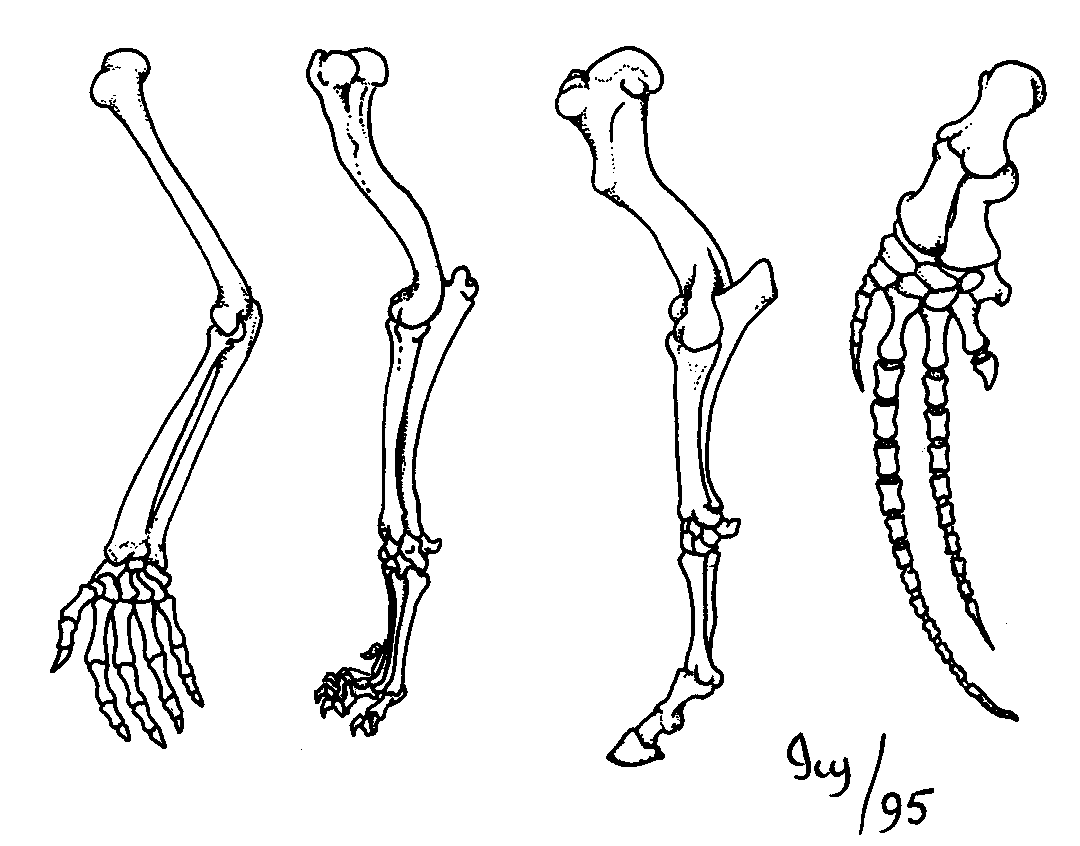
Structures with the same parts have different functions; suggests that organisms share a common ancestry
9
Multiple Choice
10
Analogous structures
Physically (but not genetically) similar structures that were not present in the last common ancestor.
Two species that evolved separately (rather than being present in the last common ancestor)
The wings of a maple seed and the wings of a bird are analogous but not homologous

11
Multiple Select
12
Multiple Choice
13
Convergent Evolution
independent evolution of similar features in species of different lineages.
The two species came to the same function, flying, but did so separately from each other.
They have “converged” on this useful trait. Both sharks and dolphins have similar body forms, yet are only distantly related: sharks are fish and dolphins are mammals.

14
Convergent evolution Ex camera eye
The cephalopod eye is “wired” in the opposite direction, with blood and nerve vessels entering from the back of the retina, rather than the front for vertebrates.
In the octopus version, the eye is constructed the “right way out,” with the nerves attached to the rear of the retina. This means that octopi do not have a blind spot.

15
Parallel evolution
Convergent is similar to Parallel evolution occurs when two independent but similar species evolve in the same direction and thus independently acquire similar characteristics; for example, gliding frogs have evolved in parallel from multiple types of tree frog.

16
Divergent Evolution
Related species evolve different traits
On a molecular level, this can happen due to random mutation unrelated to adaptive changes.

17
Multiple Choice

18
Multiple Choice

19
Multiple Choice

20
Multiple Choice

The three species pictured do not share a common ancestor, yet have evolved to have a similar anatomy and life style. This is an example of ?
21
Multiple Choice
The three species pictured do not share a common ancestor, yet have evolved to have a similar anatomy and life style. This is an example of ?
22
Multiple Choice

What type of structure does this image illustrate?
23

24
Vestigial structures
Vestigial structures have no function but may still be inherited to maintain fitness.
The formation of goosebumps in humans under stress is a vestigial reflex its function in human ancestors was to raise the body’s hair, making the ancestor appear larger and scaring off predators.
Vestigial structures are often homologous to structures that function normally in other species

25
Multiple Choice
26
Multiple Select
Evolution: Evidence Homologous Body Structures
Show answer
Auto Play
Slide 1 / 26
SLIDE

