Search Header Logo
  1. Resource Library
  2. Science
  3. Earth & Space Science
  4. Plate Tectonics
  5. Geology Lesson 2 Pangea & Plate Tectonics
Geology Lesson 2 - Pangea & Plate Tectonics

Geology Lesson 2 - Pangea & Plate Tectonics

Assessment

Presentation

Science

7th Grade

Practice Problem

Medium

NGSS
MS-ESS2-3, MS-ESS2-2, MS-ESS3-2

+2

Standards-aligned

Created by

Isabel Canizares

Used 109+ times

FREE Resource

8 Slides • 21 Questions

1

Geology Lesson 2 - Pangea & Plate Tectonics

Slide image

2

Open Ended

Okay so talking about the motion of Earth's lithosphere today, so today's gratitude plug in - share some of your favorite things to do with motion.


Example: I loved to cross country ski when I lived in NY - the beautiful snow, running into animals in nature, the sounds of the skiis and the silence around me.

3

Open Ended

Question image

Look at this map of earthquake and volcanic activity over the past 20 years or so. Write down 2 observations.

4

Multiple Choice

About how fast is Earth's surface (lithosphere) moving?

1

as fast as my teacher walks (pretty slowly)

2

as fast as your nails grow

3
4

as fast as a student leaves the building on the last day of school

5

Multiple Choice

Which of the following is NOT evidence of Earth's moving lithosphere? Look a the choices provided and there should be one that stands out as incorrect.

1

earthquake & volcanic activity

2
3

human remain evidence

4

similar fossils found on continents that are now very far apart

6

Open Ended

Question image

The top image shows the "puzzle pieces" of Earth's lithosphere. These are the pieces (aka plates) that move around. Write down 3 observations.

7

Slide image

The dark line show the edges of the plates (pieces of earth's lithosphere) that move around. The arrows are showing the direction that these pieces are moving. Notice that there are three types of motion.

8

Multiple Select

Question image

Mark the different types of motion you see of the Earth's plates (pieces of lithosphere).

1

<- ->

apart

2

-> <-

together

3
4

the lithosphere is NOT moving, because there is NO lithosphere. This is all a conspiracy theory by teachers to torture students.

9

Milky Way Model of Earth!

  • Notice the top 3 layers of the Milky Way

  • Chocolate: breaks into pieces but solid

  • Caramel: moves but is thick and acts more like a solid

  • Nougat: solid and supports the caramel

Slide image

10

Multiple Choice

Question image

Using the Milky Way model, which layer would represent which layer of Earth. Pick the correct match.

1

Lithosphere: caramel

Asthenosphere: chocolate

Mantle: nougat

2

Lithosphere: chocolate

Asthenosphere: caramel

Mantle: nougat

3

Ummm seriously all I see is yummy chocolate and I am so hungry now. Thanks a lot teacher!

11

Multiple Choice

Question image

Okay in real life if we pull earth apart we don't get caramel....which option makes the most sense of what would happen when Earth is pulled apart?

1

the chocolate surface is broken into pieces and my teacher can be found now eating it right now.

2

the lithosphere breaks into pieces & the asthenosphere can be seen on the surface (in the form of volcanoes)

3

the outer core spills onto Earth's surface and suddenly all humans start listening to heavy metal music (since outer core is liquid metal)

12

Divergent Boundary

  • Plates/Lithosphere pieces move apart

  • Material from the asthenosphere fills the gap - we get lava/volcanic activity on the surface of Earth

  • At one point a divergent boundary started in KS - but then stopped! Maybe it will restart again?!

Slide image

13

Multiple Choice

Question image

At divergent boundaries plates are moving away from each other. What happens in the space left between them?

1

Magma comes up, cools and hardens making new crust

2
3

Water comes up and fills the gap

4

Grass comes up and fills the gap

14

Multiple Choice

Question image

What happens to the magma that comes up at divergent boundaries?

1

It turns green

2

Nothing happens to the magma

3

The magma melts, wait isn't magma a liquid already?! I'm so confused.

4

The magma cools and hardens into new crust

15

Poll

Would you rather

always have a booger in your nose that moves when you breathe in and out

or a piece of food stuck between your two front teeth?

or send your science teacher this year $100,000! Girls gotta try.

16

Multiple Choice

Question image

Next we are going to do the next motion with our model sliding one part of the chocolate one way and the other the opposite -but NOT pulling the candy apart.


Based on what you see on the surface of the chocolate, which option is most likely to happen on Earth's surface.

1

Massive volcanic activity, more than what you would see at a divergent boundary.

2

Some cracks in the ground

3

My teacher would still be trying to eat the pieces of broken chocolate!

17

Transform Boundary

  • Notice the plates are still touching

  • One goes one direction, the other the opposite

  • This boundary is found in California!

Slide image

18

Multiple Choice

Question image
What type of boundary is in this image?
1
convergent plate boundary
2
divergent plate boundary
3
transform plate boundary
4
subduction

19

Multiple Choice

What type of boundary is formed when plates slide past each other?

1

convergent

2

when you like break up with your significant other, but are still friends.

3

divergent

4

transform

20

Multiple Choice

Question image

Last motion is when the two plates collide! Looking at the model image, which option below is most likely to happen to Earth's surface?

1

same thing as a transform boundary, just some cracks near the boundary

2

Volcanoes & Mountains oh My!

3

My teacher is dying looking at this yummy image. I think I am craving chocolate now too!

21

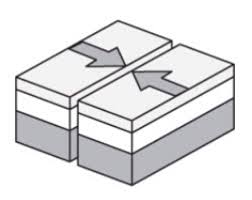
Convergent Boundary

  • Plates Collide

  • Creates mountains, volcanic mountains, or volcanic islands (depending on what plates are colliding - will go into detail in another lesson

  • NW U.S. - Cascade Mountains are all volcanic mountains!!!

Slide image

22

Multiple Choice

Question image

What is it called when plates push together?

1

divergent

2

convergent

3

transform

4

all of the above

23

Multiple Choice

Question image
Name the boundary
1
convergent boundary
2
divergent boundary
3
transform boundary
4
sergent boundary

24

Multiple Choice

What are the three types of plate boundaries?

1

convergent, divergent, transform

2

constant, diverse, transformers

3

transformers are robots in disguise

25

Multiple Select

Everytime the lithosphere moves, we get earthquakes. Which boundary motion will create an earthquake.

1

Convergent

(plates move together)

2

Divergent

(plates move apart)

3

Transform

(plates slide past eachother)

26

Pangea

  • In the last lesson you were required to try to recreate how the continents were positioned about 240 million years ago.

  • The top image is present. The bottom shows you the correct answer - well a simplified version of it.

Slide image

27

Poll

How close were you?

Pretty close

Way off, it's okay I know I tried my best and it will not count against me

I'm behind and haven't done the powerpoint yet. Oops.

28

Multiple Choice

Question image

Looking at past to present, what type of boundary caused Africa & South America to get to their current positions?

1

Convergent (collide; come together)

2

Divergent (divorce; split apart)

3

Transform (slide past each other)

4

29

Plate Tectonics

(formerly known as continental drift)

  • Earth's lithosphere is moving around

  • Movement of heat (convection) in the asthenosphere is creating this motion

  • The lithosphere still is moving

  • Earthquakes are what happen when the lithosphere moves!

Slide image

Geology Lesson 2 - Pangea & Plate Tectonics

Slide image

Show answer

Auto Play

Slide 1 / 29

SLIDE