
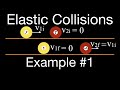
Understanding Elastic Collisions

Interactive Video
•
Physics
•
9th - 10th Grade
•
Practice Problem
•
Hard

Jennifer Brown
FREE Resource
10 questions
Show all answers
1.
MULTIPLE CHOICE QUESTION
30 sec • 1 pt
What is the main focus of the video tutorial?
Gravitational force
Frictional force
Inelastic collisions
Elastic collisions
2.
MULTIPLE CHOICE QUESTION
30 sec • 1 pt
What is the initial velocity of the second billiard ball?
Equal to the first ball
Twice the first ball
Negative of the first ball
Zero
3.
MULTIPLE CHOICE QUESTION
30 sec • 1 pt
What happens to the first billiard ball after the collision?
It moves in the opposite direction
It sticks to the second ball
It stops
It moves faster
4.
MULTIPLE CHOICE QUESTION
30 sec • 1 pt
What is the final velocity of the second billiard ball after the collision?
Zero
Equal to the initial velocity of the first ball
Half the initial velocity of the first ball
Twice the initial velocity of the first ball
5.
MULTIPLE CHOICE QUESTION
30 sec • 1 pt
Which equation is used to calculate the final velocity of the first ball?
v1_final = (2 * m2) / (m1 + m2) * v1_initial
v1_final = (m1 + m2) / (m1 - m2) * v1_initial
v1_final = (m1 * m2) / (m1 + m2) * v1_initial
v1_final = (m1 - m2) / (m1 + m2) * v1_initial
6.
MULTIPLE CHOICE QUESTION
30 sec • 1 pt
What is the significance of the term 'perfectly elastic' in the context of the collision?
Objects change shape
Objects break apart
Objects stick together
No kinetic energy is lost
7.
MULTIPLE CHOICE QUESTION
30 sec • 1 pt
How does the mass of the two billiard balls compare?
m1 is equal to m2
m1 is less than m2
m1 is twice m2
m1 is greater than m2
Access all questions and much more by creating a free account
Create resources
Host any resource
Get auto-graded reports

Continue with Google

Continue with Email

Continue with Microsoft
or continue with

%20(1).png)
Apple

Others
By signing up, you agree to our Terms of Service & Privacy Policy
Already have an account?


