

Les verbes Pouvoir, Vouloir et Devoir

Presentation
•
World Languages
•
9th - 12th Grade
•
Practice Problem
•
Easy

Rachel Metellus
Used 2+ times
FREE Resource
8 Slides • 10 Questions
1

2
Open Ended
Why is it important to understand the irregular verbs devoir, vouloir, and pouvoir when learning French?
3

4
Multiple Choice
Which of the following is the correct past participle of the verb 'vouloir' in French?
voulu
vouler
voulais
voulez
5

6
Multiple Choice
What are the different meanings of the verb 'devoir' when used with an infinitive versus when followed by a noun?
With an infinitive, it means 'to have to' or 'must'; with a noun, it means 'to owe'.
With an infinitive, it means 'to want'; with a noun, it means 'to eat'.
With an infinitive, it means 'to refuse'; with a noun, it means 'to manage'.
With an infinitive, it means 'to finish'; with a noun, it means 'to talk'.
7

8
Open Ended
Explain how the meaning of 'devoir' changes when used in the passé composé versus the imparfait.
9

10
Multiple Choice
Which of the following sentences uses 'vouloir' to express willingness?
Nous voulons dire exactement le contraire.
Biscuit? Ça veut dire cookie en français.
Oui, je veux bien prendre de la glace.
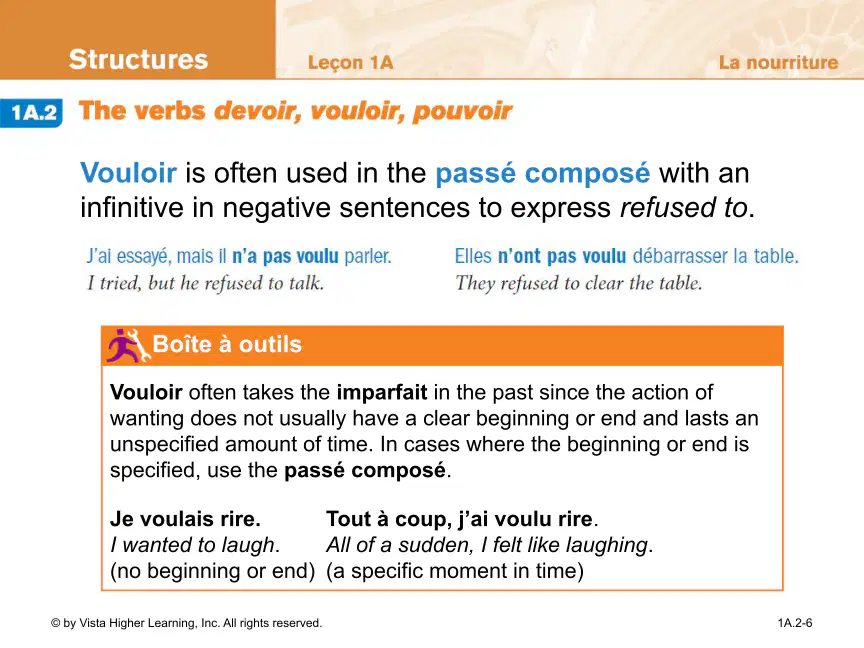
Elles n’ont pas voulu débarrasser la table.
11
12
Fill in the Blanks
Fill in the blank: In negative sentences in the passé composé, 'vouloir' with an infinitive means '
Type answer...
13

14
Open Ended
Describe the main differences in usage between 'devoir', 'vouloir', and 'pouvoir' in the present tense, based on the examples provided.
15
Multiple Select
Select all the uses of 'pouvoir' in the passé composé from the following sentences:
Nous avons pu tout finir.
Fathia a pu nous trouver.
Je n’ai pas pu aller au marché aujourd’hui.
Je voulais rire.
16

17
Open Ended
How do the past participles of devoir, vouloir, and pouvoir differ from regular verbs in French?
18
Multiple Choice
What do the French verbs devoir, vouloir, and pouvoir have in common?
They are all regular verbs.
They are all irregular verbs.
They all mean the same thing.
They are only used in the present tense.
Show answer
Auto Play
Slide 1 / 18
SLIDE
Similar Resources on Wayground

16 questions
Subjects, Verbs, and Subject Pronouns
Presentation
•
9th - 12th Grade
10 questions
Subjuntivo
Presentation
•
9th - 12th Grade
11 questions
Robo en la noche, capítulo 3
Presentation
•
9th - 12th Grade
12 questions
Imperfect vs. Preterite
Presentation
•
10th - 12th Grade
12 questions
The present progressive
Presentation
•
9th - 12th Grade
15 questions
Senderos 2 verbos como gustar
Presentation
•
9th - 12th Grade
12 questions
Los Reyes Magos-celebraciones
Presentation
•
9th - 12th Grade
14 questions
Present Progressive
Presentation
•
9th - 12th Grade
Popular Resources on Wayground
10 questions
Safety Day 2026 – Student Review

Quiz
•
9th Grade
21 questions
Continents and Oceans
Quiz
•
6th Grade
20 questions
Parts of Speech
Quiz
•
5th Grade
16 questions
Subject & Predicate
Quiz
•
5th Grade
25 questions
Multiplication Facts
Quiz
•
5th Grade
12 questions
Map Skills
Quiz
•
3rd Grade
22 questions
Continents and Oceans
Quiz
•
5th Grade
15 questions
Rounding Decimals
Quiz
•
5th Grade
Discover more resources for World Languages
20 questions
REGULAR Present tense verbs
Quiz
•
8th - 9th Grade
21 questions
Los paises hispanohablantes y sus capitales
Quiz
•
12th Grade
20 questions
Ser vs Estar
Quiz
•
9th Grade
21 questions
Spanish speaking countries and capitals
Quiz
•
9th Grade
20 questions
Preterite vs. Imperfect
Quiz
•
10th Grade
20 questions
Present tense stem-changing verbs
Quiz
•
9th Grade
20 questions
Ser vs. Estar
Quiz
•
10th Grade
45 questions
Ser vs Estar
Quiz
•
9th Grade