

STAT #1

Presentation
•
Mathematics
•
11th Grade
•
Practice Problem
•
Hard

Victor Jr.
Used 1+ times
FREE Resource
23 Slides • 22 Questions
1

2
3
Multiple Choice
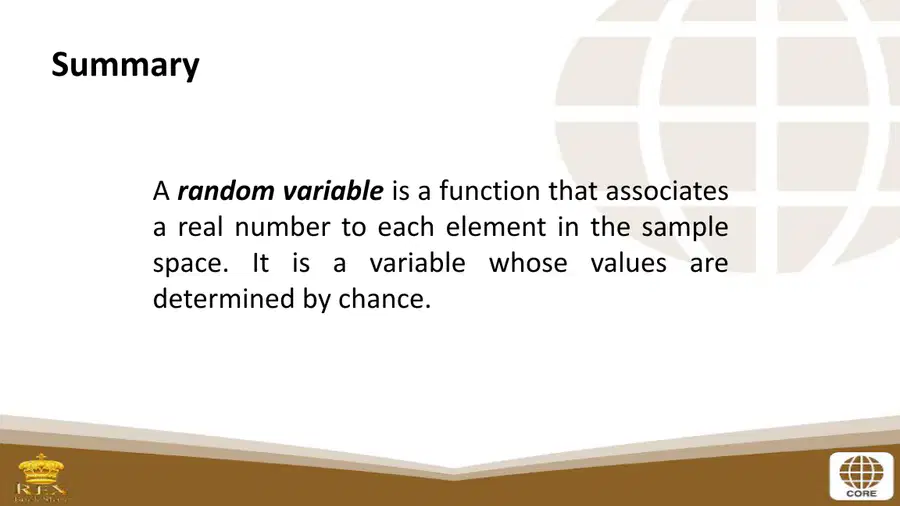
Which of the following best describes a random variable?
A variable whose value is determined by chance
A variable that always has a fixed value
A variable that can only take positive values
A variable that is always continuous
4
Open Ended
Why do you think understanding random variables is important in real-life situations?
5
6
Multiple Choice
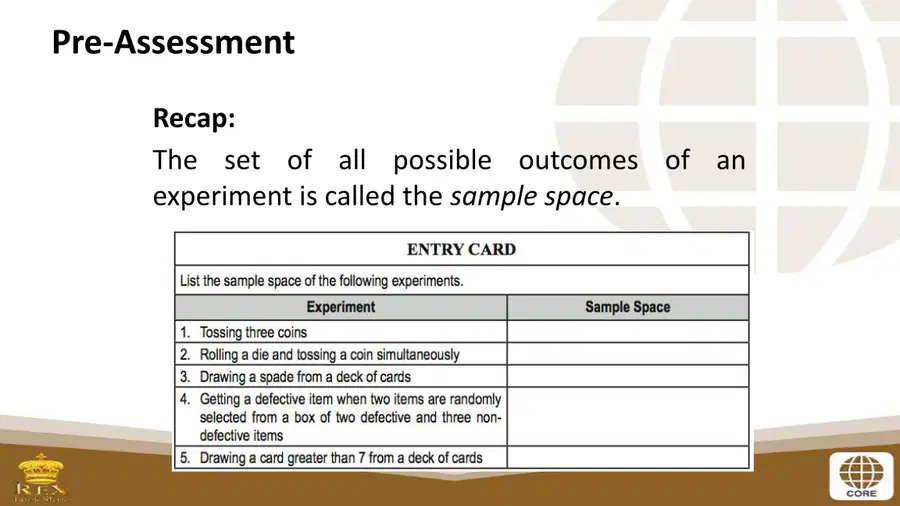
Which of the following best defines a sample space in probability?
The set of all possible outcomes of an experiment
The most likely outcome of an experiment
The outcome with the highest probability
The set of all favorable outcomes
7
8
Open Ended
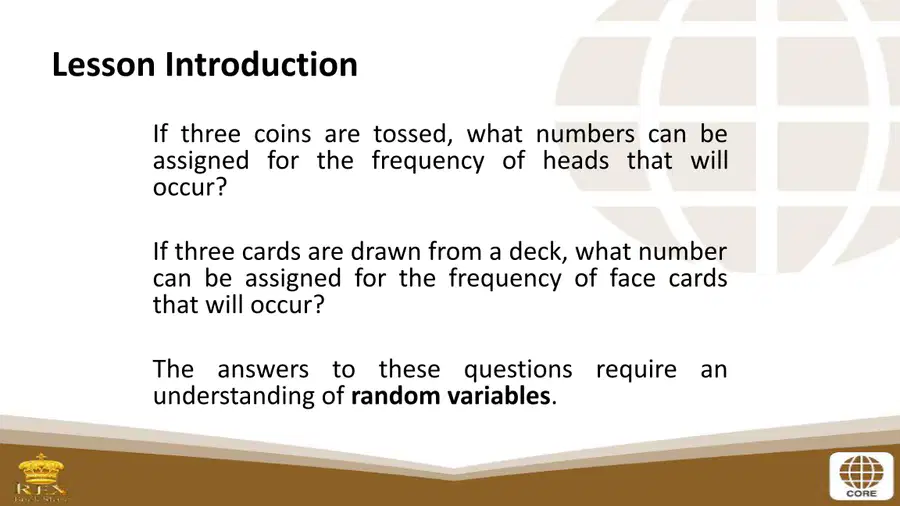
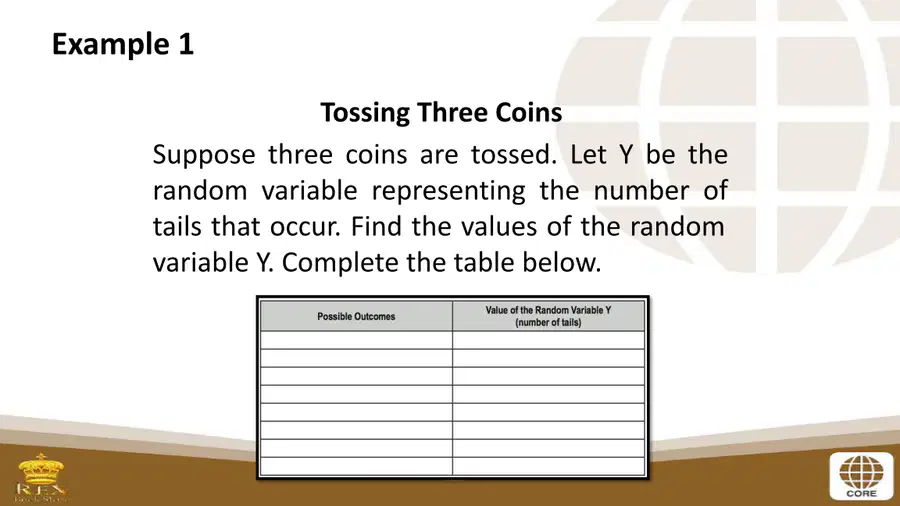
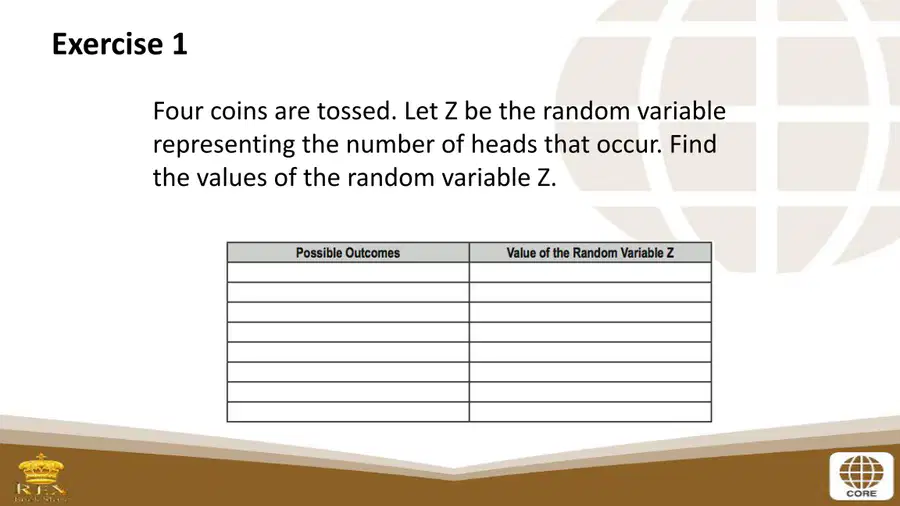
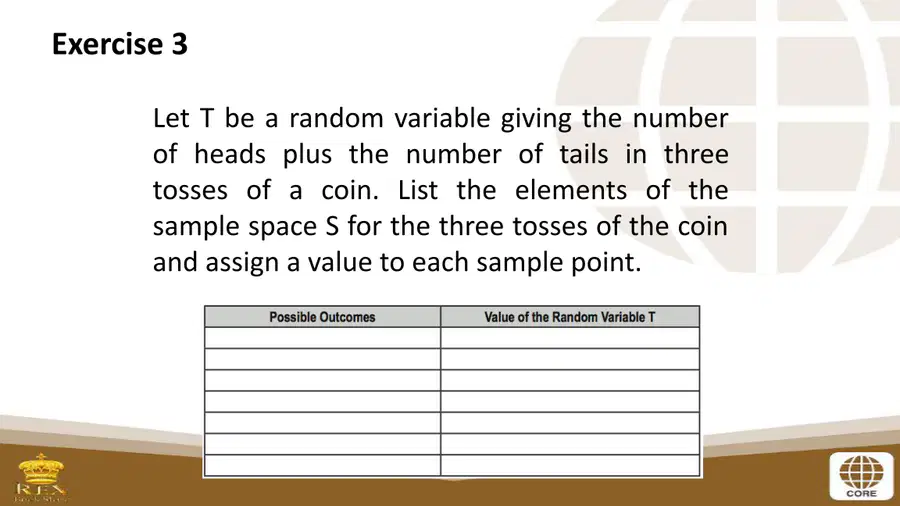
If three coins are tossed, what numbers can be assigned for the frequency of heads that will occur?
9
10
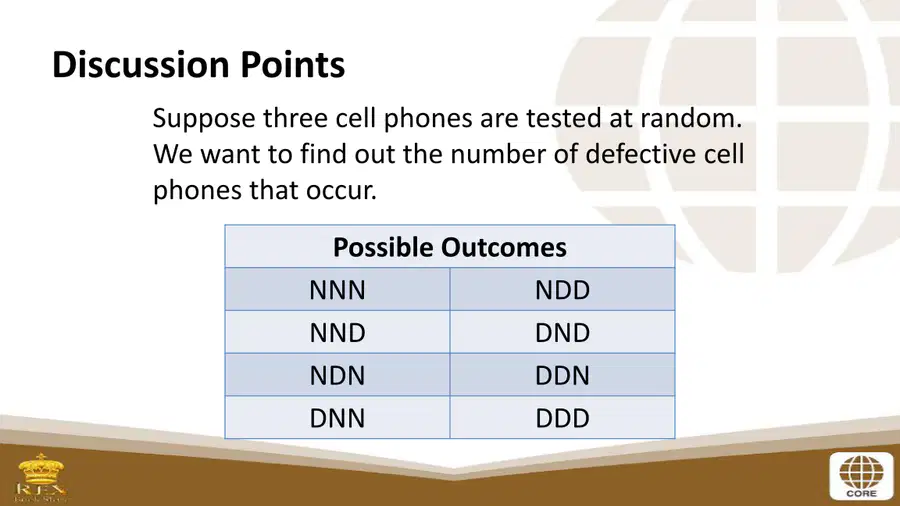
11
Multiple Select
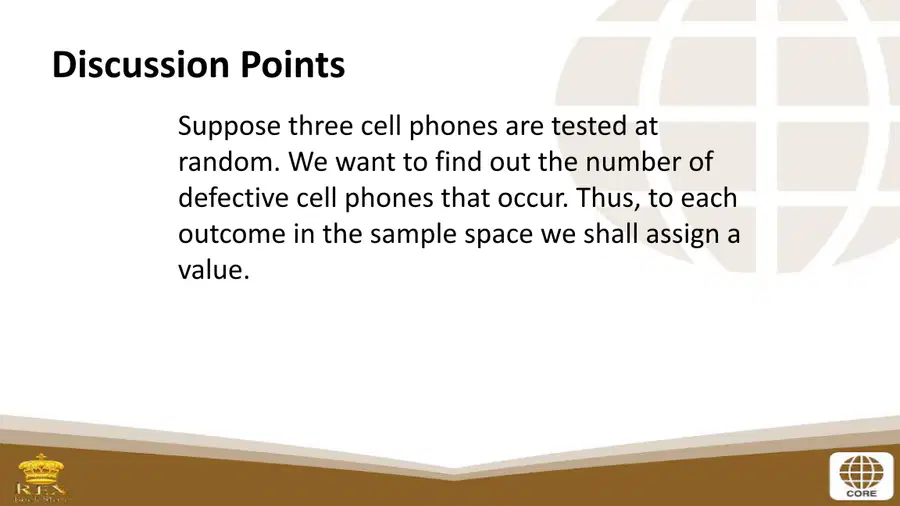
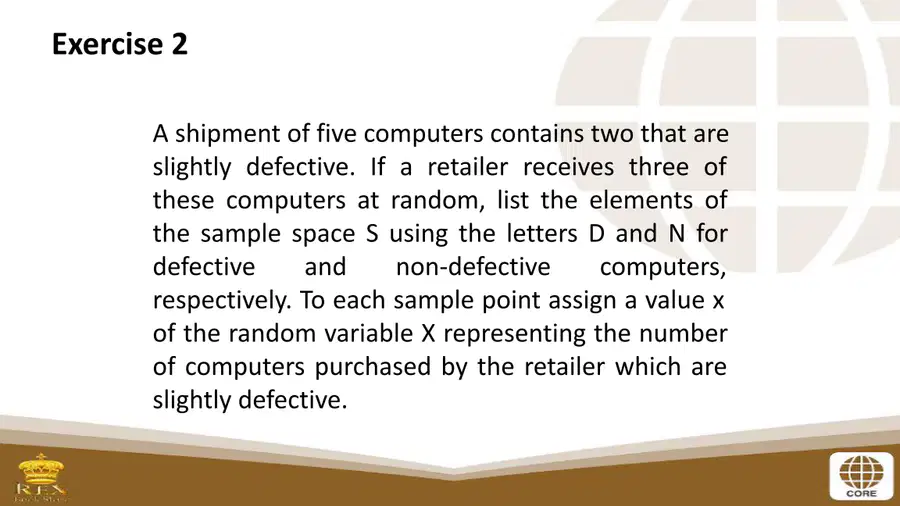
Which of the following are possible outcomes when three cell phones are tested for defects?
NNN
NND
DDD
NDN
12
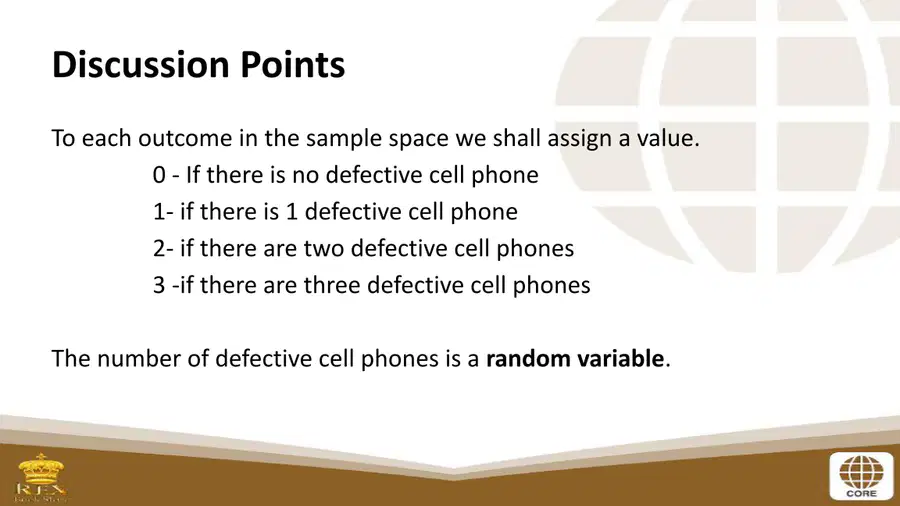
13
Fill in the Blanks
Type answer...
14
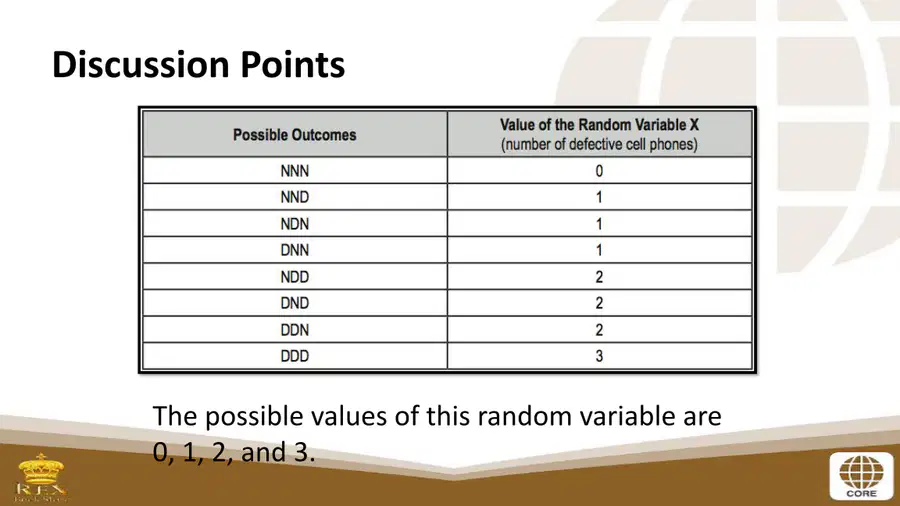
15
Open Ended
Explain how the concept of random variables helps in assigning values to outcomes in a sample space. Use the example of testing three cell phones for defects.
16
Multiple Choice
Based on the table, what value does the random variable X take for the outcome 'DND'?
1
2
3
0
17
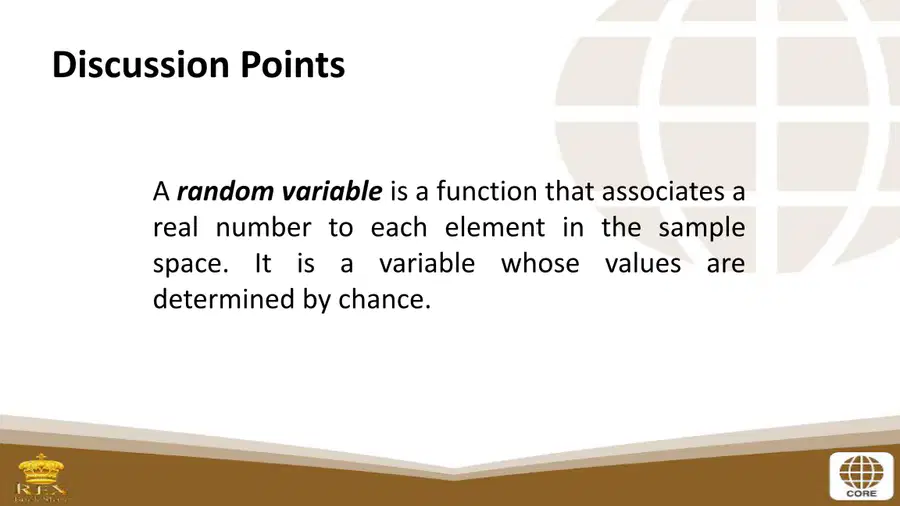
18
Multiple Choice
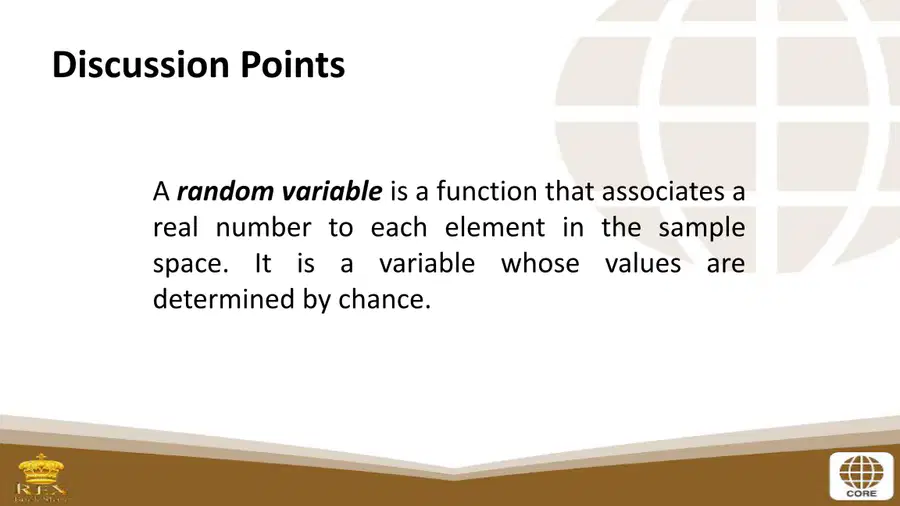
What is a random variable?
A variable that always takes the same value
A function that associates a real number to each element in the sample space
A variable whose values are always integers
A function that only works with heads in coin tosses
19
20
21
Open Ended
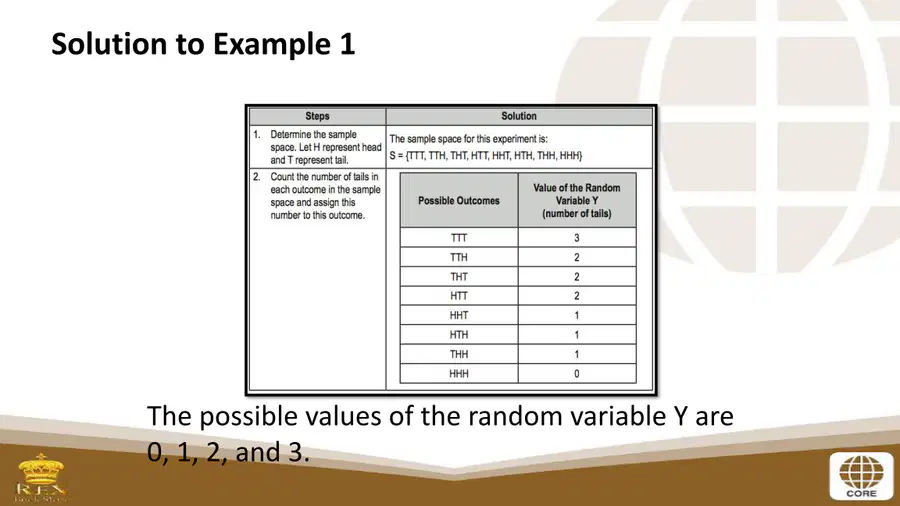
Explain the steps to determine the values of a random variable in a coin tossing experiment.
22
Multiple Choice
After tossing three coins, what are the possible values that the random variable Y (number of tails) can take?
0, 1, 2, 3
1, 2, 3, 4
0, 1, 2
1, 2, 3
23
24
25
Multiple Select
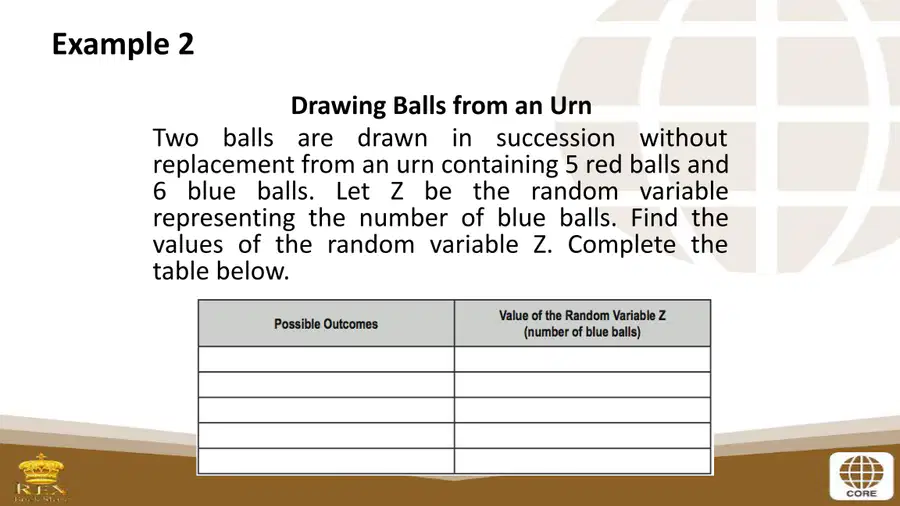
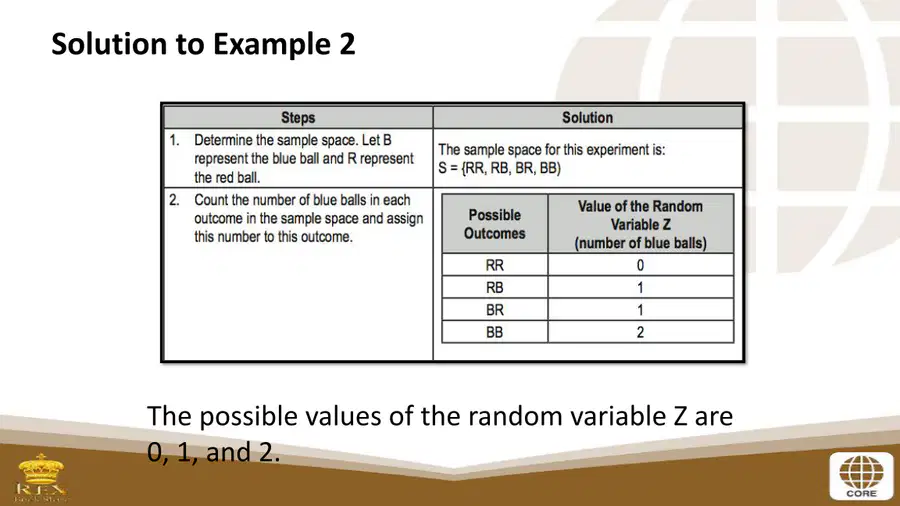
Which of the following are possible outcomes when two balls are drawn from an urn containing red and blue balls?
RR
RB
BB
BR
26
Fill in the Blanks
Type answer...
27
28
29
Fill in the Blanks
Type answer...
30
Multiple Choice
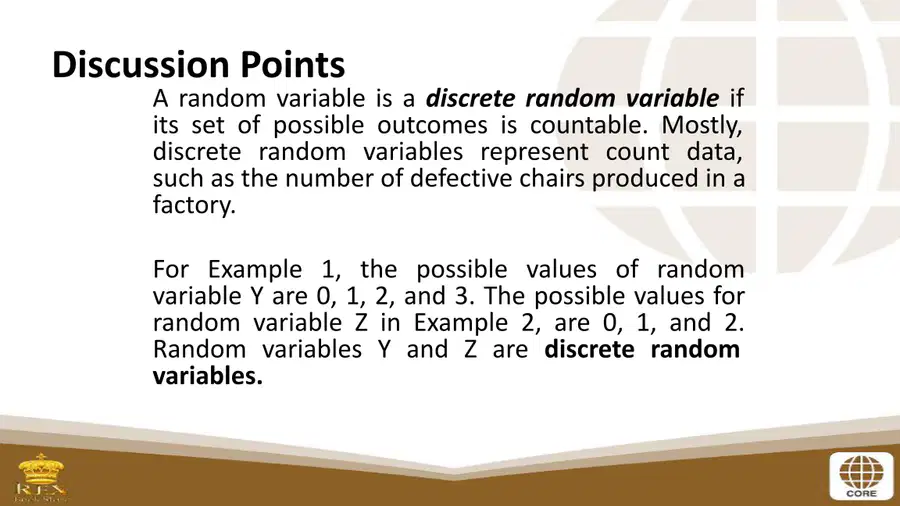
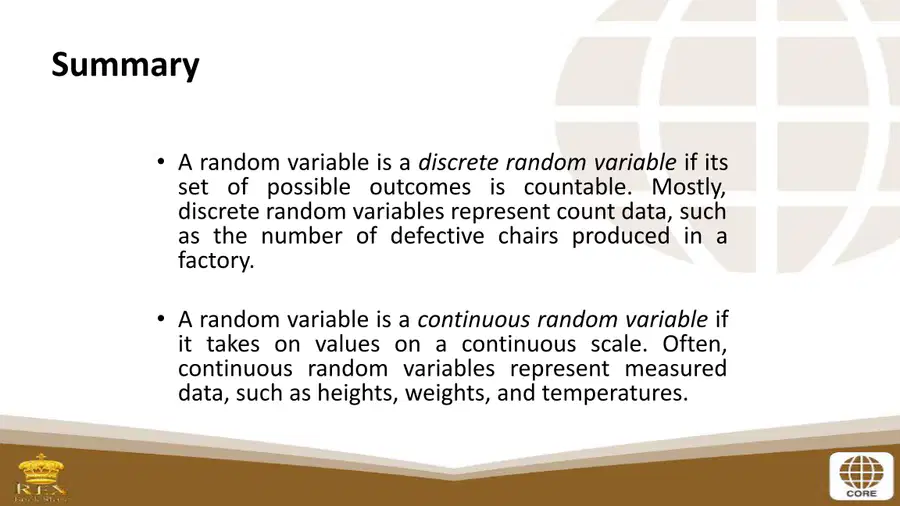
Which of the following best describes a discrete random variable?
A variable that can take any value on a continuous scale
A variable whose possible outcomes are countable
A variable that cannot be measured
A variable that only takes negative values
31
32
Multiple Choice
Which of the following scenarios best illustrates a discrete random variable?
The time taken for a chemical reaction to complete
The number of students absent in a class
The temperature recorded at noon
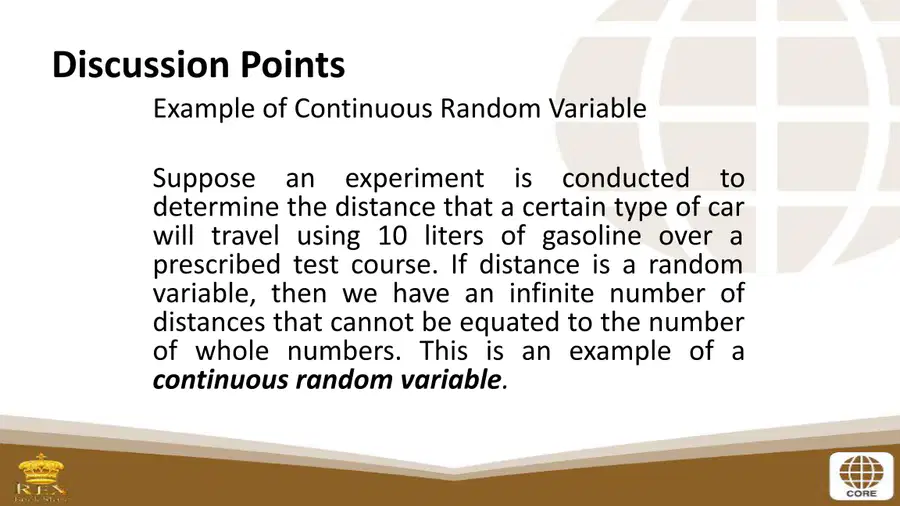
The distance a car travels on a full tank
33
Multiple Select
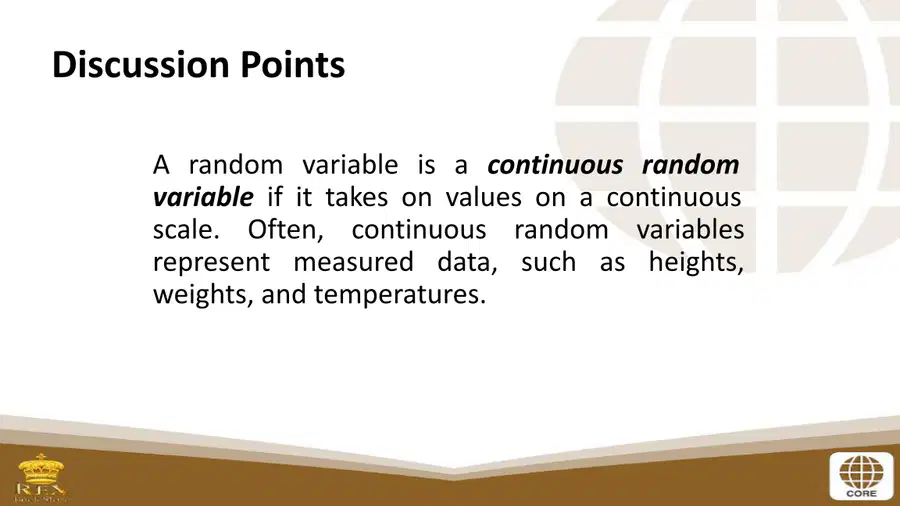
Which of the following are examples of continuous random variables?
Number of defective chairs produced in a factory
Heights of students in a class
Number of heads in a coin toss
Weights of apples
34
35
Open Ended
Suppose you are conducting an experiment to measure the amount of rainfall in a city over a month. Is the amount of rainfall a discrete or continuous random variable? Justify your answer.
36
37
38
39
40
Open Ended
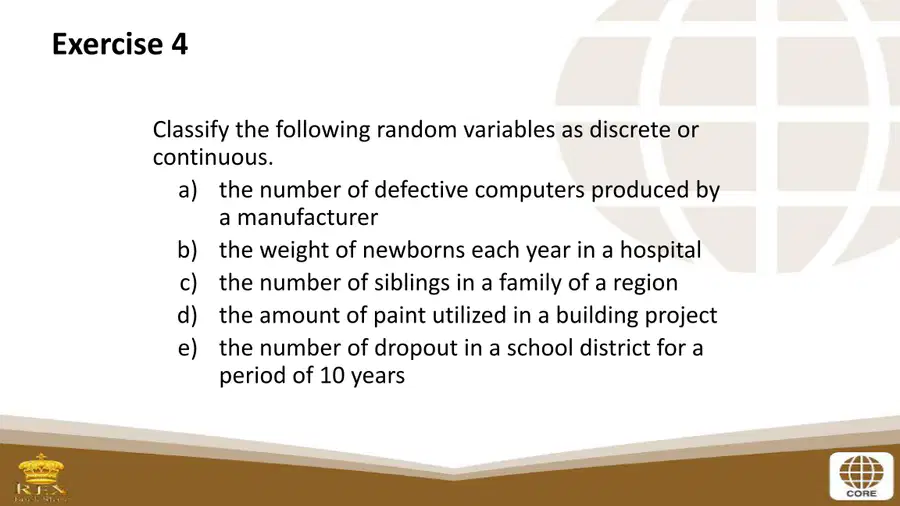
Classify the following random variables as discrete or continuous. a) the number of defective computers produced by a manufacturer b) the weight of newborns each year in a hospital c) the number of siblings in a family of a region d) the amount of paint utilized in a building project e) the number of dropout in a school district for a period of 10 years
41
42
43
Multiple Select
Select all statements that correctly describe discrete and continuous random variables.
Discrete random variables represent count data and have countable outcomes.
Continuous random variables take values on a continuous scale and represent measured data.
Discrete random variables can only take values between 0 and 1.
Continuous random variables are always integers.
44
Open Ended
What questions do you still have about random variables or their classification as discrete or continuous?
45
Multiple Choice
Which of the following is NOT an objective of this lesson on random variables?
Illustrate a random variable
Classify random variables as discrete or continuous
Find the possible values of a random variable
Calculate the mean of a random variable
Show answer
Auto Play
Slide 1 / 45
SLIDE
Similar Resources on Wayground

43 questions
Solving Linear Inequalities
Presentation
•
11th Grade
40 questions
Pembentukan Pemerintah Indonesia
Presentation
•
11th Grade
39 questions
Quadratics Characteristics
Presentation
•
10th - 11th Grade
40 questions
Concordância verbal
Presentation
•
KG
41 questions
Pengenalan Lingkaran
Presentation
•
11th Grade
39 questions
Complex Number Addition
Presentation
•
11th Grade
38 questions
1.3 More on Functions and Their Graphs
Presentation
•
11th Grade
37 questions
L2.3
Presentation
•
KG
Popular Resources on Wayground
24 questions
PBIS-HGMS Day 10

Quiz
•
6th - 8th Grade
10 questions
HCS SCI 03 Summer School Review 3
Quiz
•
3rd Grade
11 questions
Home Scope
Quiz
•
7th - 8th Grade
15 questions
HCS SCI 05 Summer School Assessment 3 Review
Quiz
•
5th Grade
35 questions
Lufkin Road Middle School Student Handbook & Policies Assessment
Quiz
•
7th Grade
18 questions
Geo 11.3 Area of Circles and Sectors
Quiz
•
9th - 11th Grade