

Valence Electrons & Ions

Presentation
•
Chemistry
•
9th Grade
•
Practice Problem
•
Medium
Standards-aligned

Juan Crosby
Used 2+ times
FREE Resource
22 Slides • 23 Questions
1

2

3

4
Multiple Choice
How many valence electrons does the following electron configuration shows:
1s2 2s2 2p6 3s2 3p4
5
Multiple Choice
Which group in the periodic table has elements with 6 valence electrons according to the electron configuration table?
Group 16
Group 14
Group 17
Group 2
6

7
Open Ended
Explain the importance of valence electrons in chemical bonding and how electron-dot notation helps represent them.
8

9
Multiple Select
Which of the following are correct rules for placing dots in electron-dot notation?
No side can have more than two dots.
Each side gets one dot before doubling up, except for hydrogen and helium.
Dots must always be paired on each side.
Hydrogen can have two dots.
10

11
Multiple Choice
Based on the Lewis structure periodic table, which of the following elements has five valence electrons?
Nitrogen (N)
Oxygen (O)
Carbon (C)
Neon (Ne)
12

13
Fill in the Blanks
Type answer...
14

15

16
Multiple Choice
Which of the following best describes the difference between a shared pair and an unshared pair of electrons in a Lewis structure?
A shared pair is involved in bonding between atoms, while an unshared pair is not.
A shared pair is always represented by a dash, while an unshared pair is always represented by dots.
A shared pair is found only in metals, while an unshared pair is found only in nonmetals.
A shared pair contains more electrons than an unshared pair.
17

18
Open Ended
Explain what is the difference between the structural formula and the Lewis dot structure.
19

20
Fill in the Blanks
Type answer...
21

22
Multiple Select
Which of the following statements about cations is/are correct?
Cations are formed when an atom loses electrons.
Cations have more protons than electrons.
Cations are always metals.
Cations are negatively charged.
23
24
Multiple Choice
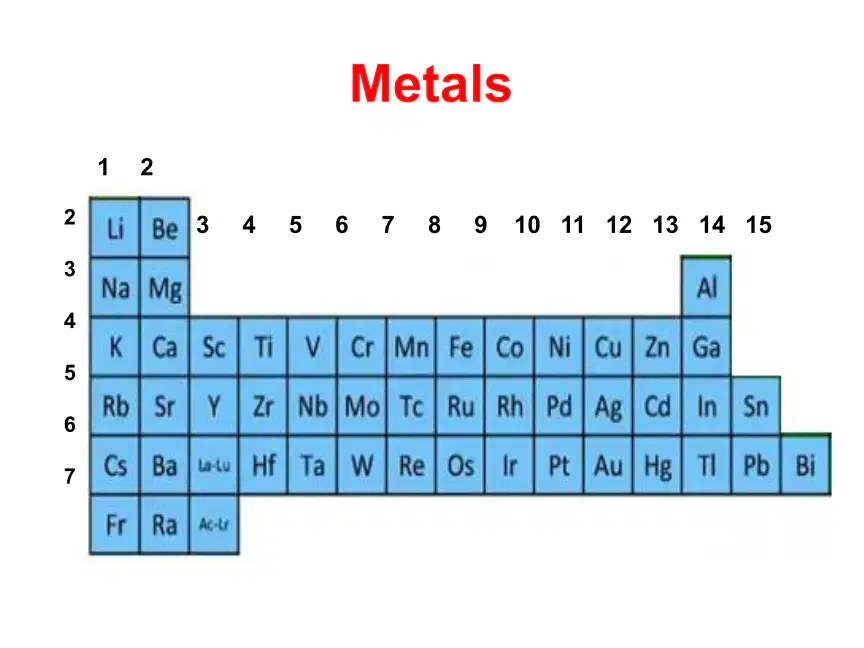
Based on the periodic table shown, which of the following elements is NOT a metal?
Na
Fe
Al
C
25

26
Open Ended
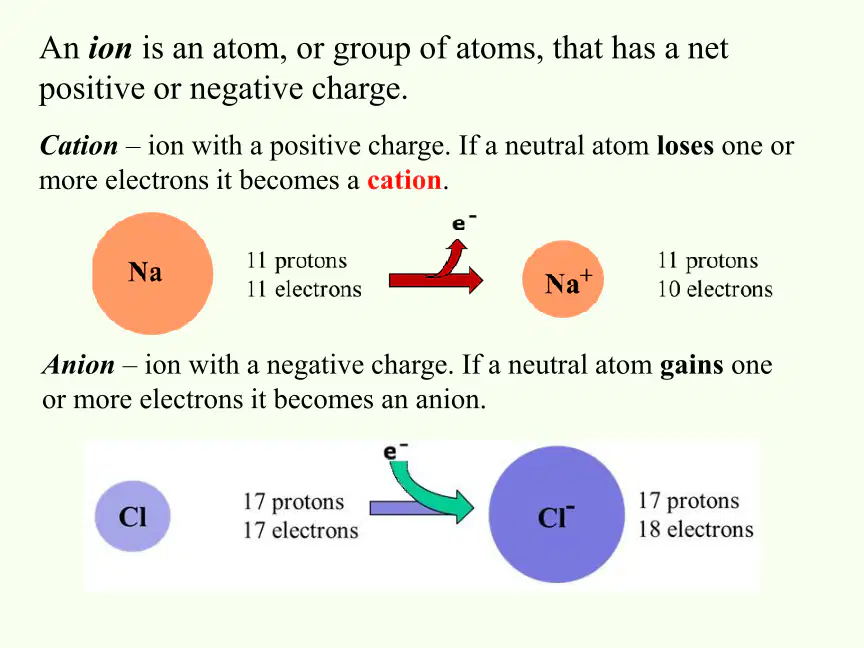
Describe the process by which a chlorine atom becomes a chloride ion, including the changes in its number of protons and electrons.
27

28
Multiple Choice
Which of the following elements is a nonmetal?
Sodium (Na)
Carbon (C)
Magnesium (Mg)
Aluminum (Al)
29
30
Open Ended
Explain the difference between a cation and an anion, including how each is formed.
31

32
Multiple Select
Which of the following statements are correct about the formation of ions?
A cation is formed when an atom gains electrons.
An anion is formed when an atom gains electrons.
A cation is formed when an atom loses electrons.
An anion is formed when an atom loses electrons.
33

34
Fill in the Blanks
Type answer...
35

36
Open Ended
Compare the electron configurations of sodium and magnesium after they form ions. What similarities and differences do you observe?
37
38
Multiple Choice
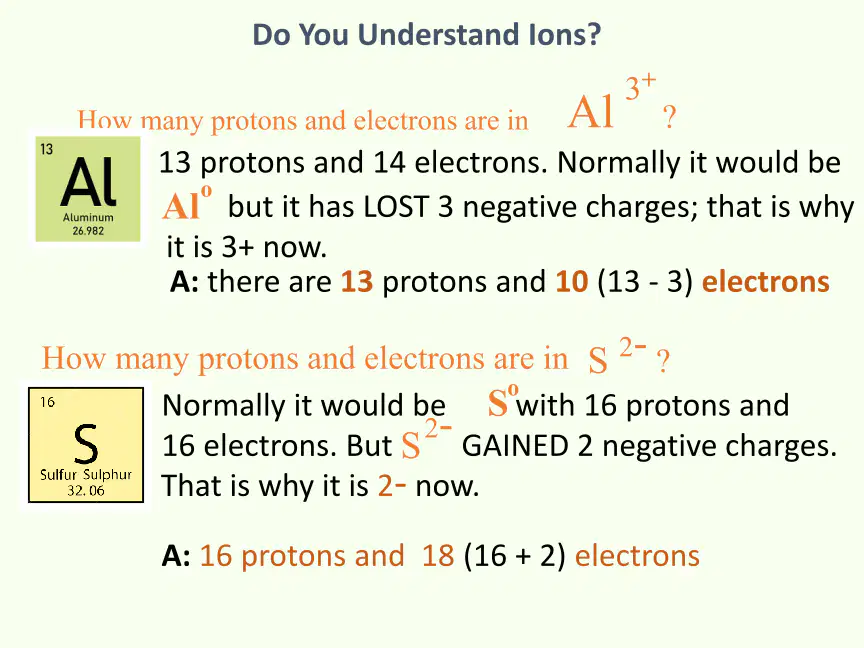
How many protons and electrons are present in S 2- ?
16 protons and 16 electrons
16 protons and 18 electrons
18 protons and 16 electrons
18 protons and 18 electrons
39

40
Fill in the Blanks
Type answer...
41

42
Open Ended
Compare and contrast the formation and size of cations and anions. What are the key differences in how metals and nonmetals form ions, and how does the gain or loss of electrons affect the size of the resulting ion?
43
Multiple Choice
What is the significance of valence electrons in chemical bonding?
They determine the color of an element
They are responsible for the chemical reactivity of an element
They are found only in noble gases
They are not involved in any chemical reactions
44
Open Ended
How do the rules for drawing Lewis dot structures help us visualize and understand chemical bonding?
45
Multiple Choice
Why is understanding valence electrons important in chemistry?
Because they determine how atoms interact and bond with each other.
Because they are found in the nucleus of the atom.
Because they are responsible for the color of compounds.
Because they are only present in metals.
Show answer
Auto Play
Slide 1 / 45
SLIDE
Similar Resources on Wayground

38 questions
Taxonomy and Three Domains
Presentation
•
9th Grade
36 questions
Lesson: Identifying Atoms, Isotopes, and Ions
Presentation
•
9th Grade
40 questions
Cell terms part 1
Presentation
•
9th - 10th Grade
39 questions
Genetics terms part 1
Presentation
•
9th - 10th Grade
40 questions
Quadratic Functions
Presentation
•
9th Grade
38 questions
Structure and Properties of Matter
Presentation
•
9th Grade
40 questions
Present stem changing verbs
Presentation
•
9th Grade
40 questions
Grade 9 Lesson 3 (Liquids/Solids)
Presentation
•
9th Grade
Popular Resources on Wayground
10 questions
HCS SCI 03 Summer School Review 4

Quiz
•
3rd Grade
11 questions
HSMS - Standard Response Protocol
Quiz
•
6th - 8th Grade
16 questions
1.1-1.2 Quiz Review
Quiz
•
9th - 12th Grade
12 questions
Exponent Expressions
Quiz
•
6th Grade
20 questions
Adding and Subtracting Integers
Quiz
•
6th - 7th Grade
11 questions
Northeast States
Quiz
•
3rd - 4th Grade
10 questions
Characterization
Quiz
•
3rd - 7th Grade
10 questions
Common Denominators
Quiz
•
5th Grade