

U5D5 Global and Local Wind Systems

Presentation
•
Science
•
9th - 12th Grade
•
Practice Problem
•
Easy
Standards-aligned

Carl Alberico
Used 1+ times
FREE Resource
28 Slides • 28 Questions
1
2
3
Multiple Choice
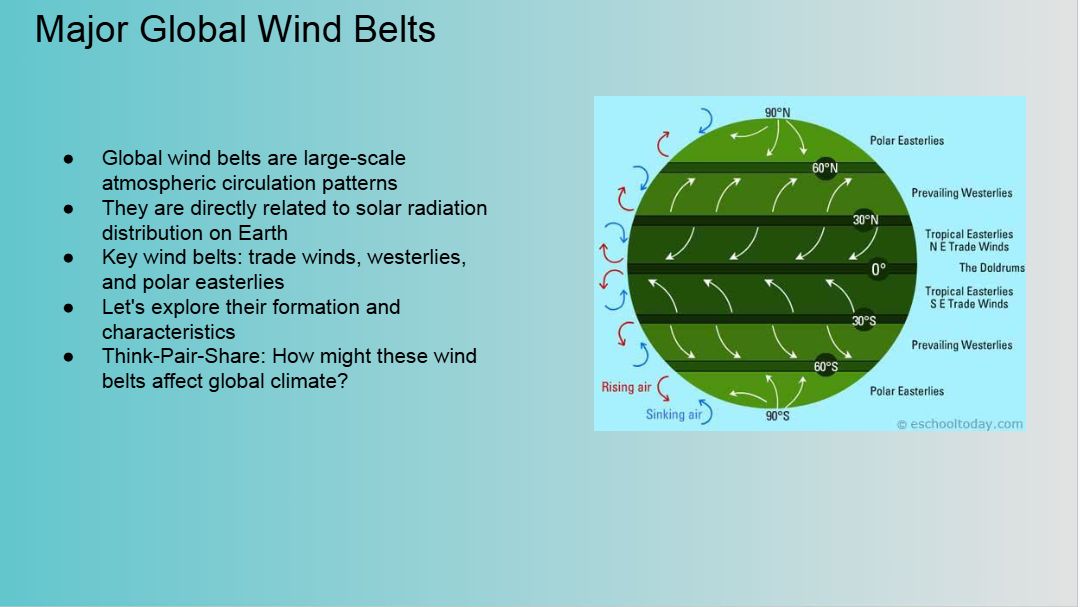
Which of the following is NOT a key global wind belt?
Trade winds
Westerlies
Polar easterlies
Monsoons
4
Open Ended
How might global wind belts affect global climate?
5
6
Open Ended
How might global wind patterns change if Earth was tilted differently?
7
8
Multiple Choice
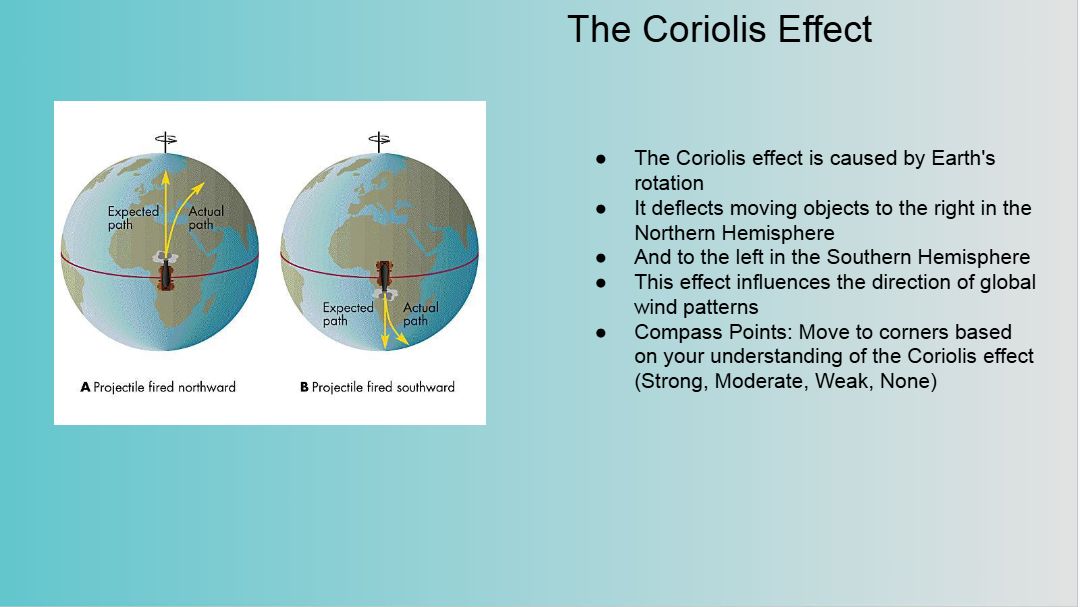
Which of the following best describes the Coriolis effect?
It is caused by Earth's rotation and deflects moving objects to the right in the Northern Hemisphere and to the left in the Southern Hemisphere.
It is caused by differences in air pressure and moves wind from the poles to the equator.
It is the effect of gravity pulling objects toward the center of the Earth.
It is the warming of Earth's surface due to solar radiation.
9
10
Multiple Select
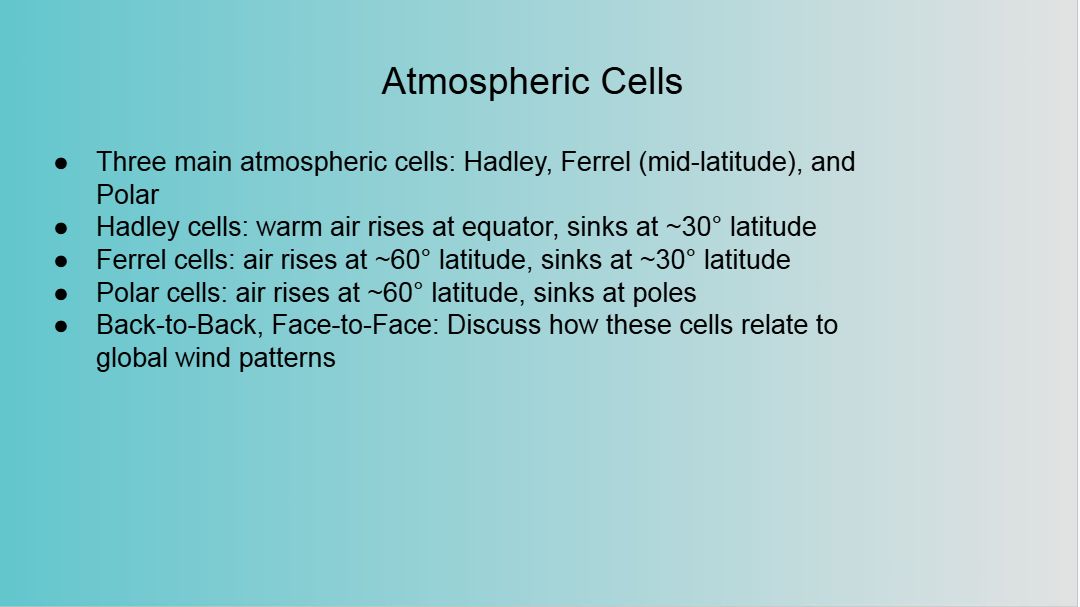
Which of the following statements about atmospheric cells is/are correct?
Hadley cells involve air rising at the equator and sinking at ~30° latitude.
Ferrel cells involve air rising at ~60° latitude and sinking at ~30° latitude.
Polar cells involve air rising at ~60° latitude and sinking at the poles.
All atmospheric cells involve air rising at the poles.
11
12
Open Ended
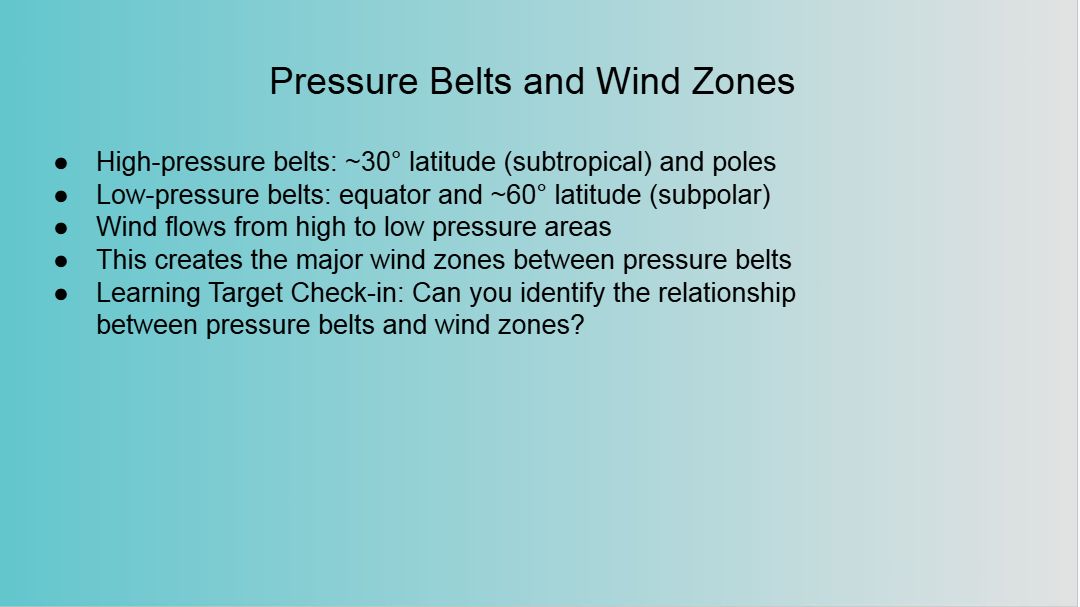
Can you identify the relationship between pressure belts and wind zones?
13
14
Fill in the Blanks
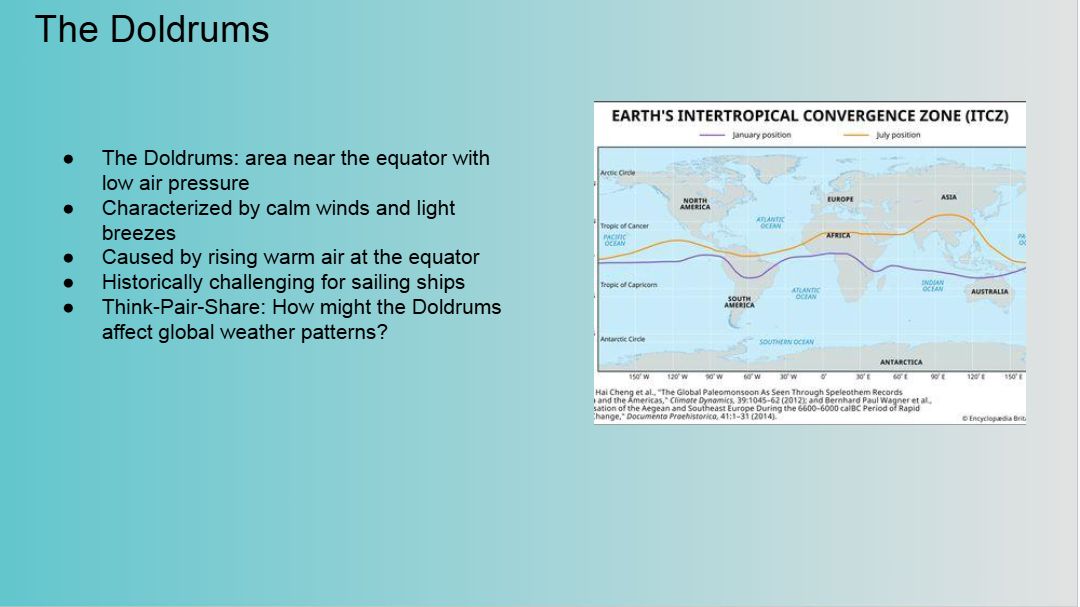
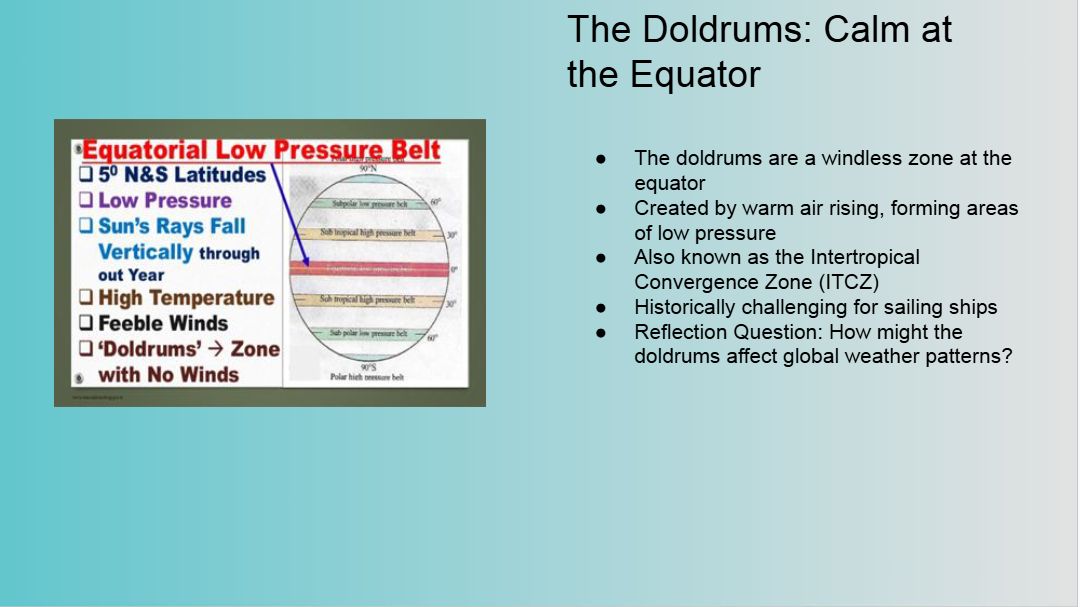
The Doldrums are characterized by
Type answer...
15
16
Open Ended
How do Horse Latitudes influence global climate patterns?
17
18
19
Multiple Choice
Which of the following is NOT a factor that influences local wind patterns?
Local geography
Temperature differences
Ocean currents
Earth's rotation only
20
21
Multiple Choice
Which of the following best explains why coastal areas experience milder winters and cooler summers compared to inland areas?
Coastal areas receive more sunlight than inland areas.
Water's high heat capacity moderates temperature changes.
Land heats up faster than water but cools down slower.
Ocean currents only affect inland climates.
22
23
Multiple Select
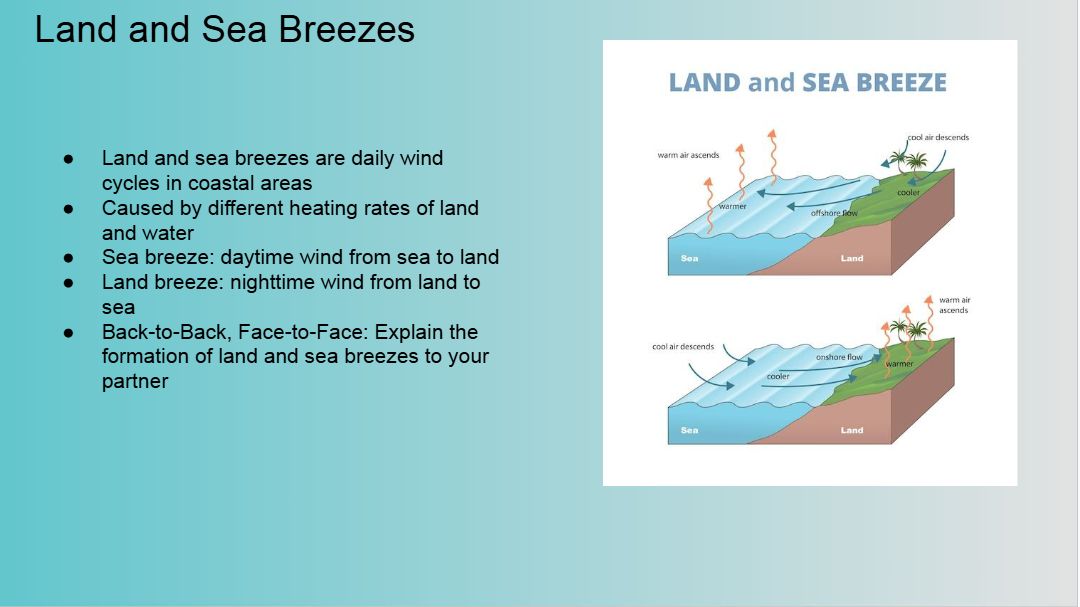
Which of the following statements about land and sea breezes are correct?
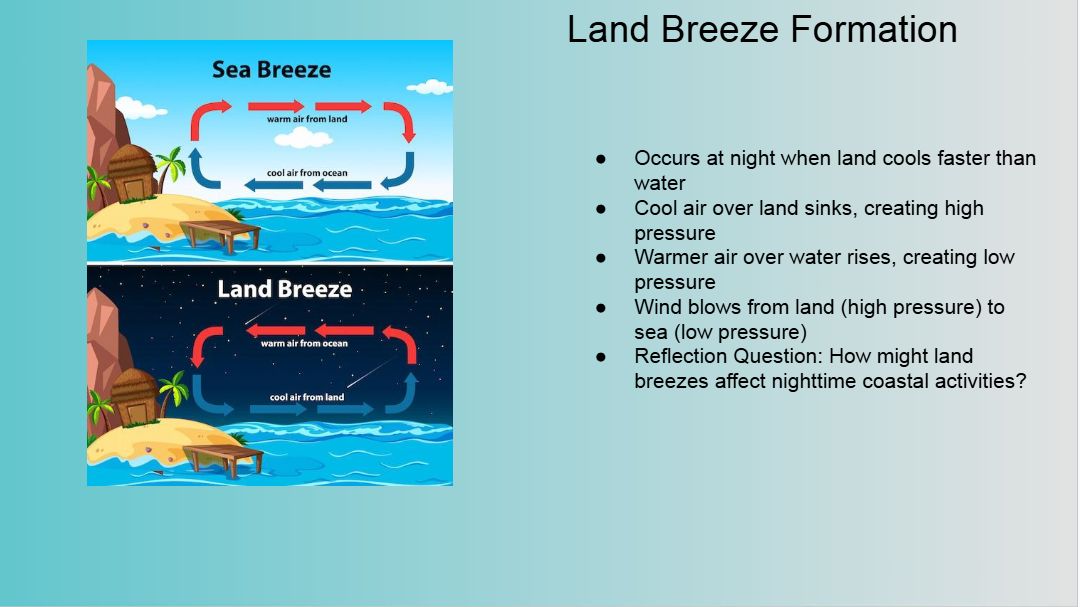
Land breeze occurs at night, blowing from land to sea.
Sea breeze occurs during the day, blowing from sea to land.
Both land and sea breezes are caused by temperature differences between land and water.
Land breeze occurs during the day, blowing from sea to land.
24
Open Ended
Explain how the difference in heat capacity between land and water drives the formation of local wind patterns such as land and sea breezes.
25
26
Fill in the Blanks
Monsoons are seasonal wind pattern shifts caused by temperature differences between
Type answer...
27
28
Open Ended
Describe how ocean currents, such as the Gulf Stream, can influence the climate of coastal regions.
29
30
31
Fill in the Blanks
Wind blows from ___ pressure to ___ pressure areas.
Type answer...
32
33
Multiple Choice
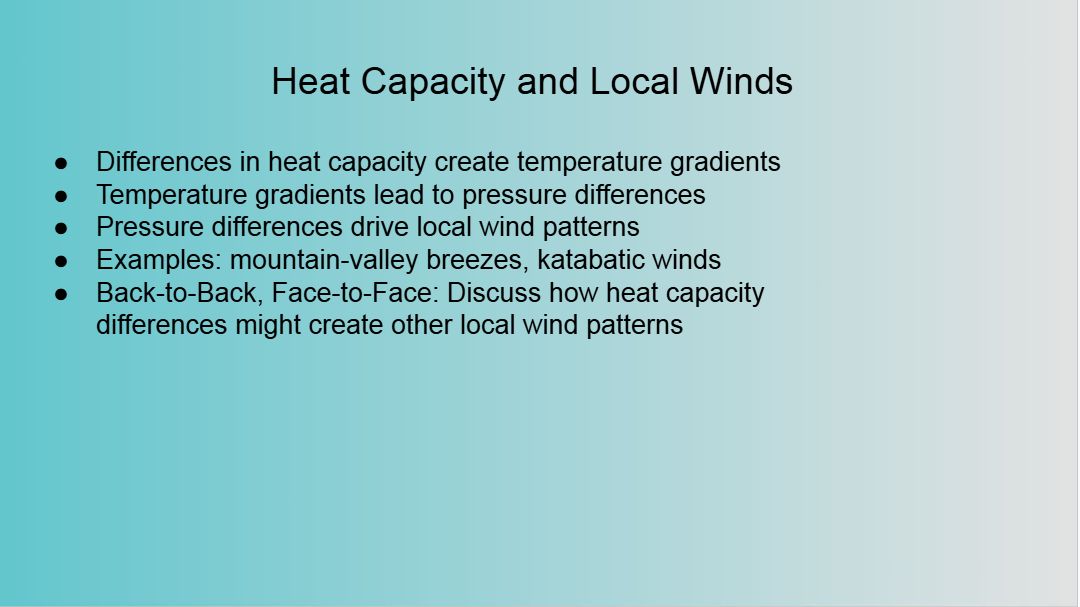
What is the main driver behind the formation of local wind patterns such as mountain-valley breezes and katabatic winds?
Differences in humidity
Differences in heat capacity
Differences in altitude
Differences in cloud cover
34
Multiple Choice
How do differences in heat capacity between land and water contribute to the formation of sea breezes and land breezes?
They cause air over land to always rise, regardless of time of day.
They create temperature and pressure gradients that reverse wind direction between day and night.
They have no effect on local wind patterns.
They only affect global wind patterns, not local ones.
35
36
Multiple Select
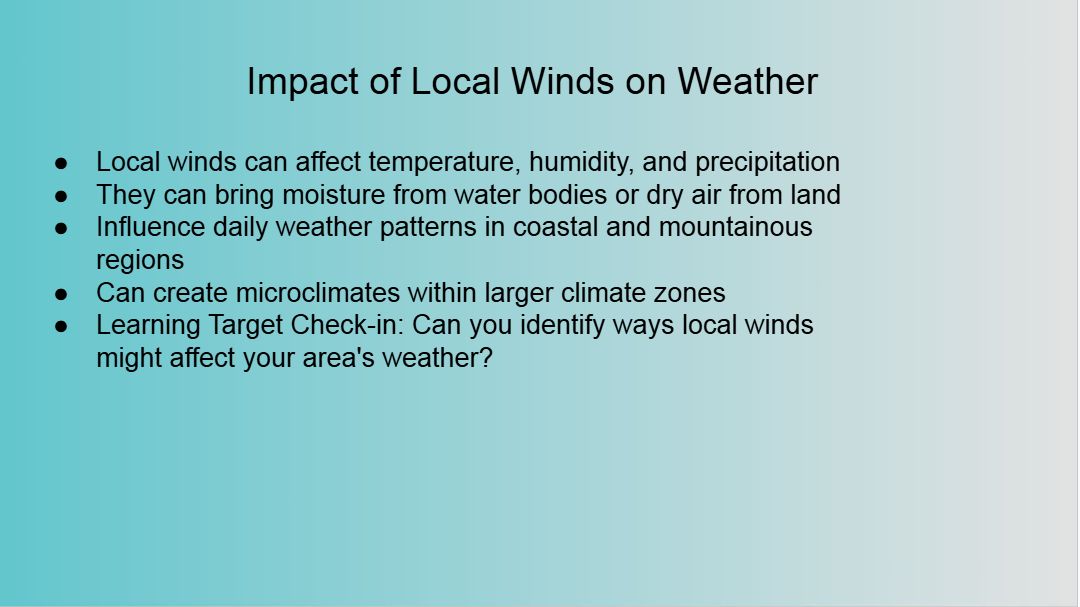
Which of the following are effects that local winds can have on weather?
Affect temperature
Bring moisture from water bodies
Create microclimates
Cause earthquakes
37
Open Ended
Describe how local winds can influence the weather in coastal and mountainous regions.
38
39
Open Ended
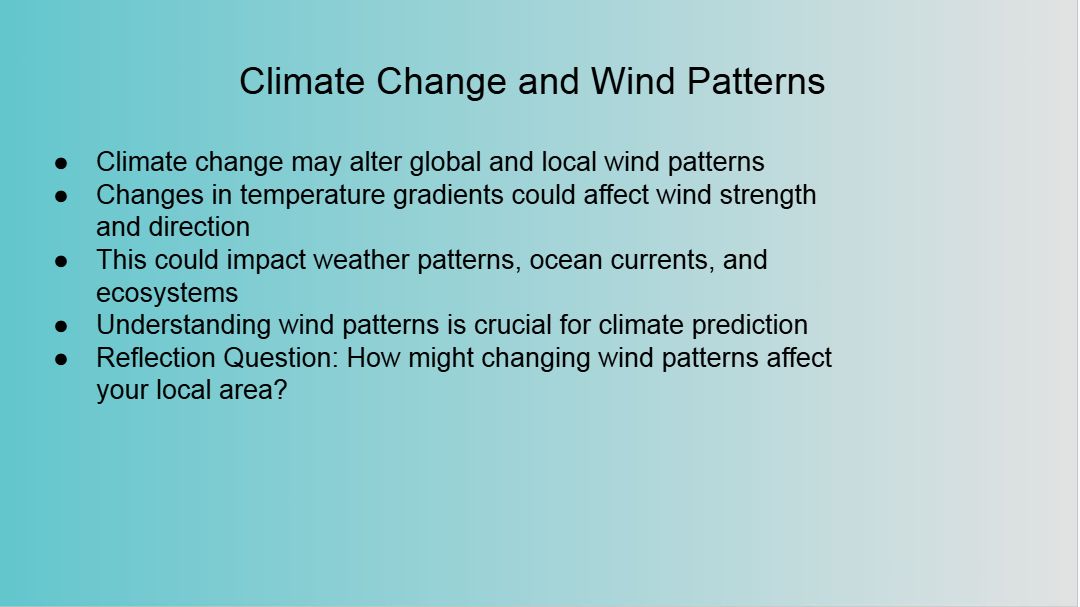
How might changing wind patterns due to climate change impact your local area?
40
41
42
Multiple Choice
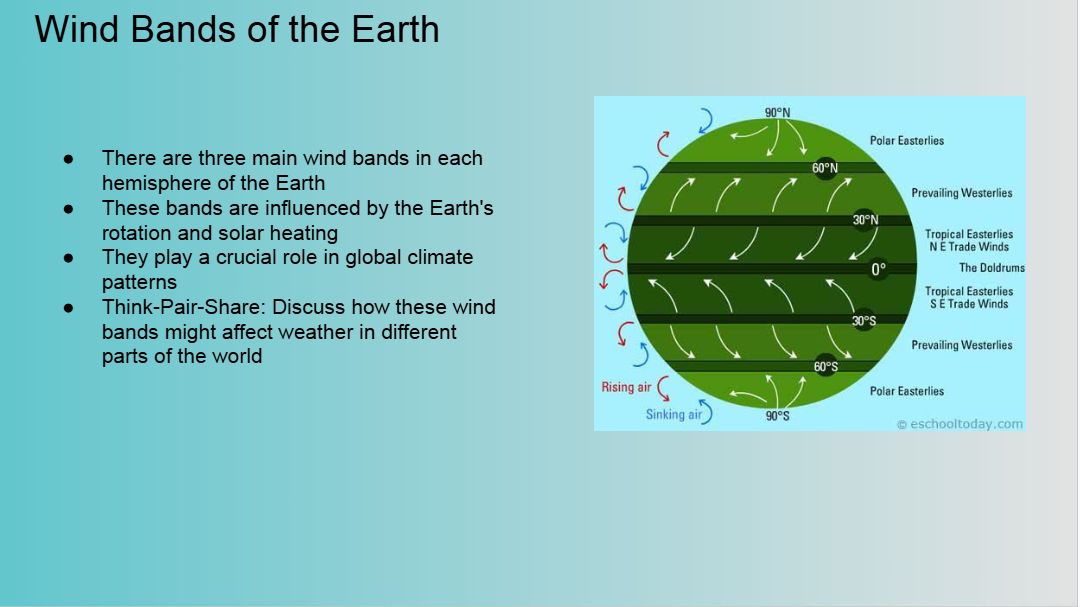
Which of the following statements best explains why there are three main wind bands in each hemisphere of the Earth?
Because of the Earth's rotation and solar heating
Because of the shape of the continents
Because of the presence of oceans
Because of the Earth's magnetic field
43
44
Open Ended
How might the doldrums affect global weather patterns?
45
46
Multiple Select
Which of the following are characteristics of sea breezes and land breezes?
Sea breezes occur during the day, land breezes at night
Both are caused by different heating rates of land and water
Sea breezes occur during the night, land breezes during the day
Both are caused by the Earth's rotation
47
48
Fill in the Blanks
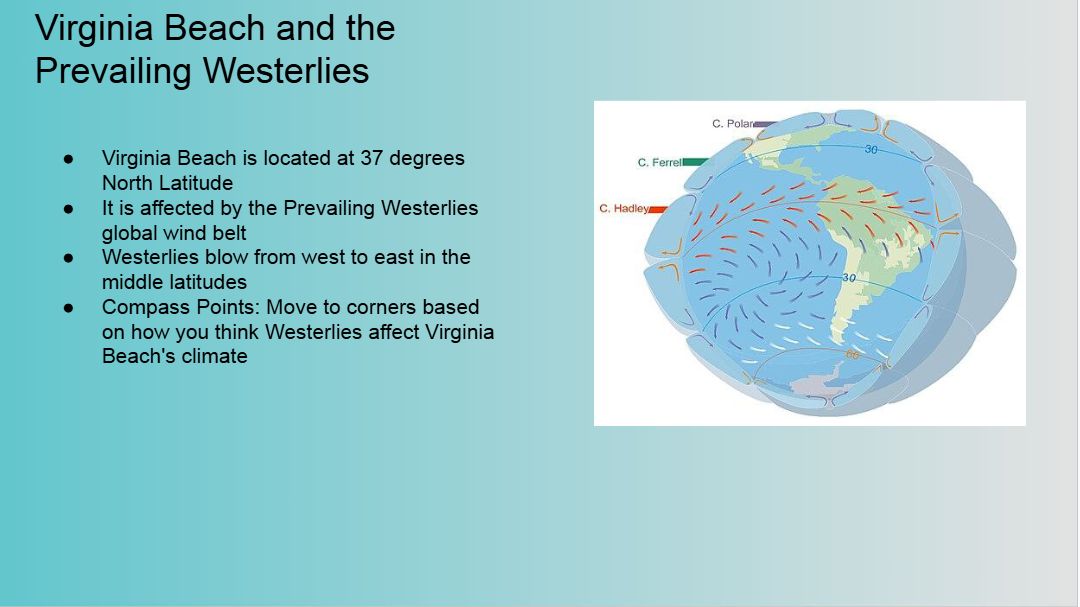
Fill in the blank: The prevailing westerlies blow from
Type answer...
49
50
Open Ended
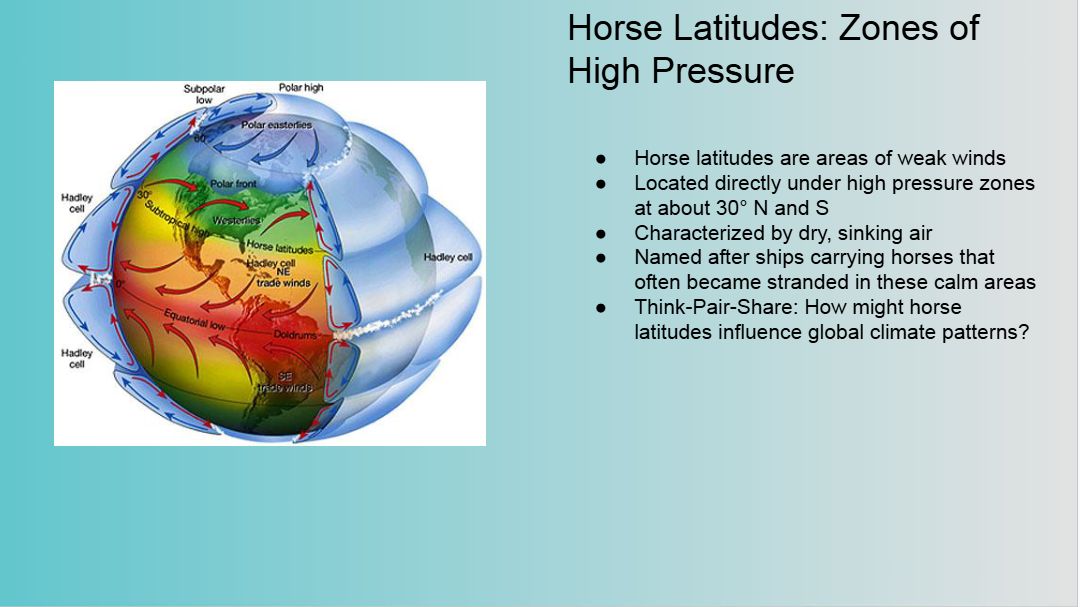
How might horse latitudes influence global climate patterns?
51
52
Open Ended
Why are winds named for the direction they blow from?
53
54
Open Ended
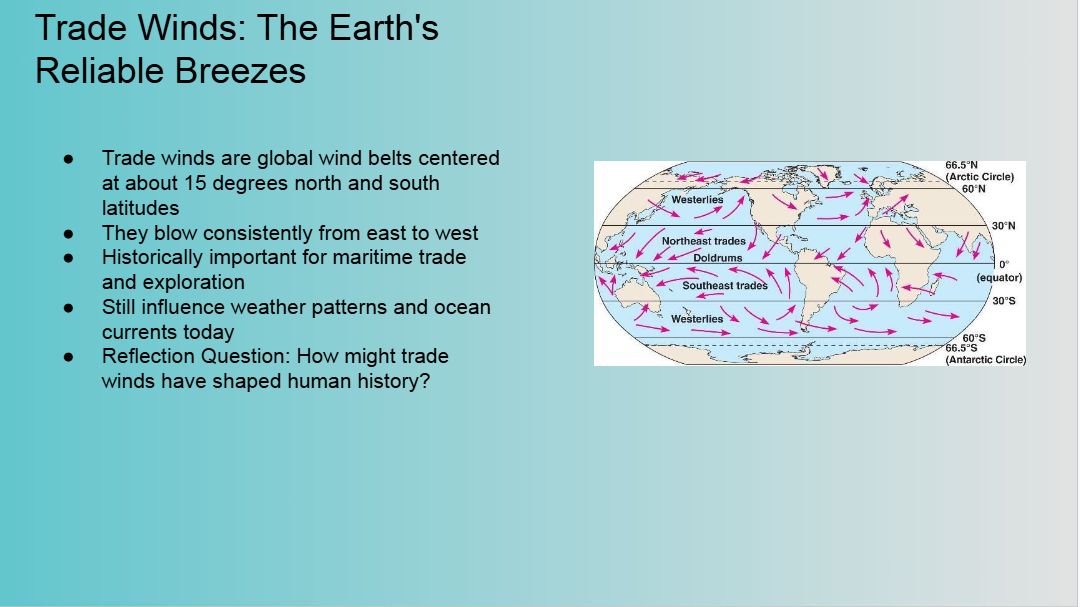
How might trade winds have shaped human history?
55
Multiple Choice
How do trade winds influence both historical maritime trade and modern weather patterns?
They cause earthquakes and volcanic eruptions
They blow from west to east, disrupting trade routes
They consistently blow from east to west, aiding navigation and affecting ocean currents
They only affect local breezes, not global patterns
56
Show answer
Auto Play
Slide 1 / 56
SLIDE
Similar Resources on Wayground

52 questions
Development Across the Lifespan Pt.2
Presentation
•
9th - 12th Grade
52 questions
HC08.2 Limiting Reactant Lecture
Presentation
•
9th - 12th Grade
51 questions
Muscular System
Presentation
•
9th - 12th Grade
50 questions
Unit 6 Latin America Physical and Cultural Geography
Presentation
•
9th - 12th Grade
49 questions
Protein Synthesis and Codon Chart Notes
Presentation
•
9th - 12th Grade
50 questions
Electricity, Current, Voltage
Presentation
•
8th - 11th Grade
53 questions
Biomolecules
Presentation
•
9th - 12th Grade
49 questions
Bacteria, Virus, and Protist Review
Presentation
•
9th - 12th Grade
Popular Resources on Wayground
10 questions
Safety Day 2026 – Student Review

Quiz
•
9th Grade
21 questions
Continents and Oceans
Quiz
•
6th Grade
20 questions
Parts of Speech
Quiz
•
5th Grade
16 questions
Subject & Predicate
Quiz
•
5th Grade
25 questions
Multiplication Facts
Quiz
•
5th Grade
12 questions
Map Skills
Quiz
•
3rd Grade
22 questions
Continents and Oceans
Quiz
•
5th Grade
15 questions
Rounding Decimals
Quiz
•
5th Grade
Discover more resources for Science
10 questions
Exploring Chemical and Physical Changes

Interactive video
•
6th - 10th Grade
20 questions
Atomic Structure
Quiz
•
9th Grade
10 questions
Exploring the Electromagnetic Spectrum for Middle School Science
Interactive video
•
6th - 10th Grade
10 questions
Exploring Force and Motion Concepts
Interactive video
•
6th - 10th Grade
10 questions
Exploring Air Masses and Weather Fronts
Interactive video
•
6th - 10th Grade
14 questions
Periodic Trends
Interactive video
•
11th Grade
10 questions
Exploring the States of Matter
Interactive video
•
6th - 10th Grade
10 questions
Exploring Forces: Net Force, Normal Force, Gravity, and Friction
Interactive video
•
6th - 10th Grade