

3.1.4 Acceleration

Presentation
•
Science
•
6th Grade
•
Practice Problem
•
Medium
Standards-aligned

Joann Peda
Used 3+ times
FREE Resource
10 Slides • 5 Questions
1
3.1.4
Acceleration


2
Review of the unit so far...
Frame of reference
Measuring distance and direction with vectors
Speed is how fast something is moving
Velocity is speed and direction which can be measured with vectors
3
Open Ended
What is acceleration?
4
Acceleration is a change in velocity of an object.
Remember that velocity is the SPEED and DIRECTION of a moving object.
So, acceleration is a change in speed and/or direction.
Most people think of acceleration as speeding up. Like a car speeding up as it travels along a highway. BUT this is only one way an object can experience acceleration.

5
So acceleration is not just about speeding up!
When an object slows down or changes direction, it involves acceleration.
Even if speed remains constant, a change in direction results in acceleration.


Hitting a ball with a bat results in a change in the ball's direction and speed, resulting in acceleration.
Acceleration occurs when a racer crosses the finish line and begins to slow down.
A skydiver experiences different accelerations as they speed up during the fall and then slow down after opening their parachute.
6
7
Open Ended
Explain how a car speeding up and slowing down are both examples of acceleration.
8
Calculating Acceleration
We will only be calculating acceleration when there is a change in speed (not direction).
To find acceleration without a change in direction, you divide the change in velocity by the change in time.
In this formula,
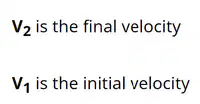

Remember that in acceleration the velocity is changing so we have to have two velocities in the formula.
9
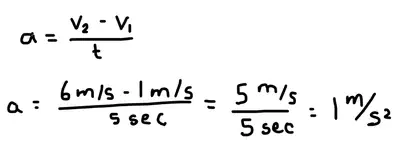
Let's look at example #1:
A bicyclist is mountain biking down a hill.
They begin with a velocity of 1 meter/second. (initial velocity)
When they reach the bottom of the hill, they have a velocity of 6 meters/second. (final velocity)
It took them 5 seconds to reach the bottom of the hill.
Always begin by rewriting the information like this:
V1 = 1 m/s
V2 = 6 m/s
t = 5 seconds
Rewrite the equation for acceleration, then plug in the numbers and chug out the answer
If you leave out the units during the calculation, just be sure to have the final units of m/s2

10
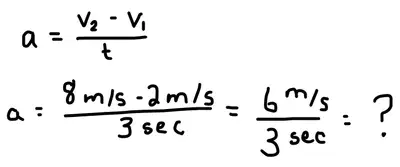
Example #2:
A skateboarder speeds up from a velocity of 2 m/s to a velocity of 8 m/s.
It took 3 seconds for this change to occur.
What was the acceleration?

Given:
v1 = 2 m/s
v2 = 8 m/s
t = 3 seconds
Plug and Chug
11
Velocity-Time Graphs
(shows the relationship between velocity and time)
Important: When reading a graph, study the x-axis and y-axis to understand what you are looking at.
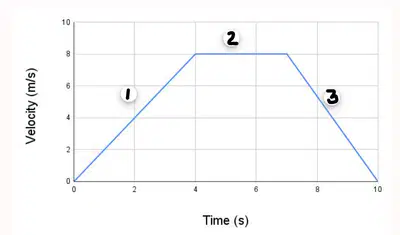
Increasing velocity (positive acceleration) from 0 m/s to 8 m/s in 4 seconds
Constant velocity (zero/no acceleration) velocity stays the same at 8 m/s for 3 seconds
Decreasing velocity (negative acceleration/deceleration) 8/ms to 0 m/s in 3 seconds
12
Labelling
Label the type of acceleration taking place at each point.
zero (no) acceleration
positive acceleration
negative acceleration
13
Multiple Select
Which is of the following is an example of acceleration?
Pick two.
a train traveling at a constant velocity
a moving car coming to a stop
a runner sprinting from the starting line
14
Multiple Choice

While racing, a runner increases from 3 m/s to 6 m/s over a period of 3 seconds.
What is the runner's acceleration?
2 m/s2
1m/s2
3 m/s2
15
What did we learn today:
Acceleration measures the change in velocity of a moving object

We can use a velocity-time graph to illustrate/model acceleration.

3.1.4
Acceleration
Show answer
Auto Play
Slide 1 / 15
SLIDE
Similar Resources on Wayground

13 questions
Climate Change
Presentation
•
6th Grade
10 questions
Acids and Bases
Presentation
•
5th Grade
11 questions
Intro to Energy End of Unit Quiz
Presentation
•
6th Grade
10 questions
Pronombres y Adjetivos
Presentation
•
6th Grade
12 questions
The Earth's 4 Spheres
Presentation
•
5th Grade
10 questions
Force and type of forces
Presentation
•
6th Grade
12 questions
Non renewable Resources
Presentation
•
6th Grade
9 questions
Biomes: Concentration on Intro of Terrestrial Biome
Presentation
•
6th Grade
Popular Resources on Wayground
24 questions
PBIS-HGMS Day 10

Quiz
•
6th - 8th Grade
10 questions
HCS SCI 03 Summer School Review 3
Quiz
•
3rd Grade
11 questions
Home Scope
Quiz
•
7th - 8th Grade
15 questions
HCS SCI 05 Summer School Assessment 3 Review
Quiz
•
5th Grade
35 questions
Lufkin Road Middle School Student Handbook & Policies Assessment
Quiz
•
7th Grade
18 questions
Geo 11.3 Area of Circles and Sectors
Quiz
•
9th - 11th Grade