
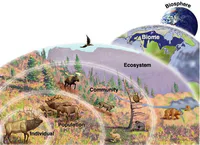
Ecological Organization
Presentation
•
Science
•
9th Grade
•
Practice Problem
•
Medium
+6
Standards-aligned
Amy Slack
Used 5+ times
FREE Resource
10 Slides • 15 Questions
1
2
3
Multiple Choice
Which of the following best describes the main focus of ecology?
The study of chemical reactions
The study of interactions between organisms and their environments
The study of historical events
The study of planets and stars
4
5
Multiple Choice
The weather is..
Abiotic
Biotic
6
7
Multiple Choice
Which of the following best describes an organism?
A group of populations living together
A single unicellular or multicellular form of life
All the biotic and abiotic factors in an area
A specific climate region
8
9
Fill in the Blanks
A population is defined as a group of organisms of
10
11
Multiple Choice
Which of the following statements about a community is correct?
It consists of only one species in an area
It includes both biotic and abiotic factors
It is made up of several interacting populations in a common environment
It refers to all the ecosystems in a region
12
13
14
Open Ended
Explain how a biome is different from an ecosystem.
15
16
Multiple Choice
17
Multiple Choice
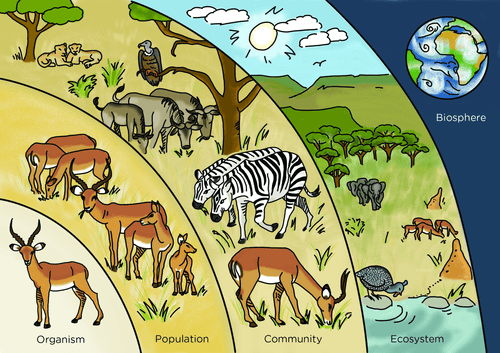
The living world is organized in levels. Biotic and abiotic factors also can be arranged into levels of biological organization. Put the words below in order from the least complex to the most complex
Community, Organism, Biome, Population, Biosphere, Ecosystem
Organism, Population, Community, Ecosystem, Biome, Biosphere
Organism, Biome, Population, Community Biosphere, Ecosystem
18
19
Multiple Choice
What is the difference between a niche and a habitat for an organism?
A niche is where an organism lives, while a habitat is the role it plays in the environment.
A niche is the unique role a species plays in the environment, while a habitat is where an organism lives.
A niche and a habitat are the same thing.
A habitat is only for plants, while a niche is only for animals.
20
Multiple Choice
21
Multiple Choice
ecosystem
22
Multiple Choice
Biologists organize the environment into ecological layers so they can communicate about the areas more efficiently. The diagram shows an example of the organization. If biologists were discussing an ecosystem, which layer on the diagram would they most likely be referencing?
Layer A
Layer D
Layer C
Layer B
23
Fill in the Blanks
Ecology is the scientific study of interactions between
Type answer...
24
Multiple Choice
25
Multiple Choice
Show answer
Auto Play
Slide 1 / 25
SLIDE

Similar Resources on Wayground
21 questions
The Moon Part 2
Presentation
•
9th Grade
20 questions
Air Masses
Presentation
•
10th Grade
20 questions
Water Pollution continued
Presentation
•
9th Grade
19 questions
Carbon and Nitrogen
Presentation
•
9th Grade
22 questions
Newton's laws of motion
Presentation
•
9th Grade
22 questions
Scientific Method review
Presentation
•
9th Grade
18 questions
Cellular Respiration vs Photosynthesis
Presentation
•
9th - 10th Grade
21 questions
CARBON AND ITS COMPOUNDS
Presentation
•
9th - 10th Grade
Popular Resources on Wayground
10 questions
Safety Day 2026 – Student Review
Quiz
•
9th Grade
21 questions
Continents and Oceans
Quiz
•
6th Grade
20 questions
Parts of Speech
Quiz
•
5th Grade
16 questions
Subject & Predicate
Quiz
•
5th Grade
25 questions
Multiplication Facts
Quiz
•
5th Grade
12 questions
Map Skills
Quiz
•
3rd Grade
22 questions
Continents and Oceans
Quiz
•
5th Grade
15 questions
Rounding Decimals
Quiz
•
5th Grade
Discover more resources for Science
10 questions
Exploring Chemical and Physical Changes
Interactive video
•
6th - 10th Grade
20 questions
Atomic Structure
Quiz
•
9th Grade
10 questions
Exploring the Electromagnetic Spectrum for Middle School Science
Interactive video
•
6th - 10th Grade
10 questions
Exploring Force and Motion Concepts
Interactive video
•
6th - 10th Grade
10 questions
Exploring Air Masses and Weather Fronts
Interactive video
•
6th - 10th Grade
10 questions
Exploring the States of Matter
Interactive video
•
6th - 10th Grade
10 questions
Exploring Forces: Net Force, Normal Force, Gravity, and Friction
Interactive video
•
6th - 10th Grade
10 questions
Differentiating Thermal Energy and Temperature
Interactive video
•
6th - 10th Grade