

Prokaryotes vs. Eukaryotes

Presentation
•
Science
•
9th - 12th Grade
•
Medium
+3
Standards-aligned

Chelsea Briggs
Used 7+ times
FREE Resource
25 Slides • 14 Questions
1

2

3

4

5
Multiple Choice
Which of the following correctly represents the order of increasing complexity in the levels of biological organization from subatomic particles to elements?
Subatomic particles → Atoms → Elements
Elements → Atoms → Subatomic particles
Atoms → Subatomic particles → Elements
Elements → Subatomic particles → Atoms
6

7

8
Fill in the Blanks
Fill in the blank: Tissues are made up of similar
9

10

11

12
Multiple Choice
What is metabolism in the context of cells?
The process of cell division.
The set of chemical reactions that occur inside of cells.
The storage of genetic material.
The movement of cells.
13

14

15

16
Fill in the Blanks
What does DNA stand for?
17

18
Multiple Select
Which of the following are examples of homeostasis in living things?
Maintaining a steady body temperature
Sweating to cool down
Drinking water when thirsty
All of the above
19

20

21

22

23
Multiple Select
Which statements are part of the cell theory?
All living things are made of one or more cells.
Cells are the basic unit of structure and function in living things.
All cells come from other cells.
Cells are only found in animals.
24

25

26
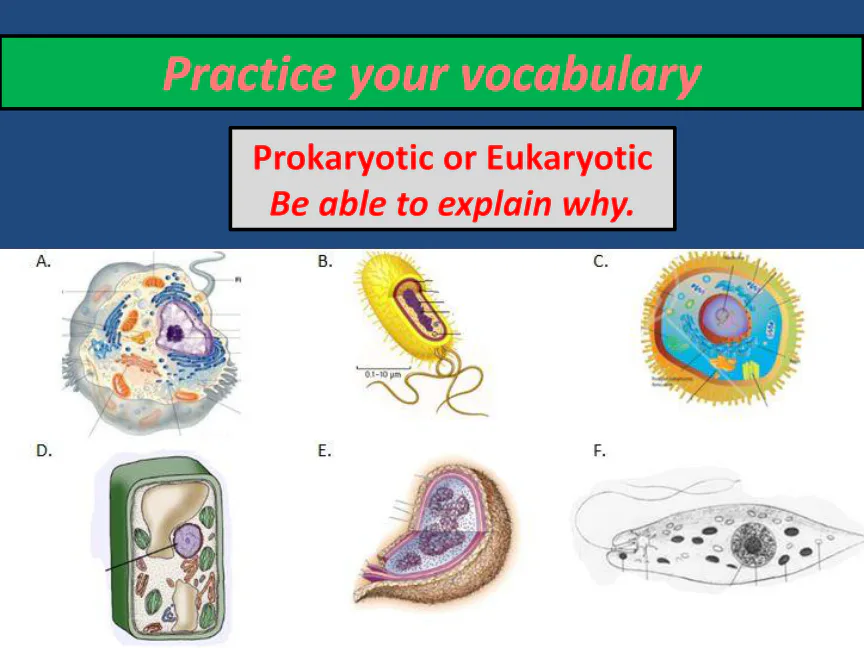
27

28

29

30

31

32
Multiple Choice
Which of the following is a key difference between prokaryotic and eukaryotic cells as shown in the diagrams?
Eukaryotic cells have a nucleus, prokaryotic cells do not.
Prokaryotic cells have mitochondria, eukaryotic cells do not.
Both cell types have chloroplasts.
Prokaryotic cells have a cell wall, eukaryotic cells do not.
33
Multiple Choice
Which of the following statements best describes a cell?
A cell is the largest structure in living organisms.
A cell is the building block of all life and the smallest structure classified as a complete living organism.
A cell is only found in animals.
A cell cannot exist independently.
34
Fill in the Blanks
According to cell theory, all cells come from other
35
Multiple Choice
Which of the following is NOT a characteristic of prokaryotic cells?
They have a nucleus.
They have a cell wall.
They have ribosomes.
They are unicellular.
36
Multiple Choice
Which of the following is a key feature of eukaryotic cells?
They lack a nucleus
They have membrane-bound organelles
They have circular chromosomes
They are always unicellular
37
Fill in the Blanks
Prokaryotic cells have a
38
Multiple Choice
Which of the following statements best explains why multicellular organisms such as plants and animals are classified as eukaryotes?
They have circular DNA in the cytoplasm
They lack membrane-bound organelles
They have membrane-bound organelles and a nucleus
They are always unicellular
39
Multiple Choice
According to the endosymbiotic theory, which organelles in ancestral eukaryotes are believed to have originated from free-living bacteria?
Chloroplast and mitochondria
Nucleus and ribosome
Golgi apparatus and lysosome
Endoplasmic reticulum and peroxisome
Show answer
Auto Play
Slide 1 / 39
SLIDE
Similar Resources on Wayground

38 questions
Chemical Reactions - Types of Reactions
Presentation
•
9th - 12th Grade
34 questions
Unit 2- Rocks and Minerals
Presentation
•
9th - 12th Grade
30 questions
Unit 2.6: Fossil Fuels
Presentation
•
9th - 12th Grade
35 questions
Nuclear fission vs fusion
Presentation
•
9th - 12th Grade
35 questions
Regulating the Cell Cycle + Cancer (part 3)
Presentation
•
9th - 12th Grade
Popular Resources on Wayground
10 questions
Safety Day 2026 – Student Review

Quiz
•
9th Grade
21 questions
Continents and Oceans
Quiz
•
6th Grade
20 questions
Parts of Speech
Quiz
•
5th Grade
16 questions
Subject & Predicate
Quiz
•
5th Grade
25 questions
Multiplication Facts
Quiz
•
5th Grade
12 questions
Map Skills
Quiz
•
3rd Grade
22 questions
Continents and Oceans
Quiz
•
5th Grade
15 questions
Rounding Decimals
Quiz
•
5th Grade
Discover more resources for Science
10 questions
Exploring Chemical and Physical Changes

Interactive video
•
6th - 10th Grade
20 questions
Atomic Structure
Quiz
•
9th Grade
10 questions
Exploring the Electromagnetic Spectrum for Middle School Science
Interactive video
•
6th - 10th Grade
10 questions
Exploring Force and Motion Concepts
Interactive video
•
6th - 10th Grade
10 questions
Exploring Air Masses and Weather Fronts
Interactive video
•
6th - 10th Grade
14 questions
Periodic Trends
Interactive video
•
11th Grade
10 questions
Exploring the States of Matter
Interactive video
•
6th - 10th Grade
10 questions
Exploring Forces: Net Force, Normal Force, Gravity, and Friction
Interactive video
•
6th - 10th Grade