
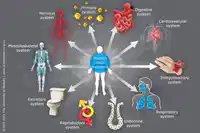
Unit 9 Review: Body Systems
Presentation
•
Science
•
9th Grade
•
Easy
Standards-aligned
Jeanne Mason-Howerton
Used 1+ times
FREE Resource
31 Slides • 7 Questions
1
2
3
4
5
6
7
8
9
10
11
12
13
14
15
16
17
18
19
20
21
22
23
24
25
26
27
28
29
30
31
32
Multiple Choice
What 2 systems: Absorb and deliver the digested nutrients to the cells
Digestive and muscular
Muscular and lymphatic
Digestive and circulatory
Nervous and skeletal
33
Multiple Choice
What 2 systems: Transports white blood cells throughout the body to fight disease
Excretory and nervous
Circulatory and immune
Respiratory and nervous
Digestive and immune
34
Multiple Choice
What 2 systems: Allow organs to contract and push food through
Muscular and Skeletal
Excretory and Muscular
Endocrine and Muscular
Muscular and Digestive
35
Multiple Choice
What 2 systems: Controls body temperature (sweating, goose bumps)
Integumentary and Immune
Circulatory and Immune
Skeletal and Integumentary
Integumentary and nervous
36
Multiple Choice
37
Multiple Choice
How do the circulatory system and immune system work together to respond to an injury?
Increased blood flow kills healthy cells which prevents infection at the site of the injury.
Increased blood flow removes infected cells from the body at the site of the injury.
Increased blood flow carries white blood cells to the site of the injury.
Increased blood flow allows for an increase in the exchange of O2 and CO2 at the site of the injury.
38
Multiple Choice
The picture shows bean-shaped glands called nodes. The clusters of cells in nodes include macrophages that break down viruses and other potentially harmful materials. Nodes also contain cells that produce protein particles capable of capturing harmful materials that flow in tissue fluid through the nodes. Different parts of the body are drained by nodes in different regions of the body.
Which body systems are directly responsible for regulating these nodes and protecting the body from harmful materials in tissue fluid?
Immune and lymphatic systems
Digestive and nervous system
Endocrine and digestive systems
Circulatory and nervous systems
Show answer
Auto Play
Slide 1 / 38
SLIDE

Similar Resources on Wayground
31 questions
Properties of Matter
Presentation
•
9th Grade
32 questions
Fossil Record
Presentation
•
8th Grade
34 questions
Atomic structure
Presentation
•
8th Grade
32 questions
Atoms and Elements
Presentation
•
9th Grade
31 questions
Life Cycle of a Star
Presentation
•
8th Grade
33 questions
The Rock Cycle
Presentation
•
9th Grade
34 questions
Motion Graphs
Presentation
•
9th Grade
32 questions
Big Bang Theory
Presentation
•
9th Grade
Popular Resources on Wayground
10 questions
Safety Day 2026 – Student Review
Quiz
•
9th Grade
21 questions
Continents and Oceans
Quiz
•
6th Grade
20 questions
Parts of Speech
Quiz
•
5th Grade
16 questions
Subject & Predicate
Quiz
•
5th Grade
25 questions
Multiplication Facts
Quiz
•
5th Grade
12 questions
Map Skills
Quiz
•
3rd Grade
22 questions
Continents and Oceans
Quiz
•
5th Grade
15 questions
Rounding Decimals
Quiz
•
5th Grade
Discover more resources for Science
10 questions
Exploring Chemical and Physical Changes
Interactive video
•
6th - 10th Grade
20 questions
Atomic Structure
Quiz
•
9th Grade
10 questions
Exploring the Electromagnetic Spectrum for Middle School Science
Interactive video
•
6th - 10th Grade
10 questions
Exploring Force and Motion Concepts
Interactive video
•
6th - 10th Grade
10 questions
Exploring Air Masses and Weather Fronts
Interactive video
•
6th - 10th Grade
10 questions
Exploring the States of Matter
Interactive video
•
6th - 10th Grade
10 questions
Exploring Forces: Net Force, Normal Force, Gravity, and Friction
Interactive video
•
6th - 10th Grade
10 questions
Differentiating Thermal Energy and Temperature
Interactive video
•
6th - 10th Grade