

Density & the Speed of Sound

Presentation
•
Science
•
6th - 8th Grade
•
Practice Problem
•
Medium

Stephanie Artis
Used 6+ times
FREE Resource
11 Slides • 3 Questions
1
Imagine you have to get across a stream by jumping from rock to rock to get to the other side. If the width of the streams below is equal,
In which situation would it be easier/quicker for you to get across?
Why?
How the medium affects the speed of wave


2
Recall that a medium can be a solid, liquid, or a gas.
In which medium, to you think a mechanical wave travels fastest?
A wave travels more quickly through denser materials, so it travels faster through solids, than it would through a liquid or gas.
**The more tightly packed the particles, the greater the density.

3
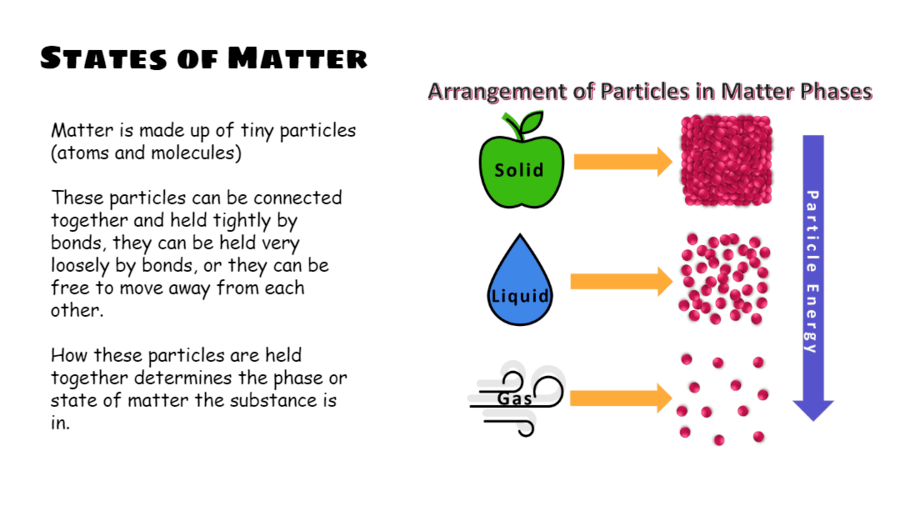
States of Matter
Particle arrangement and motion
4
5
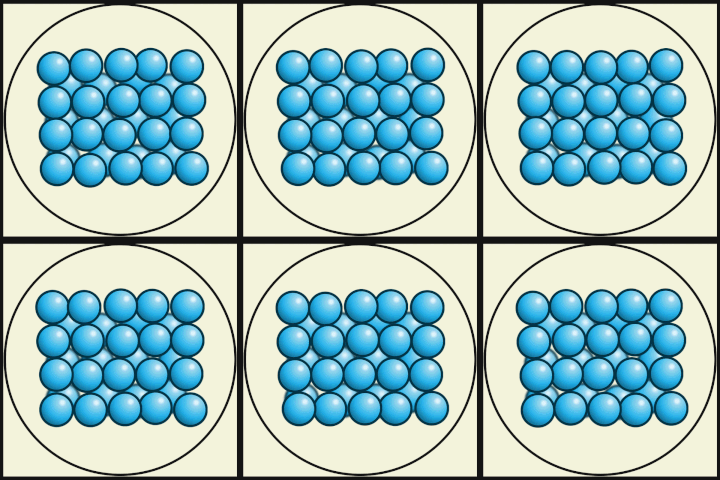
In a solid, particles are packed tightly together so they don't move much, but are dense. The electrons of each particle are constantly in motion, giving the atoms a small vibration, but they are fixed in their position.
Solids have a definite shape, as well as mass and volume, and do not conform to the shape of the container in which they are placed.
6
In a liquid, the particles are more loosely packed than in a solid, but closely enough that it is not easily compressible.
The particles are able to flow around each other, giving the liquid an indefinite shape. Therefore, the liquid will conform to the shape of its container.

7
In a gas, the particles have a great deal of space between them, so they move easily, and have high kinetic energy (energy of movement).

8
Multiple Choice
In which medium does sound (mechanical wave) travel slowest?
solid
liquid
gas
9
Sound waves travels slowest in a gas.
Rationale: In a gas, the particles are spread out far apart so it doesn't have as many particles to support it as it does in a solid (tightly packed particles) or a liquid (looser particles).
10
Multiple Choice

The table to the left shows the speed of sound in 6 materials. Which substance has the greatest density?
air
aluminum
steel
water
11
Rationale:
The chart shows the speed that sound travels in the 6 substances.
If I know that sound travels fastest in denser materials, then I know that the material with the fastest speed must have the greatest density.

12
Multiple Choice

According to the chart, how does the speed of sound in water compare to the speed of sound in air?
The speed of sound is slower in water because the molecules in water are closer to each other and more dense.
The speed of sound is slower in water because the molecules in water are closer to each other and less dense.
The speed of sound is faster in water because the molecules in water are closer to each other and less dense.
The speed of sound is faster in water because because the molecules in water are closer to each other and more dense.
13

According to the chart, the speed of sound in water (1498m/s) is faster than the speed of sound in air (343m/s), so you can rule out any choices that say the speed of sound in water is slower than in air. **Rule out the 1st 2 in this example.

Rule out!
**explanation above
Rule out!
**explanation above
Speed of sound faster- true
False part- water molecules are more dense- not less.
Closer particles means more dense.
Faster in water.- Y
molecules closer- Y
more dense- Y
Correct
14
Sound Waves (Mechanical Waves)
Sound waves are mechanical waves, meaning they need a medium to travel. The more tightly packed the particles of the medium are (more dense), the faster the wave can travel.
**If sound is traveling though the air (a gas), it will slow down when it hits water (a liquid). This causes the sound wave to refract. (bend)
Imagine you have to get across a stream by jumping from rock to rock to get to the other side. If the width of the streams below is equal,
In which situation would it be easier/quicker for you to get across?
Why?
How the medium affects the speed of wave
Show answer
Auto Play
Slide 1 / 14
SLIDE
Similar Resources on Wayground

10 questions
Energy Review
Presentation
•
6th - 8th Grade
11 questions
Subatomic Particles
Presentation
•
6th - 8th Grade
11 questions
Potential and Kinetic Energy
Presentation
•
6th - 8th Grade
13 questions
5.1: Forms of Energy
Presentation
•
6th - 8th Grade
10 questions
Solubility
Presentation
•
5th - 8th Grade
10 questions
EGG LAB
Presentation
•
6th - 8th Grade
11 questions
Layers Of Earth
Presentation
•
6th - 8th Grade
10 questions
Adding Rational Numbers
Presentation
•
6th - 8th Grade
Popular Resources on Wayground
10 questions
Safety Day 2026 – Student Review

Quiz
•
9th Grade
21 questions
Continents and Oceans
Quiz
•
6th Grade
20 questions
Parts of Speech
Quiz
•
5th Grade
16 questions
Subject & Predicate
Quiz
•
5th Grade
25 questions
Multiplication Facts
Quiz
•
5th Grade
12 questions
Map Skills
Quiz
•
3rd Grade
22 questions
Continents and Oceans
Quiz
•
5th Grade
15 questions
Rounding Decimals
Quiz
•
5th Grade
Discover more resources for Science
20 questions
Newton's Laws of Motion
Quiz
•
8th Grade
20 questions
Elements, compounds, and mixtures
Quiz
•
6th Grade
10 questions
6.6D - Relative Density Review
Quiz
•
6th Grade
15 questions
potential and kinetic energy
Quiz
•
8th Grade
21 questions
Newton's Laws of Motion
Quiz
•
8th Grade
20 questions
Elements, Compounds and Mixtures
Quiz
•
8th Grade
10 questions
Exploring Chemical and Physical Changes

Interactive video
•
6th - 10th Grade
20 questions
CONDUCTION,CONVECTION AND RADIATION
Quiz
•
6th Grade