- Resource Library
- Science
- Earth & Space Science
- Carbon Cycle
- Law Of Conservation Of Energy And Carbon Cycle
Law of Conservation of Energy and Carbon Cycle
Presentation
•
Science
•
6th - 9th Grade
•
Hard

Joseph Anderson
FREE Resource
7 Slides • 11 Questions
1
​
2
Multiple Choice
This process takes Carbohydrates (sugars and starch) and converts into Energy and Carbon Dioxide
Photosynthesis
Cellular Respiration
Combustion
Decomposition
3
Multiple Choice
This process takes Carbon Dioxide and converts into Carbohydrates and Oxygen
Photosynthesis
Cellular Respiration
Combustion
Decomposition
4
5
6
7
Multiple Choice
This process requires fungi or bacteria to break down dead organic matter (biomass) back into the soil/sediment or atmosphere by releasing solid Carbon, Carbon Dioxide, and Methane
Photosynthesis
Cellular Respiration
Combustion
Decomposition
8
Multiple Choice
What are fossil fuels made from?
Plants and animals that are buried underground for millions of years.
They absorb it from the atmosphere.
Water
Wind
9
10
11
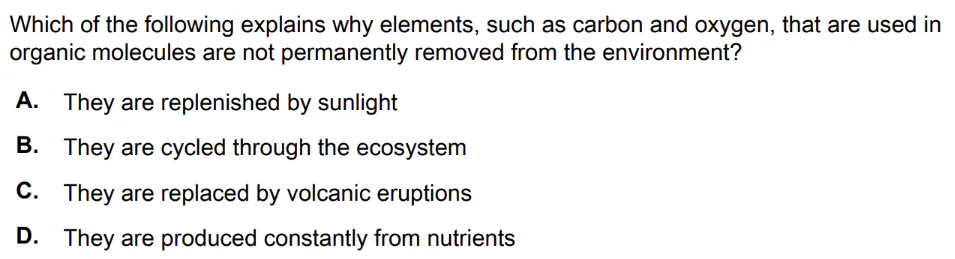
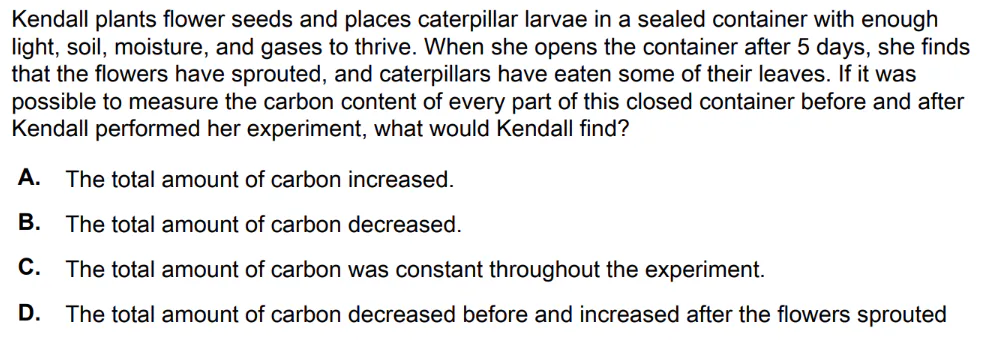
This is the scientific principle that matter is neither created or destroyed during a chemical change. Basically, what you start with, you have to end with. That is why atoms have to be equal on both sides of the equation.
12
Multiple Choice
Carbon dioxide is created by
Burning fossil fuels
Cellular respiration
Decomposing organic matter
All answers are correct
13
Multiple Choice
The Law of Conservation of Energy states:
Energy can created or destroyed but not transformed
Energy cannot be created or destroyed, it can only transformed
Energy can't be created, destroyed or transformed
Energy cannot be created or destroyed.
14
Multiple Choice
What organisms use cellular respiration to get the energy stored in food?
Animals
Plants
Neither animals nor plants
Both animals and plants
15
Multiple Choice
The law of conservation of energy says the total energy before the change _______ the total energy after it
is less than
is more than
affects
equals
16
Multiple Choice
a
b
c
d
17
Multiple Choice
a
b
c
d
18
Multiple Choice
a
b
c
d
​
Show answer
Auto Play
Slide 1 / 18
SLIDE

Similar Resources on Wayground
12 questions
Types of Heat Transfer
Presentation
•
6th - 8th Grade
12 questions
Motors
Presentation
•
6th - 8th Grade
16 questions
HMH PS U3L4E2 analyzing the structure of matter
Presentation
•
6th - 8th Grade
12 questions
Scientific Method
Presentation
•
6th - 8th Grade
14 questions
The Basics of Electricity
Presentation
•
6th - 8th Grade
14 questions
What is happening to food not eaten?
Presentation
•
6th - 8th Grade
13 questions
Body Organization - 2
Presentation
•
6th - 8th Grade
13 questions
Law of Conservation of Mass
Presentation
•
6th - 8th Grade
Popular Resources on Wayground
10 questions
Safety Day 2026 – Student Review
Quiz
•
9th Grade
21 questions
Continents and Oceans
Quiz
•
6th Grade
20 questions
Parts of Speech
Quiz
•
5th Grade
16 questions
Subject & Predicate
Quiz
•
5th Grade
25 questions
Multiplication Facts
Quiz
•
5th Grade
12 questions
Map Skills
Quiz
•
3rd Grade
22 questions
Continents and Oceans
Quiz
•
5th Grade
15 questions
Rounding Decimals
Quiz
•
5th Grade
Discover more resources for Science
20 questions
Newton's Laws of Motion
Quiz
•
8th Grade
20 questions
Elements, compounds, and mixtures
Quiz
•
6th Grade
10 questions
6.6D - Relative Density Review
Quiz
•
6th Grade
15 questions
potential and kinetic energy
Quiz
•
8th Grade
21 questions
Newton's Laws of Motion
Quiz
•
8th Grade
20 questions
Elements, Compounds and Mixtures
Quiz
•
8th Grade
10 questions
Exploring Chemical and Physical Changes
Interactive video
•
6th - 10th Grade
20 questions
CONDUCTION,CONVECTION AND RADIATION
Quiz
•
6th Grade