

Graphing Arithmetic Sequences

Presentation
•
Mathematics
•
8th - 10th Grade
•
Hard

Joseph Anderson
FREE Resource
10 Slides • 3 Questions
1
arithmetic sequences
recursive and explicit and linear
2

sequences have patterns using the four operations + - x /
3
Linear sequences are like lines with that y=mx+b formula you are all familiar with.
notice the pattern between the
y values, when looking at sequences it is like we are only going to look at the y values. We should assume the x values are constant or rewrite the table to make them constant and in numerical order.

4
here we have the same formula but it is written AN+B.
in sequences we use the letter N to represent what term we are looking at. the first term is when n=1, the second term is when n=2, and so on. think of it like when x=1 on a graph.

5
Look at the first sequence, 8 10 12 14.
remember these are like looking at the Y values. this is like when x=1, y=8. when x=2, y=10 and so on. we see a difference of +2 between y values. that difference is our slope, so we know the formula is y=2x or 2n. but what is our b? when x=0 is how we find B in graphing. we know the pattern, so if we subtract 2 from our first value, 8, that should give us the value of b. y=2x+6 or 2n+6
we now have our formulas.

6
look at the second sequence, 7 11 15 19.
if you are not sure what the pattern is, try subtracting the first term from the second. 11-7=4. then check that +4 works as a common difference between all numbers in the pattern. we see it does and subtracting 4 from the first term will give us b for our formulas. 7-4=3
y=4x+3 or 4n+3
Are you ready to try?

7
Multiple Choice

what is the linear equation of sequence 10 15 20 25 ?
8
Multiple Choice

what is the sequence formula of 8 6 4 2 ?
9

we also have special sequence formulas to learn
10
we call sequences arithmetic when the common difference is adding a constant real number.
We can use these formulas when we want to know a specific term in our sequence. Like what is the 29th term or 105th term. The tiny n represents what term we want or are looking at.

11
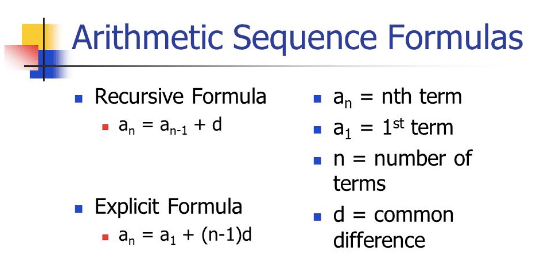
An explicit formula is used when we know the common difference and the first term and we want to know any term in the sequence.
a recursive formula is used when when we want to know what term comes next from the given term.
12
Here is an arithmetic sequence 5 8 11 14.
What term comes next? we can use the recursive formula: An=An-1 + D.
An-1 is 14 and D is 3, so An=14+3=17
17 is the next term.
What is the 10th term? we can use the explicit formula: An=A1+(n-1)D
A1=first term=5 D=3 and the n we want is 10. so A10= 5 +(10 - 1) * 3
A10 = 5 + 9 * 3 = 5 + 27 = 32
the 10th term in the sequence is 32 .
ready to try one?

13
Multiple Choice

what is the 101th term in this sequence of 3 5 7 9 ?
Hint: An=A1+(n-1)d
arithmetic sequences
recursive and explicit and linear
Show answer
Auto Play
Slide 1 / 13
SLIDE

