
Food Chain
Presentation
•
Science
•
5th Grade
•
Hard

Joseph Anderson
FREE Resource
10 Slides • 12 Questions
1
Food Chains & Organisms Lesson & Quiz
2
Materials & Directions
You need your Science Journal, a pencil, and colored pencils.
You will write each definition on the same page as your Food Chain notes.
You will then draw and label an example of a food chain.
You will attach a picture of your notes to this assignment on Google Classroom.
3
REVIEW
The next 2 slides review concepts that you wrote in your Science Journal on Monday.
4
Review:
food chain: a diagram of living things that shows what an organism eats and is eaten by
predator: animals that hunt or eat other animals
prey: animals that are hunted or eaten by other animals
5
Review:
All food chains start with the sun ☀️
The sun is the main source of energy.
The arrows in a food chain show the flow of energy.
6
Key Vocabulary & Diagrams
The next several slides include new vocabulary and a food chain diagram that you need to add on to the notes that you have already started.
7
Key Vocabulary
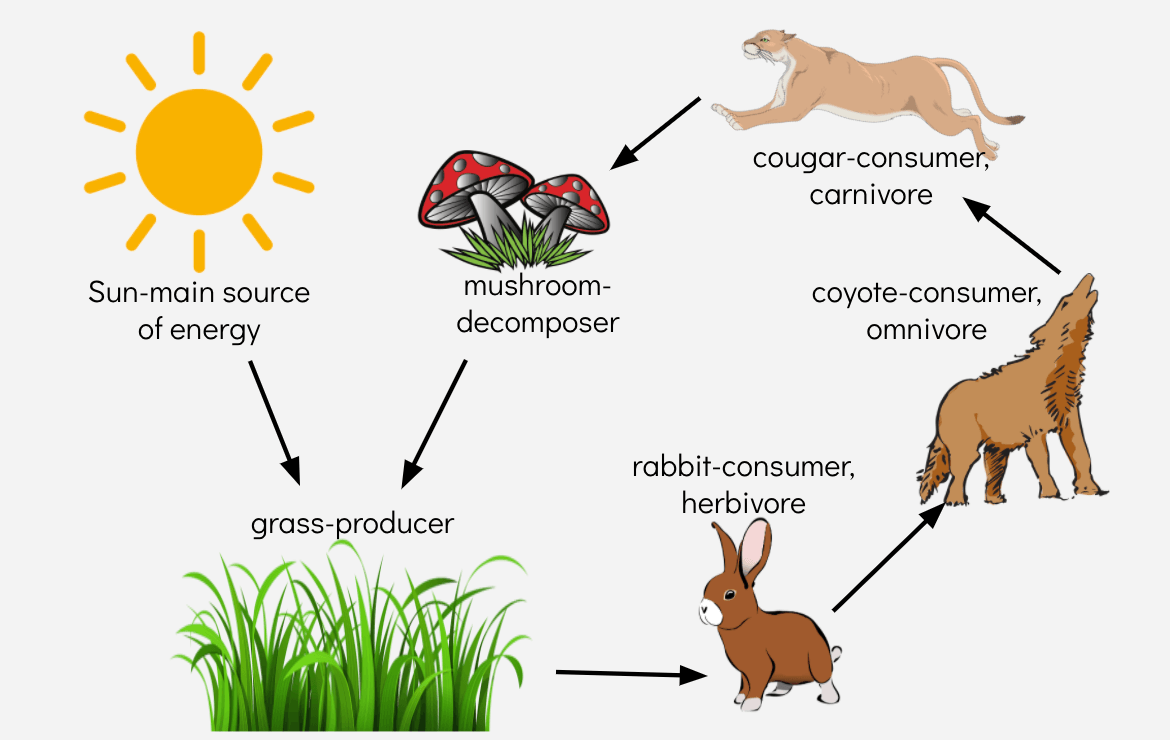
producer: a living thing that takes energy from the sun and makes (produces) its own food (usually a plant)
consumer: a living thing that needs to eat (consume) food to get energy (animals and humans)
decomposer: an organism that breaks down other dead and dying organisms
8
Types of Consumers
herbivore: consumers whose primary food source is producers (plant eaters)
carnivore: consumers whose primary food source is other consumers (meat eaters)
omnivore: consumers that eat both producers and other consumers
9
Food Chain Example
Draw and label each part of the food chain example in your journal (hint-keep your drawings SIMPLE)
10
Quiz Time!
Now, you will test your knowledge on what we have learned this week.
11
Multiple Choice
1. The main source of energy for all life is
producers
consumers
the sun
decomposers
12
Multiple Choice
2. When a millipede breaks down dead and decaying material, it is acting as what?
a producer
a decomposer
a consumer
a predator
13
Multiple Choice
3. A sequoia tree is an example of a
producer
consumer
decomposer
prey
14
Multiple Select
4. Which of the following words describe a deer? Check all that apply.
consumer
producer
herbivore
carnivore
15
Multiple Choice
5. Which organism below is an example of a carnivore?
a zebra
a giraffe
a monkey
a lion
16
Multiple Choice
6. Why are earthworms essential to our environment?
They are producers that use sunlight and water to make their own food.
They are decomposers that eat dead plants and animals and return nutrients back to the soil.
They are consumers that hunt for their food.
Earthworms are not essential to our environment.
17
Multiple Select
7. Which two questions are essential to ask when determining where an organism fits into the food chain? (Select 2 choices)
What does this organism eat?
What are the adaptations of this organism?
Does this organism hibernate?
What eats this organism?
18
Multiple Choice
8. A bear gets its energy from berries and fish. Which type of consumer is this?
an herbivore
a carnivore
an omnivore
A bear is not a consumer.
19
Multiple Choice
9. In a food chain, the arrows point from an organism to the food it eats.
True
False
20
Multiple Select
10. A cheetah stalks an antelope in the grasslands of Africa. In this scenario, what is the cheetah? (check all that apply)
a consumer
a producer
the predator
the prey
21
Multiple Select
11. A snake waits patiently in the brush as a mouse scurries by in search of some berries. In this scenario, what is the mouse? (check all that apply)
a consumer
a producer
the predator
the prey
22
Multiple Choice
12. In Mystery 2, we learned that plants "eat" something that helps them gain weight over time. What do plants "eat" that helps them gain weight?
sunlight
air
soil
insects
Food Chains & Organisms Lesson & Quiz
Show answer
Auto Play
Slide 1 / 22
SLIDE

Similar Resources on Wayground
17 questions
Physical and Chemical Changes Lesson
Presentation
•
5th Grade
18 questions
Dissolving Process (Solvent, Solute and Solution)
Presentation
•
5th Grade
18 questions
Divergent Boundaries
Presentation
•
5th Grade
18 questions
Sound - Vibrations, Frequency, and Pitch
Presentation
•
5th Grade
18 questions
Unicellular vs Multicellular
Presentation
•
5th Grade
19 questions
Earthquakes
Presentation
•
5th Grade
20 questions
5.10B Inherited Vs Learned (Acquired)
Presentation
•
5th Grade
14 questions
Law of superposition
Presentation
•
5th Grade
Popular Resources on Wayground
10 questions
Safety Day 2026 – Student Review
Quiz
•
9th Grade
21 questions
Continents and Oceans
Quiz
•
6th Grade
20 questions
Parts of Speech
Quiz
•
5th Grade
16 questions
Subject & Predicate
Quiz
•
5th Grade
25 questions
Multiplication Facts
Quiz
•
5th Grade
12 questions
Map Skills
Quiz
•
3rd Grade
22 questions
Continents and Oceans
Quiz
•
5th Grade
15 questions
Rounding Decimals
Quiz
•
5th Grade
Discover more resources for Science
20 questions
Mixtures and Solutions Practice
Quiz
•
5th Grade
20 questions
Food Chains and Food Webs Review
Quiz
•
5th Grade
20 questions
GC Interim #1 Review 2026
Quiz
•
5th Grade
20 questions
5.3 Force and Motion Study Guide Review
Quiz
•
5th Grade
15 questions
Force and Motion
Presentation
•
5th Grade
25 questions
Chemical and Physical Changes in Matter
Quiz
•
5th Grade
10 questions
Exploring the Periodic Table Structure
Interactive video
•
5th Grade
14 questions
Land Breeze and Sea Breeze
Quiz
•
5th Grade