

Hardy Weinberg

Presentation
•
Biology
•
9th - 12th Grade
•
Hard

Joseph Anderson
FREE Resource
9 Slides • 31 Questions
1
Multiple Choice
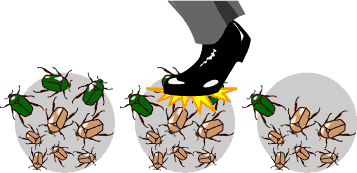
Someone steps on some bugs and randomly removes their alleles from the population. This is an example of
gene flow
genetic drift
speciation
allele frequency
2
Multiple Choice
There are 3 T alleles and 7 t alleles in a population. Calculate the frequency of the recessive allele.
30%
70%
10%
4%
3
Multiple Choice
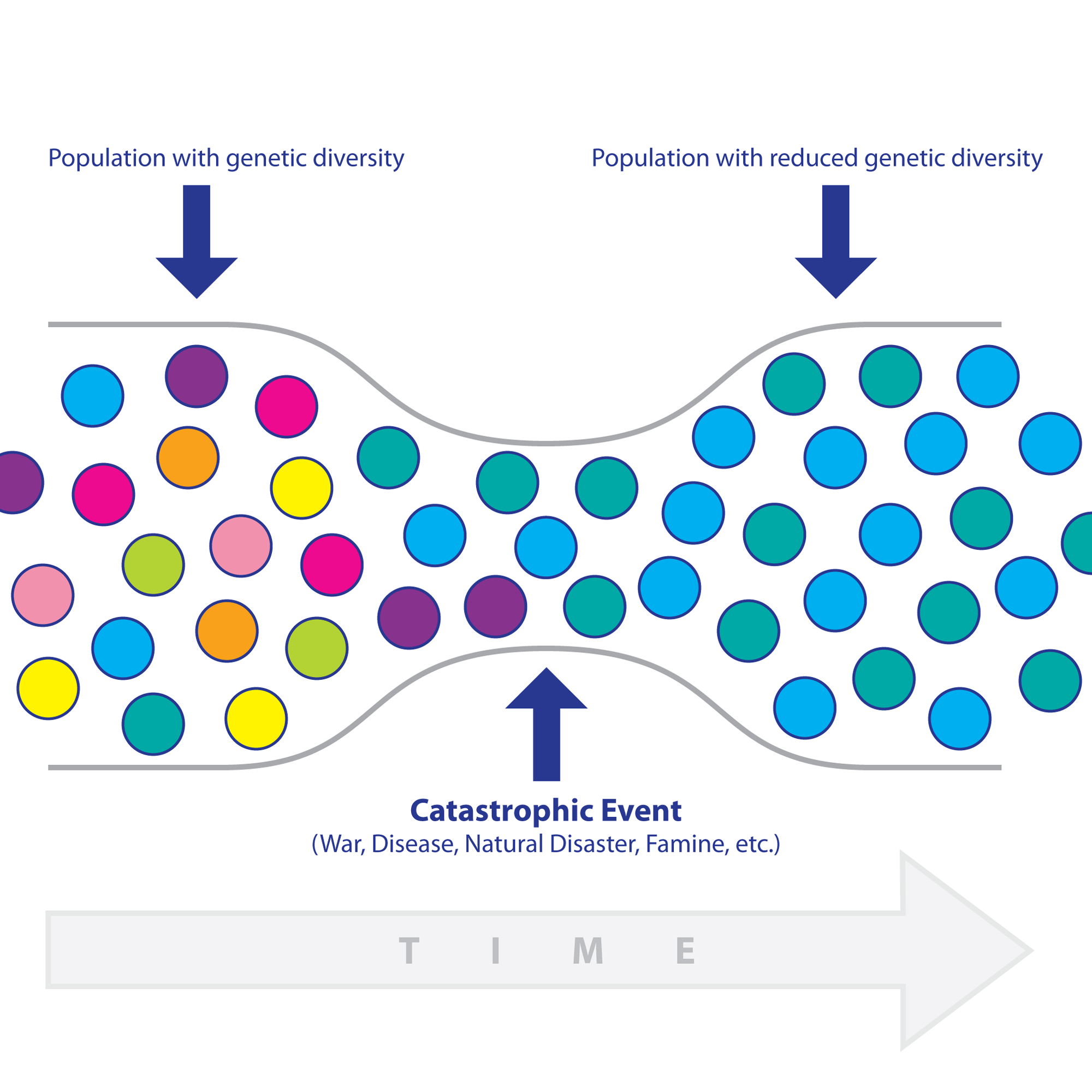
A drastic reduction in the size of a population that can change allele frequencies is called
the bottleneck effect
the founder effect
the gene flow effect
the Thanos effect
4
Multiple Choice
If a population of lizards is isolated on an island, with no new immigrants over many years, any new genetic variations are most likely to come from
recessive alleles
natural selection
mutations
speciation
5
Multiple Choice
The Amish have a higher frequency of polydactyly (extra fingers) in their community than the general population. This is due to the allele for extra fingers being present in the group that started the Amish community.
The difference in allele frequency is due to genetic flow.
The difference in allele frequency is due to the founder effect.
The difference in allele frequency is due to a bottleneck.
The difference in allele frequency is due to speciation.
6
Multiple Choice
An allele combination (BB, Bb, or bb) is called a
phenotype
genotype
mutation
gene flow
7
Multiple Choice
Small populations are more prone to genetic drift than large populations.
True
False
8
Hardy-Weinberg Introduction

9

10

11
Open Ended
Do you think Hardy-Weinberg Equilibrium is realistic? Why or why not?
12

13

Hardy-Weinberg Practice Problem
You have sampled a population in which 36
out of 100 individuals show the homozygous
recessive phenotype (aa).
Find the frequency of the aa genotype.
The frequency of the a allele
The frequency of the A allele
The frequencies of the genotypes AA and Aa
p2 + 2pq + q2 = 1
p + q = 1
p = frequency of A (dominant allele)
q = frequency of a (recessive allele)
p2 = frequency of AA (homozygous
dominant genotype)
2pq = frequency Aa (heterozygous
genotype)
q2 = frequency aa (homozygous recessive
genotype)
14


Punnett Squares - What is the ratio for this heterozygous cross?
In some birds, blue eggshells are dominant to
white eggshells
In this punnett square, p represents the
dominant alleles and q represents the recessive
alleles
15

16
Multiple Choice
p + q = 1. If p represents the dominant allele frequency, what would q represent?
the homozygous dominant genotype frequency
the recessive allele frequency
the total amount of alleles in the population
a measure of fitness in the population
17
Multiple Choice
In the Hardy-Weinberg Equation, p is the frequency of what?
The recessive allele
the dominant allele
the recessive genotype
the dominant genotype
18
Multiple Choice
In the Hardy-Weinberg Equation, q is the frequency of what?
The recessive allele
the dominant allele
the recessive genotype
the dominant genotype
19
Multiple Choice
The recessive allele
the dominant allele
the recessive genotype
the dominant genotype
20
Multiple Choice
In the Hardy-Weinberg Equation, p2 is the frequency of what?
The recessive allele
the dominant allele
the recessive genotype
the dominant genotype
21
Multiple Choice
p + q always equals 1. Which answer choice best explains this?
1 individual could have a dominant or a recessive allele.
The population is in Hardy-Weinberg equilibrium. The 1 indicates that the population has not evolved.
In terms of frequency, 1 is the highest possible number you can have.
In terms of frequency, 1 is the same as 100%. All alleles in a population added up give you 100% of the alleles.
22
Multiple Select
A rather large population of foxes has 555 individuals with tan fur and 390 individuals with red fur. Assume that red is recessive.
What should you try to start with?
p
q
q2
p2
23
Multiple Choice
A rather large population of foxes has 555 individuals with tan fur and 390 individuals with red fur. Assume that red is recessive.
If you started with q2 what do you find next?
p
q
q2
p2
24
Multiple Choice
A rather large population of foxes has 555 individuals with tan fur and 390 individuals with red fur. Assume that red is recessive.
Now that you have q, what should you solve for next?
p
q
q2
p2
25
Open Ended
A rather large population of foxes has 555 individuals with tan fur and 390 individuals with red fur. Assume that red is recessive. Calculate the following:
1. The frequencies of each allele.
2. The frequencies of each genotype.
3. How many foxes are of the heterozygous genotype?
26
Fill in the Blanks
Type answer...
27
Multiple Choice
If the frequency of recessive allele is 0.2, what is the frequency of the homozygous recessive individuals?
0.04
0.16
0.4
0.8
28
Multiple Choice
The allele frequency of p=.20 What is the frequency of the heterozygous genotype?
.80
.04
.32
.64
29
Multiple Choice
The allele frequency of p=.20 What is the frequency of the recessive genotype?
.80
.04
.32
.64
30
Multiple Choice
0.09
0.42
0.49
0.21
31
Fill in the Blanks
Type answer...
32
Fill in the Blanks
Type answer...
33

34
Open Ended
Why does it make sense that the frequency of the homozygous dominant genotype is p2?
35
Open Ended
In your notes, complete a Punnett Square for 2 parents with the genotype pq. How do the results support the Hardy-Weinberg equation? (p2 + 2pq + q2 = 1)
36
Multiple Choice

Which values can be plugged into the equation? p + q = 1
0.6 and 0.16
0.6 and 0.4
0.4 and 0.16
0.48 and 0.36
37
Fill in the Blanks
Type answer...
38
Multiple Choice
If 0.49 + 0.42 + 0.09 = 1 (p2 + 2pq + q2 = 1), what is the value for p?
0.09
0.07
0.7
0.9
39
Open Ended
p2 + 2pq + 0.81 = 1 Find the missing values (p2 and 2pq)
40


Hardy-Weinberg Example Problem
In a population of 1000 chickens, 840 hens lay blue eggs and
160 hens lay white eggs. Use the equation p2 + 2pq + q2 = 1 to
determine the predicted genotypic frequencies for this
population.
Variables
p = frequency of O (dominant allele, blue shell)
q = frequency of o (recessive allele, white shell)
p2 = frequency of chickens with OO (homozygous
dominant genotype)
2pq = frequency of chickens Oo (heterozygous genotype)
q2 = frequency of chickens with oo (homozygous
recessive genotype)
Someone steps on some bugs and randomly removes their alleles from the population. This is an example of
gene flow
genetic drift
speciation
allele frequency
Show answer
Auto Play
Slide 1 / 40
MULTIPLE CHOICE
Similar Resources on Wayground

35 questions
The Scientific Method Notes Check
Presentation
•
9th - 12th Grade
36 questions
Conjugaciones -ar, -er, -ir
Presentation
•
9th - 12th Grade
34 questions
Biology Tutorials DNA and Genetics Part 2
Presentation
•
9th - 12th Grade
38 questions
Cellular Transport
Presentation
•
8th - 12th Grade
33 questions
Solutions
Presentation
•
9th - 12th Grade
34 questions
Quizizz: Translation
Presentation
•
9th - 12th Grade
35 questions
Biomolecule terms Part 1
Presentation
•
9th - 12th Grade
Popular Resources on Wayground
24 questions
PBIS-HGMS Day 10

Quiz
•
6th - 8th Grade
10 questions
HCS SCI 03 Summer School Review 3
Quiz
•
3rd Grade
11 questions
Home Scope
Quiz
•
7th - 8th Grade
15 questions
HCS SCI 05 Summer School Assessment 3 Review
Quiz
•
5th Grade
35 questions
Lufkin Road Middle School Student Handbook & Policies Assessment
Quiz
•
7th Grade
18 questions
Geo 11.3 Area of Circles and Sectors
Quiz
•
9th - 11th Grade