Keplers Laws
Presentation
•
Science
•
9th - 12th Grade
•
Easy
+2
Standards-aligned
Tim Gault
Used 16+ times
FREE Resource
17 Slides • 7 Questions
1
Kepler's Laws
2
3
Learning Objectives
Describe the roles of gravity and tangential velocity in maintaining a planetary orbit.
Explain Kepler's three laws of planetary motion.
Define key orbital terms including ellipse, perihelion, and aphelion.
Relate a planet's orbital speed and period to its distance from the Sun.
4
5
Key Vocabulary
Gravity
The force that pulls objects together and keeps planets in their orbits around the Sun.
Ellipse
An oval shape with two focal points, representing the true path of a planet's orbit around the Sun.
Perihelion
The point in a planet's orbit where it is closest to the Sun, moving at its fastest speed.
Aphelion
The point in a planet's orbit where it is farthest from the Sun, moving at its slowest speed.
Orbital Period
The time it takes for a planet to complete one full orbit around the Sun, also known as its year.
6
What Keeps a Planet in Orbit?
Gravity acts as the centripetal force, pulling a planet toward the Sun.
The planet's tangential velocity keeps it moving forward along its orbital path.
Gravity's strength depends on objects' mass and the distance between them.
A gravity well illustrates how massive objects have stronger gravitational pulls.
7
Planets orbit the sun in an elliptical path.
First Law
8

Kepler’s Laws of Orbital Motion | How Things Fly
You can open this webpage in a new tab.
9
Multiple Choice
What does Kepler's 1st Law state?
all planets move in elliptical shaped orbits around the sun
all ellipses have one foci
the area that a planet revolves around the sun is equal
the speed that a planet revolves around the sun changes
10
Planets move faster when they are closer to the Sun and slower when they are farther away.
Second Law
11

Kepler’s Laws of Orbital Motion | How Things Fly
You can open this webpage in a new tab.
12
Kepler's Second Law
13
This law provides a relationship between the distance of a planet from the Sun and the time it takes to complete one orbit. Planets that are farther from the Sun have longer orbital periods.
Third Law
14

Kepler’s Laws of Orbital Motion | How Things Fly
You can open this webpage in a new tab.
15
Keplers Third Law
16
17
On your own, answer the remaining 6 Questions.
18
Multiple Choice
When do gravitational forces exist between two objects?
They only exist between microscopic objects.
They are always present between any two objects.
Gravitational forces only act on objects falling on Earth.
They only exist for objects in space.
19
Multiple Choice
What effect does increasing the distance between the two objects do to the gravitational force?
The distance between two objects has no effect on the gravitational force
It increases
It stays the same
It decreases
20
Multiple Choice
21
Multiple Choice
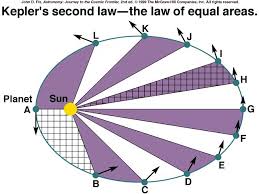
Where is the planet moving faster?
22
Multiple Choice
Based on the table, which planet in our solar system will have the fastest orbital speed?
Venus
Earth
Saturn
Mercury
23
Multiple Choice
You discover a new planet in our solar system. You measure it's orbital period to be 246 years.
Where is this planet likely to be located based on this information?
Closer to the Sun than Mercury.
Located between Earth and Jupiter.
Located between Uranus and Neptune.
Located beyond Neptune.
24
Kepler's Laws
Show answer
Auto Play
Slide 1 / 24
SLIDE

Similar Resources on Wayground
20 questions
Open SciEd Biology Lesson 4 Clover Genetics and Environment
Presentation
•
9th - 12th Grade
19 questions
Watersheds & Aquifers
Presentation
•
10th - 12th Grade
17 questions
Sedimentary Environments Near Shorelines
Presentation
•
9th - 12th Grade
19 questions
Structure of Atom
Presentation
•
9th - 12th Grade
18 questions
Cell Structures/Organelles
Presentation
•
9th - 12th Grade
21 questions
The Great Pacific Garbage Patch
Presentation
•
9th - 12th Grade
20 questions
Skeletal System: Joints
Presentation
•
9th - 12th Grade
20 questions
Momentum
Presentation
•
9th - 11th Grade
Popular Resources on Wayground
24 questions
PBIS-HGMS Day 10
Quiz
•
6th - 8th Grade
10 questions
HCS SCI 03 Summer School Review 3
Quiz
•
3rd Grade
11 questions
Home Scope
Quiz
•
7th - 8th Grade
15 questions
HCS SCI 05 Summer School Assessment 3 Review
Quiz
•
5th Grade
35 questions
Lufkin Road Middle School Student Handbook & Policies Assessment
Quiz
•
7th Grade
18 questions
Geo 11.3 Area of Circles and Sectors
Quiz
•
9th - 11th Grade