B.4.2 Lesson 4 Thermodynamic Processes
Presentation
•
Physics
•
11th Grade
•
Medium
Lester Orellana
Used 2+ times
FREE Resource
4 Slides • 33 Questions
1
Multiple Choice
2
3
Multiple Choice
4
Multiple Choice
Process B on the PV diagram is an ______________ process.
adiabatic
isobaric
isochoric
isothermal
5
Multiple Choice
A thermodynamic system where no exchange of heat takes place between system and surrounding is...
Isothermal process
Adiabatic process
Isobaric process
Isochoric process
6
Multiple Choice
7
Multiple Choice
8
Multiple Choice
A thermodynamic system where no exchange of heat takes place between system and surrounding is...
Isothermal process
Adiabatic process
Isobaric process
Isochoric process
9
Multiple Choice
Heating a closed, steel container is an example of an
Adiabatic process
Isovolumetric process
Isothermal process
Isobaric process
10
Multiple Choice
For an isovolumetric process, which of the following statements is correct?
a. Work, heat, and internal energy all undergo changes.
b. Work and heat balance each other, so that there is no change in internal energy.
c. No energy is transferred as heat; internal energy change is due to work.
d. No work is done; internal energy change is due to heat.
11
Multiple Choice
Symbol that indicates that energy is released.
U
Q
-Q
W
12
Multiple Choice
In an adiabatic process, what equals zero?
Q
W
ΔU
T
13
Multiple Choice
Pistons moving in a car is an example of an adiabatic process
True
False
14
Multiple Choice
In Isothermal process which property remains constant
Volume
Pressure
Concentration
Temperature
15
Multiple Choice
What is the name of the process in which pressure remains constant.
Isochoric process
Adiabatic process
Isobaric process
Isolated process
16
Multiple Choice
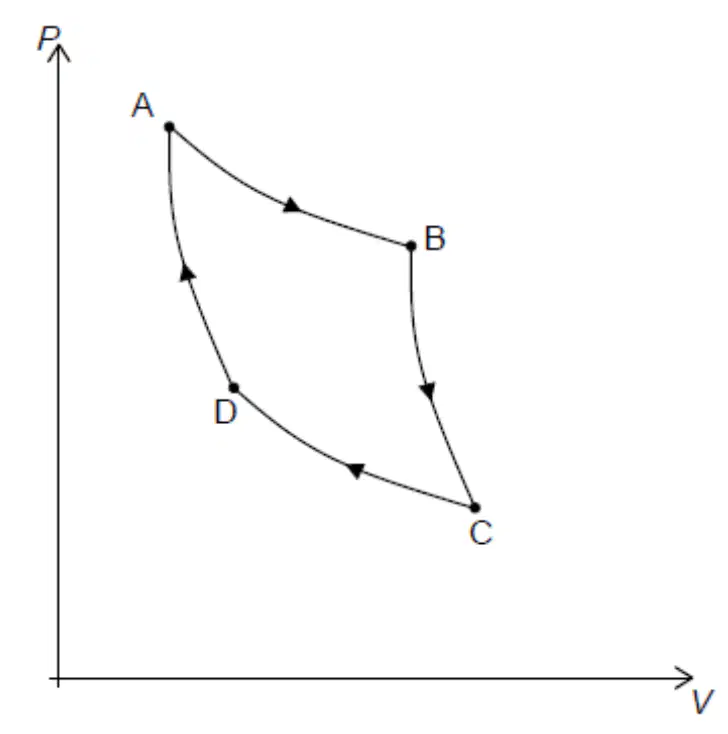
The picture represents a Carnot Cycle.
what type of process is A-B
Isothermal Expansion
Isothermal Compression
Adiabatic Expansion
Adiabatic Compression
17
Multiple Choice
The picture represents a Carnot Cycle.
what type of process is B-C
Isothermal Expansion
Isothermal Compression
Adiabatic Expansion
Adiabatic Compression
18
Multiple Choice
The picture represents a Carnot Cycle.
what type of process is C-D
Isothermal Expansion
Isothermal Compression
Adiabatic Expansion
Adiabatic Compression
19
Multiple Choice
The picture represents a Carnot Cycle.
what type of process is D-A
Isothermal Expansion
Isothermal Compression
Adiabatic Expansion
Adiabatic Compression
20
Multiple Choice
The picture represents a Carnot Cycle.
Which process keeps the same temperature but compresses the volume.
A-B
B-C
C-D
D-A
21
Multiple Choice
The picture represents a Carnot Cycle.
Which process represents partially the 1st Law of
Thermodynamic –Q=–∆V.
A-B
B-C
C-D
D-A
22
Multiple Choice
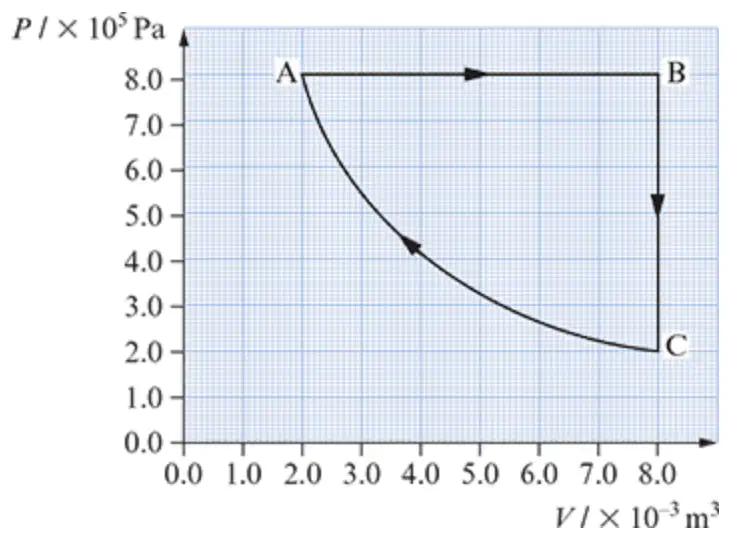
Which process is isobaric?
A-B
B-C
C-A
None
23
Multiple Choice
Which process shows +W?
A-B
B-C
C-A
None
24
Multiple Choice
Which process shows +∆V?
A-B
B-C
C-A
None
25
Multiple Choice
Which process shows ∆U=0?
A-B
B-C
C-A
None
26
Multiple Choice
Which process shows ∆Ek gas=0?
A-B
B-C
C-A
None
27
Multiple Choice
Which process shows –∆V?
A-B
B-C
C-A
None
28
Multiple Choice
Which process shows TB=TC?
A-B
B-C
C-A
None
29
Multiple Choice
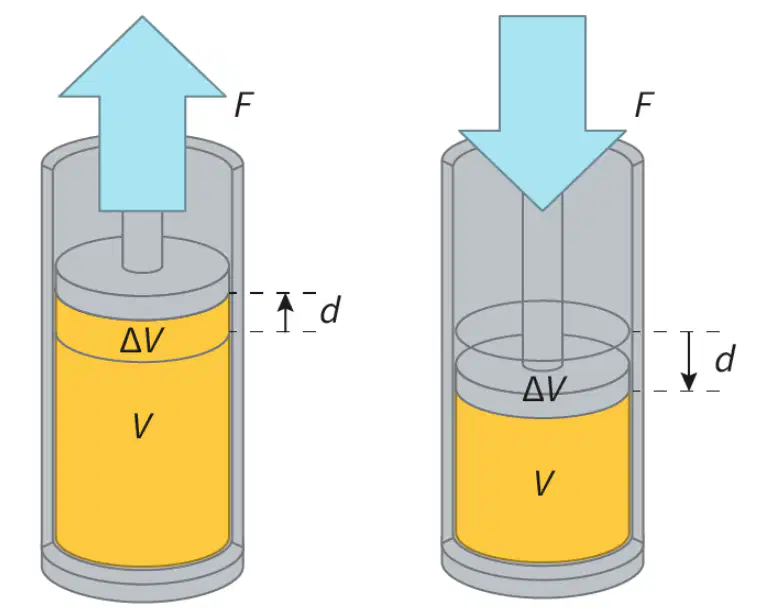
Isolated system.
The picture on the left represents:
Negative work by the gas inside the cylinder
Positive work by the gas inside of cylinder
Positive work by the surroundings.
30
Multiple Choice
Isolated System.
The picture on the left represents:
+∆V
+W
+∆P
–∆V
–∆P
31
Multiple Choice
Isolated System.
The picture on the right represents that the work is done on the gas:
+W
+∆P
–W
–∆P
32
Multiple Choice
What best describes an adiabatic process?
Heat exchange occurs with the surroundings
Heat exchange occurs within the system
No heat exchange occurs with the surroundings
No work is performed by the system
33
Explanation Slide...
An adiabatic process is one where there is no heat exchange between the system and its surroundings. This means that no heat enters or leaves the system during the process.
34
Multiple Choice
In an adiabatic expansion of an ideal gas, what happens to the temperature?
Increases
Decreases
Remains constant
None
35
Explanation Slide...
During an adiabatic expansion, the gas expands without any heat being added or removed. As the gas does work on the surroundings, it loses internal energy, leading to a decrease in temperature.
36
Multiple Choice
Which of the following processes is most likely to approximate an adiabatic process?
A well-insulated gas cylinder expanding quickly
A gas cylinder with controlled heat exchange
A gas cylinder expanding slowly with constant heat addition
A gas cylinder in contact with an ice bath
37
Explanation Slide...
A well-insulated gas cylinder expanding quickly is more likely to approximate an adiabatic process because the insulation prevents heat exchange, and the rapid expansion reduces the time available for heat transfer.
Show answer
Auto Play
Slide 1 / 37
MULTIPLE CHOICE

Similar Resources on Wayground
34 questions
Unit 1 Concept 1 Notes - Describing Motion
Presentation
•
11th Grade
34 questions
World War II: The Homefront
Presentation
•
10th - 11th Grade
32 questions
Circle Vocabulary & Central Angles
Presentation
•
11th Grade
27 questions
CAPTION CHAPTER 2
Presentation
•
11th Grade
29 questions
The Korean War
Presentation
•
11th - 12th Grade
32 questions
G11L4.3
Presentation
•
11th Grade
29 questions
Momentum Impulse
Presentation
•
11th - 12th Grade
31 questions
Intro to the Mole and Molar Mass
Presentation
•
10th - 11th Grade
Popular Resources on Wayground
24 questions
PBIS-HGMS Day 10
Quiz
•
6th - 8th Grade
10 questions
HCS SCI 03 Summer School Review 3
Quiz
•
3rd Grade
11 questions
Home Scope
Quiz
•
7th - 8th Grade
15 questions
HCS SCI 05 Summer School Assessment 3 Review
Quiz
•
5th Grade
35 questions
Lufkin Road Middle School Student Handbook & Policies Assessment
Quiz
•
7th Grade
18 questions
Geo 11.3 Area of Circles and Sectors
Quiz
•
9th - 11th Grade