

Protein Synthesis: Transcription and Translation

Presentation
•
Science
•
9th - 12th Grade
•
Medium
+6
Standards-aligned

Adrienne Aguilar
Used 15+ times
FREE Resource
16 Slides • 20 Questions
1
2
Describe the functions and types of RNA
Describe the basic processes of transcription and translation and the role of enzymes in producing proteins.
3
Multiple Choice
What macromolecule is made up of C,H,O,N?
Carbohydrates
Lipids
Proteins
Nucleic acids
4
Multiple Choice
Which of the following is the monomer for proteins?
Amio Acids
Nucleic Acids
mRNA
tRNA
5
Multiple Choice
What are the 3 parts of the nucleotide?
6
Labeling
Label the nucleotide.
Sugar
Phosphate group
Nitrogen Base
7
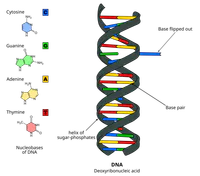
§Nucleic Acid
§Double Stranded
§Double Helix Shaped
§Deoxyribose (sugar in nucleotide)
§Nitrogen Bases:
§A, T, G, C (remember, T is specific to DNA)
§Replicates and stores genetic information
§Found in nucleus of eukaryotes
8
§Nucleic Acid
§Single Stranded
§Ribose (sugar in nucleotide)
§Nitrogen Bases:
§A, U, G, C (U is specific to RNA)
§Transfers genetic information from DNA into a format used to build proteins
§Moves from nucleus to cytoplasm

9
Multiple Choice
10
Multiple Choice
11
3 Types of RNA
1. Messenger RNA (mRNA)
RNA that carries genetic code from nucleus to ribosomes
2. Ribosomal RNA (rRNA)
RNA that is in ribosomes to help assemble proteins
3. Transfer RNA (tRNA)
RNA that carries amino acids to ribosomes to build proteins
12
Multiple Choice
What brings the amino acids to the ribosome to assemble a protein?
mRNA
DNA
tRNA
rRNA
13
Multiple Choice
This type of RNA is responsible for copy the DNA and bringing it out of the nucleus.
tRNA
mRNA
rRNA
dRNA
14
Multiple Choice
Which organelle contains rRNA and is responsible for reading mRNA in order to synthesize a protein?
mitochondria
chloroplast
ribosome
nucleus
15

16
Genes are instructions for making specific proteins, but they do not build the proteins directly.
The flow of information within a cell goes from DNA to RNA to protein.
The two major steps in this passing of information are transcription and translation.
17
Reorder
Genetic information flows in one direction put the following steps in order
DNA
RNA
Protein
18
What: DNA is used to synthesize(make) mRNA molecule.
Where: Nucleus
Who’s involved: RNA polymerase (enzyme that makes mRNA by matching nucleotides), mRNA, DNA
Why: To build mRNA molecule used to transfer instructions for building protein
What happens afterwards: mRNA goes to a ribosome for Translation.

19
Multiple Choice
What is the location where transcription occurs?
lysosome
cytoplasm
nucleus
chloroplast
20
21

22
Match
Match the base pairs (pay attention to DNA vs RNA)
RNA
U
RNA
A
RNA
C
RNA
G
DNA
A
DNA
T
DNA
G
DNA
C
DNA
A
DNA
T
DNA
G
DNA
C
23
Multiple Choice
Transcribe the following DNA strand: CTG AAT
GAC TTA
CTG AAT
GAC UUA
CUG AAU
24
Multiple Choice
What is the mRNA strand transcribed from the DNA sequence:
DNA: TAC-GGC-AAG
DNA: TAC-GGC-AAG
mRNA: AUG-CCG-UUC
DNA: TAC-GGC-AAG
mRNA: ATG-GGC-TTC
DNA: TAC-GGC-AAG
mRNA: AUC-GGC-AAG
DNA: TAC-GGC-AAG
mRNA: TAG-CCG-AAC
25
What: Ribosome (rRNA) attaches mRNA molecule and reads mRNA nucleotide sequence in groups of 3s (called codons) in order to assemble a protein. tRNA brings amino acids required to be linked into polypeptide(protein).
Where: Ribosome and cytoplasm
Who’s involved: all types of RNA, ribosome, and amino acids
Final product: Protein!
26
Translation

27
Multiple Choice
Each set of 3 mRNA nucleotides used to code for a specific amino acid is called what?
codon
RNA
tridon
base
28
Multiple Choice

What is the location in the cell for translation?
Cytoplasm
Nucleus
Lysosome
Golgi apparatus
29
30
Reorder
What are the steps in order of protein synthesis.
Messenger RNA is produced using DNA as a template
mRNA attaches to the ribosome
tRNA transfers amino acid to ribosome based on specific codon in mRNA
Amino acids bond together to create a peptide chain
A protein is created
31

32
Labeling
Label the diagram
nucleus
Transcription
mRNA
Translation
ribosome
33
Multiple Choice
In what process is mRNA synthesized?
Translation
Transposition
Transcription
Transportation
34
Match
Match the vocabulary term to its definition.
Replication
Transcription
Translation
DNA to DNA
DNA to RNA
RNA to protein
DNA to DNA
DNA to RNA
RNA to protein
35
1. Replication - make more DNA
2. Transcription - DNA to RNA
3. Translation - RNA to Protein
4. Proteins - Control the body

36
Compare and contrast the two processes involved to create proteins. Make sure to address purpose, location, molecules involved, etc.
Show answer
Auto Play
Slide 1 / 36
SLIDE
Similar Resources on Wayground

31 questions
Characteristics of Life & Biological Levels of Organization
Presentation
•
9th - 12th Grade
30 questions
Cell Membrane
Presentation
•
9th - 12th Grade
33 questions
Snapshot 1 Lobo Review
Presentation
•
9th - 12th Grade
31 questions
5D Viruses Remediation
Presentation
•
9th - 12th Grade
30 questions
CBA #1 Retest tutorial lesson
Presentation
•
9th - 12th Grade
31 questions
HS Bio Test Prep 3
Presentation
•
9th - 12th Grade
31 questions
Modern Classification Lesson
Presentation
•
9th - 12th Grade
29 questions
Mitosis
Presentation
•
9th - 12th Grade
Popular Resources on Wayground
10 questions
Safety Day 2026 – Student Review

Quiz
•
9th Grade
21 questions
Continents and Oceans
Quiz
•
6th Grade
20 questions
Parts of Speech
Quiz
•
5th Grade
16 questions
Subject & Predicate
Quiz
•
5th Grade
25 questions
Multiplication Facts
Quiz
•
5th Grade
12 questions
Map Skills
Quiz
•
3rd Grade
22 questions
Continents and Oceans
Quiz
•
5th Grade
15 questions
Rounding Decimals
Quiz
•
5th Grade
Discover more resources for Science
10 questions
Exploring Chemical and Physical Changes

Interactive video
•
6th - 10th Grade
20 questions
Atomic Structure
Quiz
•
9th Grade
10 questions
Exploring the Electromagnetic Spectrum for Middle School Science
Interactive video
•
6th - 10th Grade
10 questions
Exploring Force and Motion Concepts
Interactive video
•
6th - 10th Grade
10 questions
Exploring Air Masses and Weather Fronts
Interactive video
•
6th - 10th Grade
14 questions
Periodic Trends
Interactive video
•
11th Grade
10 questions
Exploring the States of Matter
Interactive video
•
6th - 10th Grade
10 questions
Exploring Forces: Net Force, Normal Force, Gravity, and Friction
Interactive video
•
6th - 10th Grade