

Untitled lesson

Presentation
•
Social Studies
•
11th Grade
•
Practice Problem
•
Medium

Robert Wiery
Used 4+ times
FREE Resource
10 Slides • 1 Question
1
The Influence of the Media in Political Campaigns
(Lesson 9 Section 4)

Mr. Wiery
American Government
2
Introduction
In 1960, Richard Nixon and John Kennedy were running for president. They participated in the first televised debate between two presidential candidates. Nixon was weakened by a bout of the flu. He appeared nervous, awkward, and uneasy. His face looked pale and sweaty. He did not allow the television producers to improve his appearance with makeup. Kennedy, in contrast, appeared confident, relaxed, and healthy.
Those who watched the debate on television
concluded that Kennedy had won. Those who
listened on the radio considered Nixon the
winner. The difference reflected not what the
two candidates said about the issues. It
reflected the images they projected. This
outcome underscored the growing importance
of image over issues in political campaigns.
3
Image Making and the Role of Media Consultants
The 1960 debate was a turning point in political campaigns, marking a television victory for Kennedy and paving the way for media consultants to play a bigger role. These consultants help candidates present a strong, appealing image to voters by advising them on everything from appearance to communication skills. They ensure candidates dress well, look good on camera, and respond effectively to the press and voter questions.
Media consultants also handle the strategy for campaign media. They work to secure free coverage in news outlets, but much of the campaign's visibility relies on paid ads, which are costly. Consultants use opinion polls and focus groups to make informed decisions on ad content, timing, and placement to maximize impact. Focus groups test campaign messages, providing feedback so ads are refined before the public sees them.
4
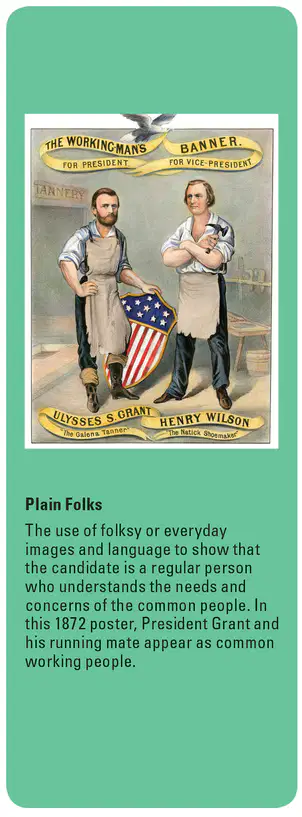
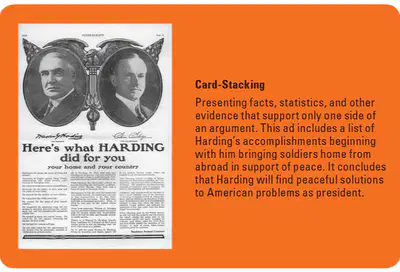
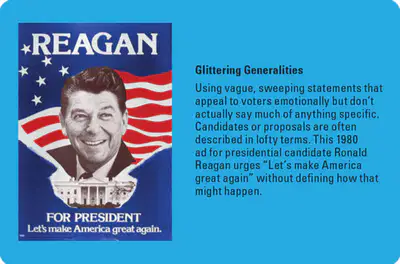
Common Persuasive Techniques Used in Political Advertising
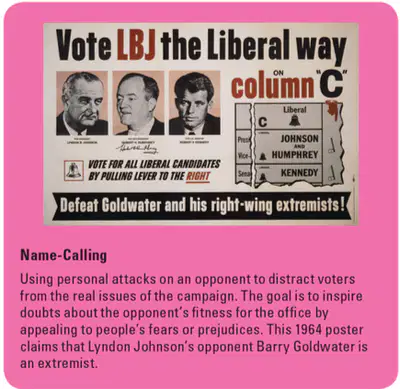
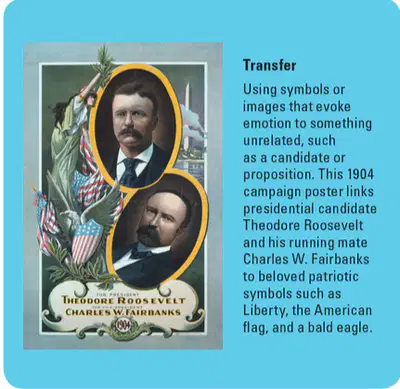
5
Common Persuasive Techniques Used in Political Advertising
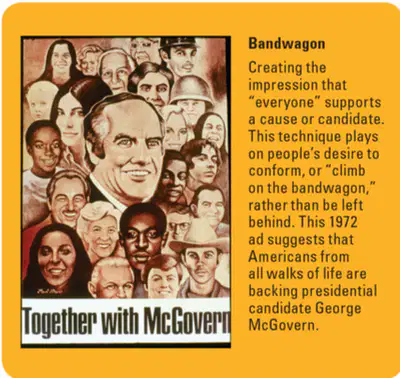
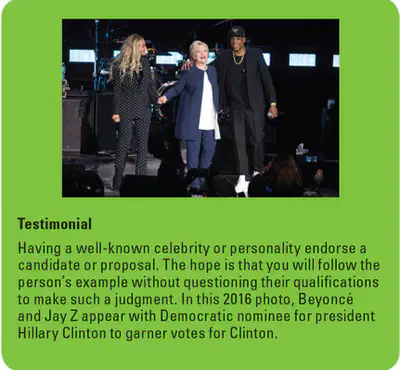
6
Common Persuasive Techniques Used in Political Advertising
7
Types of Campaign Ads: Issue Versus Image
Political ads fall into two main types: issue ads and image ads. Issue ads focus on specific topics, like school funding or taxes, and can be positive, promoting a candidate's stance, or negative, attacking an opponent's position. For example, an opponent against the death penalty might be criticized as "soft on crime."
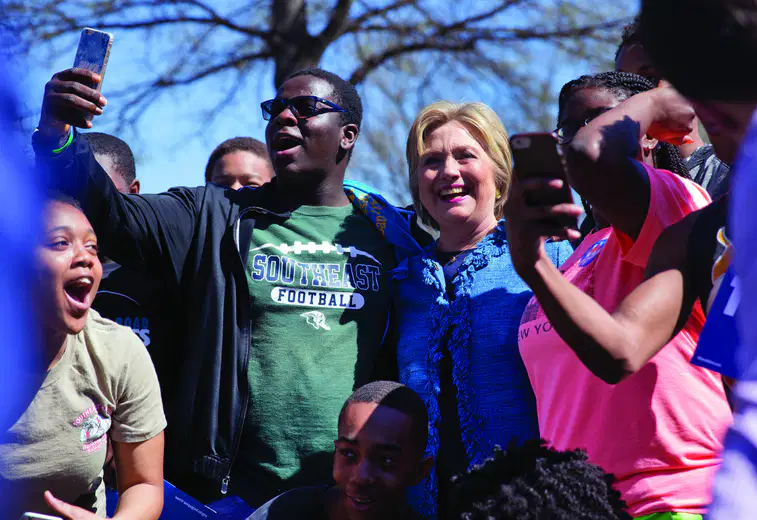
Image ads focus on the candidate’s character or persona. Positive image ads show the candidate as a caring leader or everyday person, while negative ones paint the opponent as weak or untrustworthy. Negative ads often use unflattering photos to make the opponent seem unfit for office. Both types use persuasive techniques to sway voter opinion.
8
Attracting Media Coverage: Photo Ops and Streamlined Conventions
Candidates and media consultants work hard to gain free news coverage, often through staged events called "photo ops." These events are crafted to create memorable images, like the famous 2003 photo of President Bush in a flight suit on the USS Lincoln with a "Mission Accomplished" banner behind him, signaling the end of major combat in Iraq.
Political conventions are also carefully planned for media impact. In the past, lengthy speeches and debates at conventions led networks to reduce coverage. To keep viewer interest, parties now streamline conventions, completing important business off-camera. Prime-time events and speeches are crafted to highlight party values and promote candidates to the public.
9
Media Coverage of Elections: Horse Races and Soap Operas
Election news often follows two main patterns: horse race coverage and soap opera stories. Horse race coverage treats the election like a sporting event, focusing on who is winning and why, often using opinion polls to show who's ahead. Issues are only discussed in terms of how they impact a candidate's chances. Sometimes, efforts to create powerful photo ops for coverage don’t work as intended; for example, in 1988, Michael Dukakis was mocked when he posed in a tank wearing an oversized helmet, which looked more comical than presidential.
Soap opera stories, on the other hand, center around the personal ups and downs of candidates, prioritizing character issues and gossip over policy. This approach often leads to "gotcha" journalism, where reporters look to catch candidates making mistakes. For instance, during the 2016 election, Donald Trump claimed he was targeted by gotcha journalism when reporters highlighted his lack of knowledge about certain international terrorists.
10
Why Campaigns "Go Negative"
Media consultants may sometimes advise a candidate to "go negative" and use attack ads, despite public dislike for mudslinging. This choice isn’t made lightly, as negative campaigning can lead to criticism of a candidate’s character. As Adlai Stevenson once warned, "He who slings mud generally loses ground." However, some consultants, like Cathy Allen, recommend going negative only when there is strong evidence of wrongdoing by the opponent or if the candidate faces an uphill battle.
Negative campaigning continues because it is often effective. Some believe that attack ads discourage people from voting, while others argue they spark voter interest and increase turnout by pushing voters toward a different candidate. How well negative ads work depends largely on how voters react each election season, making mudslinging a recurring strategy in politics.
11
Dropdown
The Influence of the Media in Political Campaigns
(Lesson 9 Section 4)
Mr. Wiery
American Government
Show answer
Auto Play
Slide 1 / 11
SLIDE
Similar Resources on Wayground

8 questions
Development 2
Presentation
•
11th Grade
7 questions
Community Helpers
Presentation
•
KG
6 questions
Untitled Lesson
Presentation
•
11th Grade
10 questions
Quadratic Sequences
Presentation
•
11th Grade
9 questions
IQ
Presentation
•
11th Grade
10 questions
Plessy v. Ferguson
Presentation
•
12th Grade
7 questions
Monday, September 22 - Period 3 Lesson 5
Presentation
•
11th Grade
7 questions
Protest, Rebellion, and Tradition
Presentation
•
11th Grade
Popular Resources on Wayground
24 questions
PBIS-HGMS Day 10

Quiz
•
6th - 8th Grade
10 questions
HCS SCI 03 Summer School Review 3
Quiz
•
3rd Grade
11 questions
Home Scope
Quiz
•
7th - 8th Grade
15 questions
HCS SCI 05 Summer School Assessment 3 Review
Quiz
•
5th Grade
35 questions
Lufkin Road Middle School Student Handbook & Policies Assessment
Quiz
•
7th Grade
18 questions
Geo 11.3 Area of Circles and Sectors
Quiz
•
9th - 11th Grade