

Gamification.

Presentation
•
English
•
University
•
Easy
+18
Standards-aligned

Paola Cortez
Used 1+ times
FREE Resource
15 Slides • 15 Questions
1

Unit 1
Content: Gamified
Activities.
Educational
Technology.
Professor: Estela Aracely García Cruz
2
Open Ended

Have you ever used a game in a class? Yes/ No? Mention which one.
3


General data.
4
Multiple Choice

This generation comprises a crew of people between 7 and 22 years.
Generation z.
Millenials.
Generation x.
Silent GGeneration.
5
Multiple Choice

This generation comprises a crew of people between 23 and 38 years.
Generation z.
Millenials.
Generation x.
Silent Generation.
6
Multiple Choice

This generation comprises a crew of people between 39 and 54 years.
Generation z.
Millenials.
Generation x.
Silent Generation.
7
Multiple Choice
This generation comprises a crew of people between 74 and 91 years.
Generation z.
Millenials.
Generation x.
Silent Generation.
8

Digital native vs Digital immigrant.
Digital natives
New generation of
young people born into
the digital age.
They process
information quickly,
enjoy multi-tasking and
gaming
Digital immigrants
Those who learnt to use
computers at some stage
during their adult life.
-They were born before
1980s.
-The older crew, they
weren’t raised in a digital
environment.
9
Categorize
a generation of people, also called "Traditionalists," who were born between 1928-1946.
term used to describe Americans born during the late 1990s and early 2000s.
a person who started using digital technology, computers, the internet, etc.
a person who grew up with the presence of digital technology or in the information age.
a group of individuals who are highly proficient in using technology and digital devices from a young age.
individuals who had to adapt to using digital technology later in life.
individuals who are known for their strong digital skills and ability to adapt quickly to new technologies.
Individuals who value hard work, discipline, and loyalty in their professional and personal lives.

Organice estas opciones en las categorías correctas
10


11
Video Response

Explain briefly the main difference between Digital Natives and Digital Inmigrants.

12


13
Drag and Drop

14
Drag and Drop

Digital inmigrants.
15

What is Gamification?
According to Werbach and Hunter (2012), “it
is the use of game elements and game design
techniques in non-game contexts”
It means: Triggering intrinsic and extrinsic
motivation in students to develop their skills
through engaging activities with an
educational purpose.
16
Audio Response

What is gamification?

17

What is the objective of
using gamification?
• The main objective of Gamification is to increase
participation
and
motivate
users
using
game
elements
such
as
points,
leaderboards,
and
immediate feedback among other things.
• It is based in the success of the gaming industry,
social media, and decades of research in human
psychology. Basically, any task, assignment, process
or theoretical context can be gamified.
18
Word Cloud

Mention one benefit of using games in class.
19

What game elements can I use in a class?
• Points, badges, leaderboards, progress
bars/progression charts, performance graphs, quests,
levels, avatars, social elements, and rewards. All these
elements have different purposes and can be adapted
to basically any work, business or education related
environment.
20
Match

Match the correct answers.
A position on a real or imaginary scale of amount, quantity, extent, or quality.
An icon or figure representing a particular person in video games, internet forums, etc.
A scoreboard showing the names and current scores of the leading competitor.
A mark, token, or gift that is given in recognition of one's achievement or service.
A system of ranking people or things according to their quality, importance, or success.
Levels.
Avatar.
Leaderboard.
Rewards
Points
Levels.
Avatar.
Leaderboard.
Rewards
Points
21

How would
you use the
following
game
elements?
22
Labeling
Match the game element.
Insignia.
Mark.
Level.
23

Game elements
Badges
Levels
Leaderboards
Progress bar
They
represent
student's achievements.
Marks, insignias…
Game
element
that
allows players to see
where they are and how
they progressed.
Scoreboard showing
names and current
scores.
Graphical control
element used to
visualize the progression
of a game.
Virtual currency
Awards, trading and
gifting
Challenges between users
Coins or tokens used to
reward players and
create game economy.
Incentives players
receive for any
achievement.
Competitions in which two or more people are
engaged.
24
Draw
Try to draw your favorite game element.
25

Other ways to apply gamification in the classroom.
Class competitions:
Contest in which two or more
people
are
engaged
where
typically
only
one
or
afew
participants will win, and others
will not.
Teacher vs. Class:
Students must follow a rule that
the teacher sets. Anytime a
student follows the rule, the Class
gets a point. Anytime a student
does not follow a rule, the
teacher gets a point.
Awards:
a prize or other mark of
recognition given in honor of an
achievement.
Giving learning badges:
a special or distinctive mark,
token, or device worn as a sign of
membership and achievement.
26

Benefits of gamification.
1.
Increases
learner
engagement.
When learners feel positive about their learning process and know that they are going to be rewarded in some way for their efforts, then they stop becoming passive observers and turn into active participants.
2.
Makes
eLearning
fun
and
interactive.
Gamification in eLearning makes learning not only informative, but fun and exciting too. This creates the feeling of immersion, which offers learners the opportunity to feel as though they are an integral part of the overall learning process
27
Multiple Select
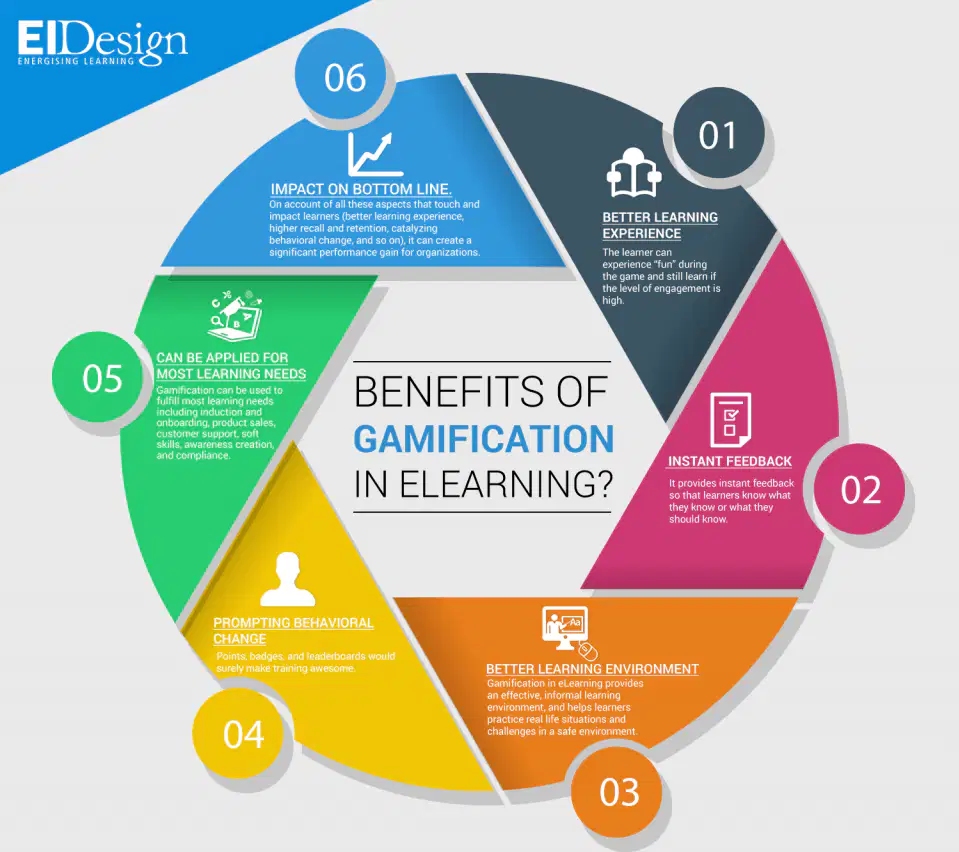
What are the benefits of gamification?
Better Engagement.
Improved Information Retention.
Leads to overstimulation or game play addiction.
Improved Collaboration.
28

Quizlet
Quizlet is a free website providing learning tools for students, including flashcards, study and game modes.
You start by creating your own study sets with terms and definitions.
Create
You can copy and paste from another source, or use Quizlet´s built-in auto-define feature to speed up to creating process.
Add
Over
40
million
user-
generated flashcard sets
are on the website.
Find
Track your progress with
powerful and game models.
Study
Review
your
material,
shuffle/randomize,
or
listen with audio.
Flashcards
Track your correct-incorrect answersand retest the ones you´ve missed.
Learn
Randomly generate tests based on your flashcard set.
Test
Scatter
Race against the clock to drag and match terms and definitions.
29


Access to the platform
https://quizlet.com/
Research shows that testing yourself with
flashcards is more effective than rereading
your notes. From math to medicine to modern
languages, Quizlet is used by students in over
100 different subjects.
Loved by educators in over 50% of U.S.
schools and 150 countries.
30


Unit 1
Content: Gamified
Activities.
Educational
Technology.
Professor: Estela Aracely García Cruz
Show answer
Auto Play
Slide 1 / 30
SLIDE
Similar Resources on Wayground

24 questions
Can or Can't
Presentation
•
University
23 questions
-ED Pronunciation
Presentation
•
University
20 questions
Spelling of -ing Verb Forms
Presentation
•
University
19 questions
simple present continuous tenses
Presentation
•
University
23 questions
PAST SIMPLE VS PAST CONTINUOUS
Presentation
•
University
21 questions
Comparison with as ... as
Presentation
•
University
23 questions
E11.U4.Grammar: Present perfect v.s Past simple
Presentation
•
12th Grade
Popular Resources on Wayground
10 questions
Safety Day 2026 – Student Review

Quiz
•
9th Grade
21 questions
Continents and Oceans
Quiz
•
6th Grade
20 questions
Parts of Speech
Quiz
•
5th Grade
16 questions
Subject & Predicate
Quiz
•
5th Grade
25 questions
Multiplication Facts
Quiz
•
5th Grade
12 questions
Map Skills
Quiz
•
3rd Grade
22 questions
Continents and Oceans
Quiz
•
5th Grade
15 questions
Rounding Decimals
Quiz
•
5th Grade
Discover more resources for English
20 questions
Disney Trivia
Quiz
•
University
10 questions
Spanish Greetings and Goodbyes!
Presentation
•
6th Grade - University
20 questions
Physical or Chemical Change/Phases
Quiz
•
8th Grade - University
39 questions
Unit 7 Key Terms
Quiz
•
11th Grade - University
25 questions
SER and Subject Pronouns
Quiz
•
8th Grade - University
38 questions
Unit 6 Key Terms
Quiz
•
11th Grade - University
19 questions
Key Concepts in Buddhism
Quiz
•
University
0 questions
Cell Domain Basic Review (Biology)
Quiz
•
University