
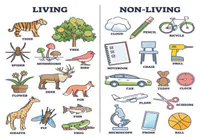
Classification

Presentation
•
Science
•
7th Grade
•
Medium

Maria Woodbury
Used 2+ times
FREE Resource
14 Slides • 12 Questions
1
How do we organize LIVING things?

2
Classifying organisms one step at a time

3
"Dichotomous" means divided in two parts. These help determine what an organism is through a series of choices that lead you to the correct answer

4

5
Multiple Choice
The word "dichotomous" means...
divided into two parts
not living
two cots for me to sleep on
6

7

8

9
Multiple Choice
The study of how things are classified is known as:
Binomial nomenclature
Taxonomy
A dichotomous key
10
Look at the images of the insects.
Start on question 1.
Depending on the answer, go where the question tells you to go.
Stop when your organism has been identified.

11

12

13
-Builiding blocks of life
-Cells can have different functions
-Living things can be MULTICELLULAR, or UNICELLULAR
-Each kingdom will have different characteristics in their cells
14
15
Multiple Choice
Plant cells and animal cells have similar organelles
True
False
16
Multiple Choice
The nucleus controls the activities of the cell, and houses the genetic code
True
False
17
Match
Match the following
mitochondria
cytoplasm
vacuoles
cell membrane
organelles
generate energy and heat for the cell
keeps things in place in the cell
store water, nutrients and waste
holds the cell together
specialised structures
generate energy and heat for the cell
keeps things in place in the cell
store water, nutrients and waste
holds the cell together
specialised structures
18
Labeling
Label the following parts of an animal and plant cell
nucleus
chloroplast
animal cell
cell wall
vacuole
19
Fungi can be made up of many cells or a single cell
The cells of fungi DO NOT have chloroplasts
Fungi tends to feed off dead organisms
Protists can be multicellular or unicellular, and can contain chloroplasts
Monera are single cell organisms that don't have a nucleus. Bacteria is an example of an organism belonging to the monera kingdom
20
Match
Match the following organisms to their correct kingdom
Animal
Plant
Fungi
Protists
Monera
jaguar
cactus
mushroom
algae
bacteria
jaguar
cactus
mushroom
algae
bacteria
21
Categorize
sponges
star fish
scorpion
snake
Organize these options into the right categories
22
Categorize
whale
eagle
turtle
shark
Organize these options into the right categories
23
We belong to the mammal group
Mammals are divided into three subgroups
PLACENTALS- those with babies inside the mother, attached with a placenta
MONOTREMES- those that lay eggs, but the babies need milk from the mother. These live only in Australia and New Guinea. Example is the echidna
MARSUPIALS- give birth to live young, but they live in a pouch until fully developed- predominantly found in Australia
24
Fill in the Blanks
Animals that give birth to live young and th baby is attached to the mother by a placenta
25
Fill in the Blanks

An echidna is an example of a
26
Fill in the Blanks

A kangaroo is an example of a
How do we organize LIVING things?
Show answer
Auto Play
Slide 1 / 26
SLIDE
Similar Resources on Wayground

21 questions
Classification Study Guide Lesson
Presentation
•
7th Grade
19 questions
Dominance and Expression of Genes
Presentation
•
7th Grade
23 questions
Body Systems: The Muscular System
Presentation
•
7th Grade
20 questions
Potential and Kinetic Energy
Presentation
•
7th Grade
20 questions
Cells
Presentation
•
7th Grade
21 questions
Carbon Cycle
Presentation
•
7th Grade
21 questions
Human Body System Review
Presentation
•
7th Grade
20 questions
Variations Notes
Presentation
•
7th Grade
Popular Resources on Wayground
10 questions
Safety Day 2026 – Student Review

Quiz
•
9th Grade
21 questions
Continents and Oceans
Quiz
•
6th Grade
20 questions
Parts of Speech
Quiz
•
5th Grade
16 questions
Subject & Predicate
Quiz
•
5th Grade
25 questions
Multiplication Facts
Quiz
•
5th Grade
12 questions
Map Skills
Quiz
•
3rd Grade
22 questions
Continents and Oceans
Quiz
•
5th Grade
15 questions
Rounding Decimals
Quiz
•
5th Grade
Discover more resources for Science
10 questions
Exploring Chemical and Physical Changes

Interactive video
•
6th - 10th Grade
14 questions
Week 1 Falcon Flex Fast and Curious
Quiz
•
7th Grade
42 questions
Explore Plate Tectonics and Boundaries
Quiz
•
7th Grade
21 questions
Waves and Wave Properties
Quiz
•
6th - 8th Grade
16 questions
Photosynthesis and Cellular Respiration Review
Quiz
•
7th Grade
20 questions
Food Webs + Energy Pyramids
Quiz
•
7th Grade
9 questions
Biology: Cell Structure
Interactive video
•
7th Grade
8 questions
Diffusion and Osmosis Review
Presentation
•
6th - 8th Grade