Search Header Logo
classification

classification

Assessment

Presentation

•

Biology

•

9th Grade

•

Medium

Created by

supper teacher

Used 112+ times

FREE Resource

29 Slides • 61 Questions

1

media
​living or non-living ?

2

media

3

media

4

media

5

media
​

7

media

8

Multiple Choice

Which of the following use energy, grow, reproduce, and respond to their environment?
1
All living things
2
only animals
3
only plants
4
all nonliving things

9

Multiple Choice

A process where an organism becomes larger (bigger in size)

1

Growth

2

Development

3

Stimulus

4

Response

10

Multiple Choice

What is the definition of movement in living organisms?

1

The chemical reaction that breaks down nutrient molecules in living cells to release energy for metabolism

2

The permanent increase in size and dry weight by increasing the number of cells or the size of cells or both

3

The action of an organism or a part of an organism causing a change in position or location

4

The ability to detect or perceive stimuli in the internal or external environment and respond appropriately

11

Multiple Choice

What is respiration in living organisms?

1

The ability to detect or sense stimuli in the internal or external environment and respond appropriately

2

The action of an organism or a part of an organism causing a change in position or location

3

The permanent increase in size and dry mass by increasing the number of cells or cell size or both

4

The chemical reaction breaking down nutrient molecules in living cells to release energy for metabolism

12

Multiple Choice

What is the definition of sensitivity in organisms?

1

The permanent increase in size and dry weight by increasing the number of cells or cell size or both

2

The ability to detect or perceive stimuli in the internal or external environment and perform appropriate responses

3

The chemical reaction breaking down nutrient molecules in living cells to release energy for metabolism

4

The action of an organism or part of an organism causing a change in position or location

13

Multiple Choice

What is growth in organisms?

1

Growth is the permanent increase in size and dry mass by increasing the number of cells or the size of cells or both

2

The action of an organism or a part of an organism causing a change in position or place

3

The ability to detect or perceive stimuli in the internal or external environment and respond appropriately

4

The chemical reaction breaking down nutrient molecules in living cells to release energy for metabolism

14

Multiple Choice

What is the definition of excretion in living organisms?

1

Elimination of harmful substances, metabolic waste products (chemical reactions within cells including respiration), and excess substances compared to needs from the organism

2

The ability to detect or sense stimuli in the internal or external environment and respond appropriately

3

Permanent increase in size and dry mass by increasing the number of cells or cell size or both

4

Chemical reaction breaking down nutrient molecules in living cells to release energy for metabolism

15

Multiple Choice

What is the process of photosynthesis in plants?

1

The ability to detect or sense stimuli in the internal or external environment and respond appropriately

2

The action of an organism or a part of an organism causing a change in position or location

3

The chemical reaction converting light energy into chemical energy stored in glucose

4

The permanent increase in size and dry weight by increasing the number of cells or the size of cells or both

16

Multiple Choice

What is the function of chlorophyll in photosynthesis?

1

The ability to detect or sense stimuli in the internal or external environment and respond appropriately

2

The action of an organism or a part of an organism causing a change in position or location

3

The pigment that absorbs light energy for the process of photosynthesis

4

The chemical reaction breaking down nutrient molecules in living cells to release energy for metabolism

17

Multiple Choice

What is the role of stomata in plant leaves?

1

The permanent increase in size and dry weight by increasing the number of cells or the size of cells or both

2

The ability to detect or perceive stimuli in the internal or external environment and respond appropriately

3

The small openings that allow for gas exchange and transpiration

4

The action of an organism or a part of an organism causing a change in position or location

18

Multiple Choice

What is the role of stomata in plant leaves?

1

The permanent increase in size and dry weight by increasing the number of cells or the size of cells or both

2

The ability to detect or perceive stimuli in the internal or external environment and respond appropriately

3

The small openings that allow for gas exchange and transpiration

4

The action of an organism or a part of an organism causing a change in position or location

19

Multiple Choice

What is the process of transpiration in plants?

1

The ability to detect or sense stimuli in the internal or external environment and respond appropriately

2

The action of an organism or a part of an organism causing a change in position or location

3

The loss of water vapor from plant leaves through small openings called stomata

4

The permanent increase in size and dry weight by increasing the number of cells or the size of cells or both

20

Multiple Choice

What is the function of mitochondria in living cells?

1

The ability to detect or sense stimuli in the internal or external environment and respond appropriately

2

The action of an organism or a part of an organism causing a change in position or location

3

The organelle responsible for producing energy through cellular respiration

4

The chemical reaction breaking down nutrient molecules in living cells to release energy for metabolism

21

Multiple Choice

What is the role of DNA in genetic inheritance?

1

The permanent increase in size and dry weight by increasing the number of cells or the size of cells or both

2

The ability to detect or perceive stimuli in the internal or external environment and respond appropriately

3

The molecule that carries genetic information and determines inherited traits

4

The chemical reaction converting light energy into chemical energy stored in glucose

22

media

23

Multiple Choice

Question image

What is classification?

1

grouping things based on their differences

2

grouping things based on random ideas

3

grouping things based on their similarities

24

Multiple Choice

Which of the following identifies the levels of classification in the correct order?

1

kingdom, phylum, class, order, family, genus, species

2

genus, species, kingdom, phylum, class, order, family

3

kingdom, genus, species, phylum, class, order, family

4

genus, species, phylum, class, order, family, kingdom

25

Multiple Choice

Which of the following best describes why is the classification of living organisms using the binomial naming system important?

1

To distinguish one organisms and another

2

Because some organisms may not be able to respond towards stimuli

3

So that it can be easily understood by all scientists around the world

4

To ensure that the organism is well understood

26

Multiple Choice

The scientific name for an organism is made from the:
1
class and family name
2
genus and species name
3
domain and kingdom name
4
kingdom and phylum name

27

Multiple Choice

What is the most specific level of classification?
1
Family
2
Domain
3
Species
4
Carolus Linnaeus

28

media

29

media

30

media

31

media

32

media

33

media

34

Multiple Choice

Mammals have a bony ____ with a backbone and jaws, breathe only with ____, have four limbs and skin covered with hair or fur.

1

exoskeleton , lungs

2

endoskeleton , gills

3

endoskeleton , lungs

4

exoskeleton, gills

35

Multiple Choice

_____ have an outer covering of scales.

1

Birds

2

Mammals

3

Amphibians

4

Reptiles

36

Multiple Choice

What is one distinguishing feature of mammals that is absent in other classes of vertebrates?

1

they breathe only with lungs and have four limbs

2

they have milk-producing glands

3

they are endothermic

4

they have a bony endoskeleton with a backbone and jaws

37

Multiple Choice

Which is true concerning amphibian development?

1

It includes an aquatic larval form.

2

Newborns respire using gills.

3

Adults respire using lungs.

4

All of these

38

Multiple Choice

Mammal skins are covered with ____ or fur.

1

feathers

2

hair

3

scales

4

wool

39

media

40

media

41

Multiple Choice

The exoskeleton of an arthropod is made of which of the following?

1

chitin

2

protin

3

nacre

4

spongin

42

Multiple Choice

Question image
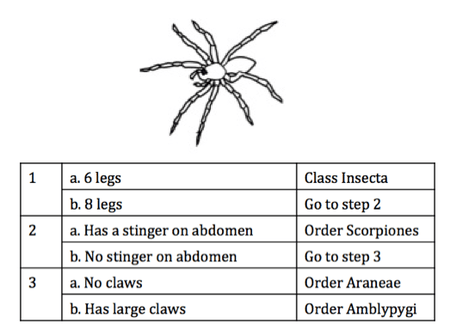
An illustration and a dichotomous key are given. What is the correct classification for this organism?
1
Class Insecta
2
Order Amblygygi
3
Order Araneae
4
Order Scorpiones

43

Multiple Choice

Question image
A student discovers an arachnid with a segmented abdomen, long legs, and a tail with no stinger. The student uses the dichotomous key below to identify it. Which arachnid has the student found?
1
Whip Scorpion
2
Wind Scorpion
3
Daddy long legs
4
Scorpion

44

Multiple Choice

Question image
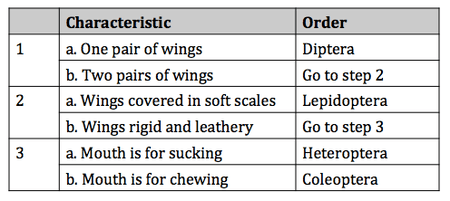
A dichotomous key for insects is given. To what order does an insect with two pairs of scaly wings belong?
1
Coleoptera
2
Heteroptera
3
Diptera
4
Lepidoptera

45

media

46

media

47

Multiple Choice

Question image

Is this plant a monocot or dicot?

1

Monocot

2

Dicot

48

Multiple Choice

Question image

What is this plant?

1

perennial

2

monocot

3

annual

4

dicot

49

Multiple Choice

Question image

What is this root system classified as?

1

Fibrous root

2

Taproot

50

Multiple Choice

Question image

What type of root system is this?

1

Tap root

2

Fibrous root

51

media

52

media

53

media

54

media

56

Multiple Choice

Fungi obtain energy

1

Directly from the sun

2

From inorganic (unnatural) materials in their environment

3

By absorbing organic (natural) materials

4

From nuclear fusion

57

Multiple Choice

Fungi are important to an ecosystem as

1

Producers

2

Controllers

3

Decomposers

4

Regulators

58

Multiple Choice

Which is not true about fungi?

1

All are consumers

2

All are multicellular

3

Are eukaryotic

4

Can be useful to humans

59

Multiple Choice

Fungi are _____, which means they cannot make their own food.

1

Autotrophs

2

Heterotrophs

3

Carnivores

4

Omnivores

60

Multiple Choice

What is an example of a fungus?
1
moss
2
mold
3
bryophyte
4
protist

61

Multiple Choice

Fungi usually like dry and bright places to grow
1
true 
2
false

62

Multiple Choice

Which are examples of fungi?
1
mold
2
yeast
3
mushrooms
4
all of the above

63

Multiple Choice

Fungi are like animals because...
1
they all reproduce sexually.
2
they get their food from other organisms.
3
they can move from one place to another.
4
They are not like animals.

64

Multiple Choice

A fungus is an organism whose cells have
1
a nuclei
2
cell walls
3
no chlorophyll
4
A, B and C

65

Multiple Choice

__________ are fungi that that produce the gas that makes bread rise.
1
Mushrooms
2
Athletes' foot
3
Blue Cheese
4
Yeast

66

media

67

media

68

Multiple Choice

Question image
1

A

2

B

3

C

4

D

69

Multiple Choice

Question image
1

A

2

B

3

C

4

D

70

Multiple Choice

Question image
1

A

2

B

3

C

4

D

71

Multiple Choice

Question image
1

A

2

B

3

C

4

D

72

Multiple Choice

Question image
1

A

2

B

3

C

4

D

73

Multiple Choice

Question image
1

A

2

B

3

C

4

D

74

Multiple Choice

Question image
1

A

2

B

3

C

4

D

75

Multiple Choice

Question image
1

A

2

B

3

C

4

D

76

Multiple Choice

Question image
1

A

2

B

3

C

4

D

77

Multiple Choice

Question image
1

A

2

B

3

C

4

D

78

Multiple Choice

Question image
1

A

2

B

3

C

4

D

79

Multiple Choice

Question image
1

A

2

B

3

C

4

D

80

Multiple Choice

Question image
1

A

2

B

3

C

4

D

81

Multiple Choice

Question image
1

A

2

B

3

C

4

D

82

Multiple Choice

Question image
1

A

2

B

3

C

4

D

83

Multiple Choice

Question image
1

A

2

B

3

C

4

D

84

Multiple Choice

Question image
1

A

2

B

3

C

4

D

85

Multiple Choice

Question image
1

A

2

B

3

C

4

D

86

Multiple Choice

Question image
1

A

2

B

3

C

4

D

87

media

88

media

89

media

90

media
pattern-tertiary
media
​living or non-living ?

Show answer

Auto Play

Slide 1 / 90

SLIDE