

Periodic Trends

Presentation
•
Science
•
10th Grade
•
Medium
+13
Standards-aligned

Morgan Hepburn
Used 1+ times
FREE Resource
12 Slides • 19 Questions
1

2

3
Valence electrons are electrons in outermost incomplete shells.
If you skip the transition metals, you can count valence electrons by counting groups.
Transition metals have 2-3 valence electrons.

10th Grade: Use the chart below to update your valence electron worksheet. Skip transition metals
4
Fill in the Blanks
What is the only noble gas that doesn't have 8 valence electrons?
Type answer...
5
Fill in the Blanks
Chlorine has
Type answer...
6
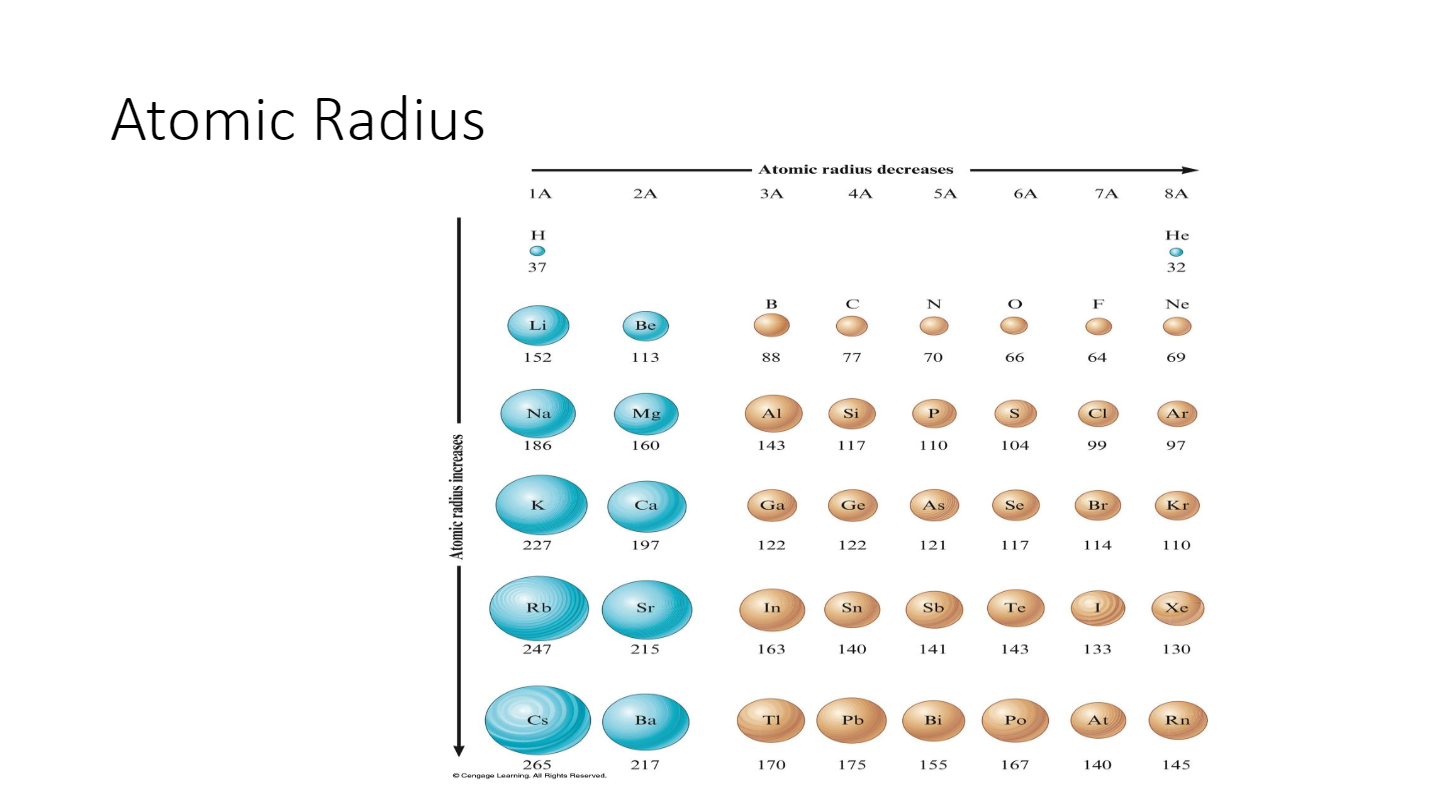
Atomic radius increases as you go down a group and decreases as you go across a period
7
Fill in the Blanks
Atomic radius INCREASES when you go
Type answer...
8
Multiple Choice
Atomic radius DECREASES when
when you go across a row from right to left
when you go down a group
when you go across a row from left to right
when you go across a group from left to right
9
Reorder
Put in order from biggest to smallest (decreasing size)
Calcium
Iron
Zinc
Bromine
Krypton
10
Open Ended
Why does atomic radius decrease as you go across a period?
11
Open Ended
Why does atomic radius increase as you go down a group?
12

13
Multiple Choice
Which is the smallest
chlorine
chlorine ion
aluminum ion
magnesium ion
14
Reorder
Put these ions and atoms in order from biggest to smallest (DECREASING SIZE)
nitride ion (nitrogen ion)
oxide ion (oxygen ion)
fluoride ion (fluorine ion)
neon atom
15

16

17
Multiple Choice
Ionization energy ________________ as you go DOWN a group
increases
decreases
18
Multiple Choice
Which atom has larger ionization energy
aluminum
sulfur
19
Multiple Choice
Which atom has smaller ionization energy
strontium
iodine
20
Energy released when an electron is ADDED to an element.
Affinity means a preference or something that you like. Elements with high electron affinity want to or are more likely to take electrons from other elements.
Non-metals have higher electron affinities than metals.
Electron affinity INCREASES as you go from left to right across a period and DECREASES as you go from top to bottom down a group.
21

22
Fill in the Blanks
Electron affinity
23
Multiple Choice
This element has the lowest electron affinity
magnesium
sodium
silicon
sulfur
24
Multiple Choice
This element has the highest electron affinity
iron
calcium
chlorine
radon
25
Recall, molecules are groups of atoms that SHARE electrons.
Only valence electrons are involved in forming these “shared electron bonds” (covalent bonds)
Atoms within a molecule do not always share electrons equally. Some pull them closer to themselves than others.
Electronegativity is a measure of how strongly the atoms within a molecule attract the electrons shared between them.
Increases as you go left to right across a period.
Decreases as you go from top to bottom down a group.
26

27
Multiple Choice
What element is the most electronegative
fluorine
bromine
iodine
astatine
28
Multiple Choice
What element is the LEAST electronegative
cadmium (Cd)
antimony (Sb)
Zirconium (Zr)
Francium (Fr)
29

the impulse for which a chemical substance undergoes a chemical reaction, either by itself or with other materials
30
Multiple Choice
What metal is most reactive
lithium
sodium
potassium
rubidium
31
Multiple Choice
What non-metal is the most reactive
iodine
sulfur
oxygen
fluorine
Show answer
Auto Play
Slide 1 / 31
SLIDE
Similar Resources on Wayground

25 questions
Gas Laws Practice ASYNCH
Presentation
•
10th Grade
25 questions
Electron Configuration, Orbital Notation, & Dot diagrams
Presentation
•
9th - 12th Grade
26 questions
Rigid Transformations
Presentation
•
10th Grade
21 questions
El imperfecto
Presentation
•
10th Grade
23 questions
Ionic bonding
Presentation
•
9th Grade
20 questions
Photosynthesis
Presentation
•
9th - 11th Grade
26 questions
Ionic Bonds
Presentation
•
9th Grade
Popular Resources on Wayground
10 questions
Safety Day 2026 – Student Review

Quiz
•
9th Grade
21 questions
Continents and Oceans
Quiz
•
6th Grade
20 questions
Parts of Speech
Quiz
•
5th Grade
16 questions
Subject & Predicate
Quiz
•
5th Grade
25 questions
Multiplication Facts
Quiz
•
5th Grade
12 questions
Map Skills
Quiz
•
3rd Grade
22 questions
Continents and Oceans
Quiz
•
5th Grade
15 questions
Rounding Decimals
Quiz
•
5th Grade
Discover more resources for Science
10 questions
Exploring Chemical and Physical Changes

Interactive video
•
6th - 10th Grade
10 questions
Exploring the Electromagnetic Spectrum for Middle School Science
Interactive video
•
6th - 10th Grade
10 questions
Exploring Force and Motion Concepts
Interactive video
•
6th - 10th Grade
10 questions
Exploring Air Masses and Weather Fronts
Interactive video
•
6th - 10th Grade
10 questions
Exploring the States of Matter
Interactive video
•
6th - 10th Grade
10 questions
Exploring Forces: Net Force, Normal Force, Gravity, and Friction
Interactive video
•
6th - 10th Grade
10 questions
Differentiating Thermal Energy and Temperature
Interactive video
•
6th - 10th Grade
10 questions
Exploring the States of Matter and Thermal Energy
Interactive video
•
6th - 10th Grade