

Soil Task Cards

Presentation
•
Science
•
5th Grade
•
Practice Problem
•
Easy
+4
Standards-aligned

Celena Berry
Used 2+ times
FREE Resource
9 Slides • 4 Questions
1
Discovering the hidden wonders beneath our feet
2
Exploring Soil Secrets
Soil is a mixture of decaying organic material, weathered rock, water, mineral fragments, and air.
It takes thousands of years to develop.
Soil types range from largest particle size to smallest: gravel, sand, silt, clay.
Soil texture can be tested by rubbing samples between fingers or examining with a hand lens.
Small pieces of rock in soil are called gravel and have a rough texture.
Material formed from decaying plants and animals in soil is called humus.
Students investigate soil types' water retention capacity.
3
Word Cloud

What is the main component of soil?
4
Main Component of Soil
Did you know? Soil is made up of a combination of decaying organic material, weathered rock, water, and mineral fragments. It provides a habitat for plants, animals, and microorganisms, and plays a crucial role in supporting life on Earth.
5
Exploring Soil Secrets
6
Multiple Choice
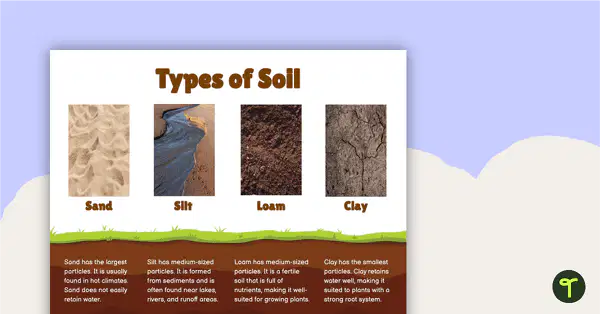
Which soil type has the highest water retention?
Clay
Silt
Sand
Loam
7
Water Retention:
8
Exploring Soil Secrets
9
Multiple Choice

What is the best tool to compare soil samples?
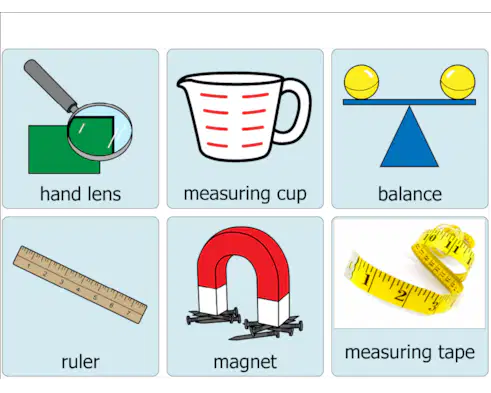
Magnifying (hand) lens
Clay
Gravel
Sand
10
Magnifying Lens
Magnifying lens is the best tool to compare soil samples. It allows you to examine the soil particles and identify their characteristics. With a magnifying lens, you can observe the size, shape, and color of the soil particles, which can provide valuable insights about the soil composition. It's like having a microscope for soil analysis!
11
Exploring Soil Secrets
Soil needs water to support plant growth. Scientists can determine a soil sample's water retention ability by analyzing its particle size and texture. Plants require nutrients, air, and water to survive. Understanding soil properties is crucial for successful gardening and agriculture.
12
Multiple Choice
What is one way scientists can determine a soil sample's water retention ability?
By analyzing its particle size and texture
By measuring its pH level
By observing its color
By testing its electrical conductivity
13
Soil Water Retention
Trivia: Scientists determine a soil sample's water retention ability by analyzing its particle size and texture. This helps them understand how well the soil can hold water, which is crucial for plant growth. Other methods like measuring pH level, observing color, and testing electrical conductivity are not directly related to water retention.
Discovering the hidden wonders beneath our feet
Show answer
Auto Play
Slide 1 / 13
SLIDE
Similar Resources on Wayground

11 questions
Science --- Investigations vs. Experiments
Presentation
•
5th Grade
9 questions
Cell Organelles
Presentation
•
6th Grade
8 questions
Study Jams Properties of Matter
Presentation
•
6th Grade
10 questions
English Year 5 : Topic 5 food and health
Presentation
•
5th Grade
8 questions
5th Life Science - Heredity
Presentation
•
5th Grade
10 questions
Separating Mixtures
Presentation
•
4th - 5th Grade
9 questions
ESS.5.1.2: Interpreting Weather Data & Conditions
Presentation
•
5th Grade
11 questions
Conservation of Matter
Presentation
•
5th Grade
Popular Resources on Wayground
10 questions
Safety Day 2026 – Student Review

Quiz
•
9th Grade
21 questions
Continents and Oceans
Quiz
•
6th Grade
20 questions
Parts of Speech
Quiz
•
5th Grade
16 questions
Subject & Predicate
Quiz
•
5th Grade
25 questions
Multiplication Facts
Quiz
•
5th Grade
12 questions
Map Skills
Quiz
•
3rd Grade
22 questions
Continents and Oceans
Quiz
•
5th Grade
15 questions
Rounding Decimals
Quiz
•
5th Grade
Discover more resources for Science
20 questions
Mixtures and Solutions Practice
Quiz
•
5th Grade
20 questions
Food Chains and Food Webs Review
Quiz
•
5th Grade
20 questions
GC Interim #1 Review 2026
Quiz
•
5th Grade
20 questions
5.3 Force and Motion Study Guide Review
Quiz
•
5th Grade
15 questions
Force and Motion
Presentation
•
5th Grade
25 questions
Chemical and Physical Changes in Matter
Quiz
•
5th Grade
10 questions
Exploring the Periodic Table Structure

Interactive video
•
5th Grade
14 questions
Land Breeze and Sea Breeze
Quiz
•
5th Grade