

Chem Unit 1 Day 2 Lesson: Matter

Presentation
•
Physics
•
10th Grade
•
Hard
+1
Standards-aligned

Kaye Pickett
FREE Resource
23 Slides • 11 Questions
1

2

COMPOSITION
OF MATTER
3
1How close the molecules are to one another, and 2how quickly they move determine what state of matter a substance is in.
4
solid
liquid
gas
plasma

5
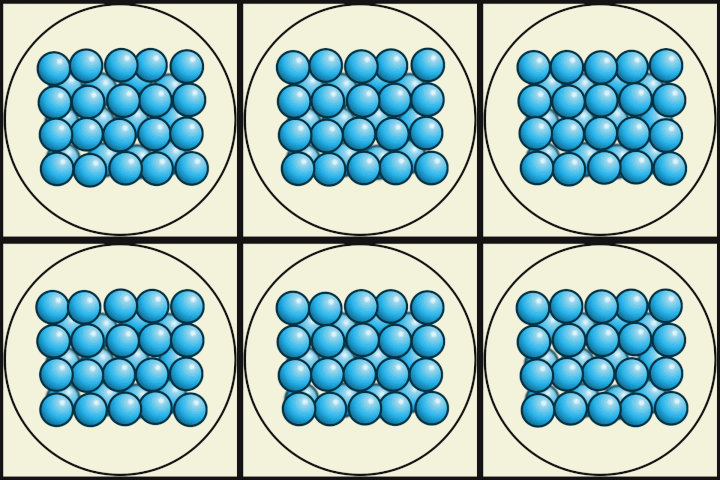
In a solid, particles are packed tightly together so they don't move much, but are dense. The electrons of each particle are constantly in motion, giving the atoms a small vibration, but they are fixed in their position.
Solids have a definite shape, as well as mass and volume, and do not conform to the shape of the container in which they are placed.
6
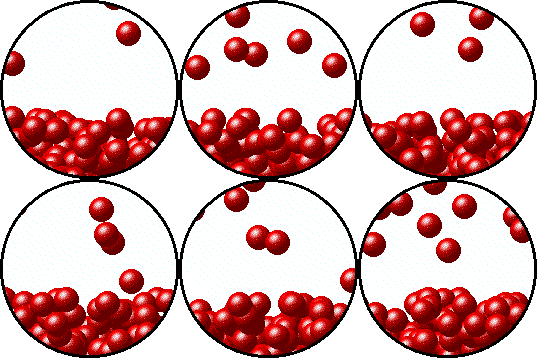
In a liquid, the particles are more loosely packed than in a solid, but closely enough that it is not easily compressible.
The particles are able to flow around each other, giving the liquid an indefinite shape. Therefore, the liquid will conform to the shape of its container.

7
Open Ended
Give an example of a liquid.
8
In a gas, the particles have a great deal of space between them, so they move easily, and have high kinetic energy (energy of movement).
9
Plasma is not a common state of matter here on Earth, but it may be the most common state of matter in the universe. Stars are essentially superheated balls of plasma.
Plasma consists of highly charged gas particles with extremely high kinetic energy (energy in motion).
Think of plasma as gas, with an electrical charge.

10
Matter is anything that has mass, or takes up space.
All matter is comprised of particles.
Particles are constantly moving.
Every substance can be a solid, liquid or gas, but at different temperatures.

11
Draw
Circle the solid.
12
Draw
Circle the liquid.
13
Draw
Circle the gas.
14

Elements, Compounds, and Mixtures
15

A Puresubstance is a substance that cannot
be broken down into simpler parts and still
retain their properties. Pure substances
CANNOT be separated PHYSICALLY.
Pure Substances are one of two types: either
ELEMENTS or COMPOUNDS
16

Elements are pure substances in which all
atoms are the exact same.
Separated only by NUCLEAR FISSION
Found on the periodic table of elements
Ex – oxygen, gold, zinc
17
The same element, only it always appears in pairs.
Diatomic Elements

18

Replace this with your body text.
Duplicate this text as many times as you would like.
The 7 diatomic elements
19
Replace this with your body text.
Duplicate this text as many times as you would like.
All provided templates can be reused multiple times.

20
the components of the mixture are uniformly and evenly mixed throughout
sample taken with the same mixture have the same composition

21

Compounds are substances with 2 or more elements
chemically combined (bonded) in a fixed proportion.
Ex – Water – H2O always has 2 molecules of
hydrogen and 1 molecule of oxygen
Ex – Table Salt – NaCl has one sodium to one
chlorine
Separated by CHEMICAL REACTIONS
22

Examples of Elements Examples of Compounds
• Helium
• Silver
• Gold
• Carbon
• Platinum
• Chlorine
• Hydrogen
• Oxygen
• Aluminum
• Sodium
• NaCl (table salt)
• H2O (water)
• CaCO3 (chalk)
• SiO2 (glass)
• H2SO4 (battery acid)
• CO2 (carbon dioxide)
• NaClO (bleach)
• C6H12O6 (glucose)
• HCl (stomach acid)
• NaHCO3 (baking soda)
23

A mixture contains 2 or more substances that CAN
be physically separated 🡪 heating, distilling, cooling,
sorting, filtering.
2 Main types:
Homogeneous and
Heterogeneous
24

Types of Mixtures:
Homogeneous mixture – a mixture of different materials
that looks the same all the way through.
•Very small particles,
•No “chunks”
Ex - Apple juice, salt water, tomato soup, iced tea
25
the components of the mixture are not uniformy mixed throughout
sample taken with the sample mixture have different composition

26

Heterogeneous mixture – A mixture of
different materials that does NOT look the same
all the way through.
• Very Large Particles
• Has chunks in it
Ex – vegetable soup
27
Multiple Choice

Which are elements?
A
B
C & D
C
28
Multiple Choice
One similarity between all mixtures and compounds is that both
are heterogeneous
are homogeneous
combine in definite ratio
consist of two or more substances
29
A gas has no definite shape or volume. If unconfined, the particles of a gas will spread out indefinitely (forever). However, if confined, the gas will expand to fill its container.

30
Multiple Choice
Which state of matter does not contain easily flowing particles?
Solid
Liquid
Gas
Plasma
31
Multiple Choice
Which state of matter has the ability for its particles to be easily compressed?
Solid
Liquid
Gas
Plasma
32
Multiple Choice
Which state of matter is much like a gas, but with particles that are charged?
Solid
Liquid
Gas
Plasma
33
Multiple Choice
Which state of matter has a definite shape?
Solid
Liquid
Gas
Plasma
34
Reorder
Reorder the following in order from MOST energy to LEAST energy.
Show answer
Auto Play
Slide 1 / 34
SLIDE
Similar Resources on Wayground

28 questions
Procedure Text
Presentation
•
10th Grade
25 questions
Domains and Kingdoms
Presentation
•
10th Grade
26 questions
Texas Independence
Presentation
•
10th Grade
29 questions
unit 9 -- oscillations
Presentation
•
10th Grade
28 questions
Electromagnet
Presentation
•
10th Grade
26 questions
Circuits and Symbols
Presentation
•
9th - 12th Grade
28 questions
Gas Laws
Presentation
•
10th Grade
29 questions
Ionic Bonding
Presentation
•
10th Grade
Popular Resources on Wayground
10 questions
Safety Day 2026 – Student Review

Quiz
•
9th Grade
21 questions
Continents and Oceans
Quiz
•
6th Grade
20 questions
Parts of Speech
Quiz
•
5th Grade
16 questions
Subject & Predicate
Quiz
•
5th Grade
25 questions
Multiplication Facts
Quiz
•
5th Grade
12 questions
Map Skills
Quiz
•
3rd Grade
22 questions
Continents and Oceans
Quiz
•
5th Grade
15 questions
Rounding Decimals
Quiz
•
5th Grade
