

SS Bio Unit 4 Lesson

Presentation
•
Science
•
9th - 12th Grade
•
Hard
+5
Standards-aligned

Beth VanOstrand
Used 1+ times
FREE Resource
20 Slides • 19 Questions
1

2

3
Multiple Choice
Enter: Oxygen
Exit: Carbon dioxide
Enter: Water vapor
Exit: Glucose
Enter: Carbon dioxide
Exit: Oxygen
Enter: Light
Exit: Water vapor
4
Multiple Choice

To make light
To make mitochondria
To make glucose
To release carbon dioxide
5
Multiple Choice

Which organelle is responsible making food (Glucose) using sunlight?
Cell Membrane
Nucleus
Chloroplast
Mitochondria
6

7
Multiple Choice
Which of the following is the correct equation for PHOTOSYNTHESIS?
light + carbon dioxide + water --> glucose + oxygen
carbon dioxide + sugar + water --> oxygen + light
oxygen + light + water --> carbon dioxide + sugar
carbon dioxide + oxygen + water --> Light+ Sugar
8
Dropdown
9
Multiple Select
Which organisms are capable of performing photosynthesis?
some bacteria
animals
algae
plants
10
How does this process relate to photosynthesis?

11

12

13

14

15
Multiple Choice
Cellular respiration is...
the process by which cells break down glucose into energy.
the process by which cells break light down into energy.
the process by which cells communicate with other cells.
16
Multiple Choice
In which way are photosynthesis and cellular respiration different?
Cellular respiration stores ATP, while photosynthesis releases ATP.
Cellular respiration produces oxygen, while photosynthesis uses oxygen.
Photosynthesis releases energy, while cellular respiration stores energy.
Photosynthesis uses carbon dioxide, while cellular respiration produces carbon dioxide.
17
Multiple Choice
Cellular respiration occurs in
chloroplasts
mitochondria
golgi aparatus
thylakoid
18
Multiple Choice
Which type of organism would MOST likely benefit directly from increased levels of CO2?
mushroom
tree
bird
fish
19
Multiple Choice
How can energy from the sun be transferred to animals?
The sun's energy is transformed into food by plants, animals eat plants as food so that they can transform that food into energy.
Plants produced energy through photosynthesis, animals that eat that energy can produce food.
Plants transformed energy of the sun into gases that animals can breath in to use as energy through respiration.
Animals are able to use energy from the sun by eating the plants that provides energy for the animals.
20

21

22

23

24

25
Multiple Choice
Giraffes have long necks that help them reach leaves high up in trees. They get all the energy they need from plants such as this. What type of consumer are giraffes.
carnivore
omnivore
herbivore
decomposer
26
Multiple Choice
Mushrooms often grow around dead plants such as decomposing trees. They break down these dead organisms and put energy that stores in the plant back into the ground for other plants to use. What type of consumer are mushrooms?
carnivore
omnivore
herbivore
decomposer
27

28

29
Draw
Circle every secondary consumer in red
30
Reorder

Put this food chain in the correct order
Grass
Rabbit
Snake
Hawk
31
Fill in the Blanks
What organism is missing from this food chain?
Shrub ->
32
Depending on a human's diet they will fall on a different consumer level.
Trophic Levels Reading
"Humans, for example, are primary consumers when they eat plants such as vegetables. They are secondary consumers when they eat cows. They are tertiary consumers when they eat salmon."
33

As discussed, food webs are interconnecting food chains for multiple organisms
However, they're also a map of how energy & nutrients get passed along
Food webs
34

Food webs show the direction energy moves; the arrows indicate the flow of an organism's energy from one trophic level to another.
Ex: the shark eats the tuna, gaining energy
Energy flow
35
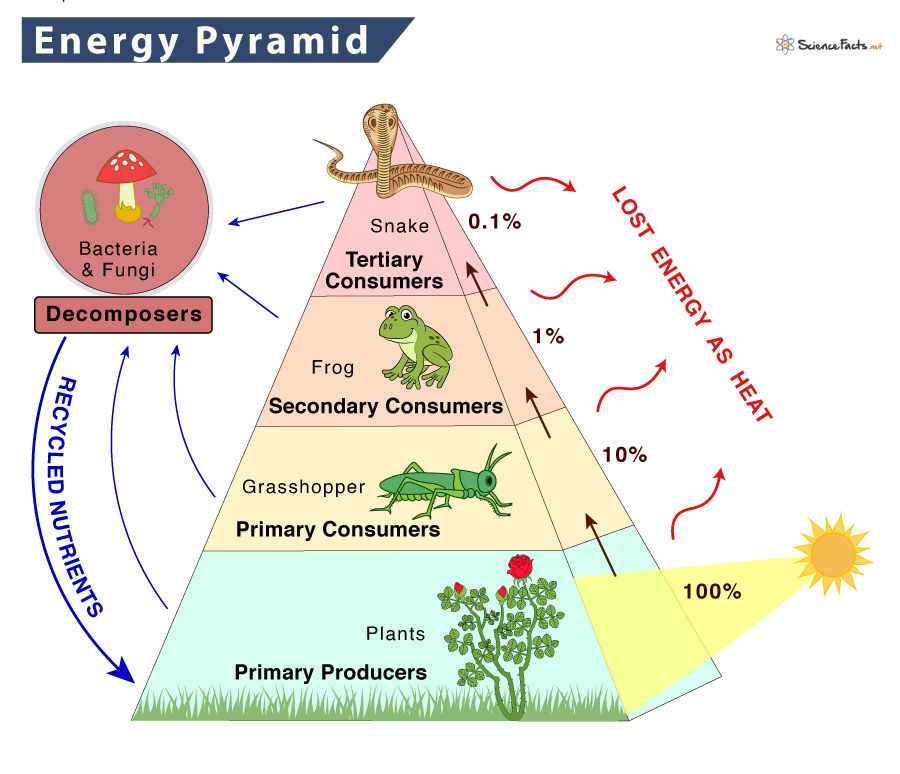
Available Kcal decreases every time you move up a trophic level
Only about 10% of energy in an organism is gained by eating it
Ex: There could be a total of 1,000 Kcal in a bowl of lettuce. If you eat it, your body only gains 100 Kcal
This is ten percent PER LEVEL increase; so if a fish eats a 100 KCal mayfly, and you eat that fish, you only gain 1 Kcal worth of that bug's energy! (100 x 0.1 x 0.1 = 1)
36
Multiple Choice
How much energy is passed along every trophic level increase?
50%
25%
100%
10%
37
Multiple Choice
A gopher has gained 200 Kcal from eating grass all day. A snake comes along and eats that gopher, gaining a portion of those Kcal. A hawk swoops down and eats the snake; how many trophic levels have we moved up?
2
3
4
5
38
Math Response
A gopher has gained 200 Kcal from eating grass all day. A snake comes along and eats that gopher, gaining a portion of those Kcal. A hawk swoops down and eats the snake; how many Kcal from the grass is transferred to the hawk?
39
SImilar to a food chain or web, energy pyramids are a diagram that show us the amount of energy that moves from one trophic level to another
Energy Pyramid

Show answer
Auto Play
Slide 1 / 39
SLIDE
Similar Resources on Wayground

33 questions
Enzymes and Their Actions
Presentation
•
9th - 12th Grade
34 questions
Waves and Their Types
Presentation
•
9th - 12th Grade
34 questions
Classifying and Describing Waves
Presentation
•
9th - 12th Grade
37 questions
Intro to Chemical Bonding
Presentation
•
9th - 12th Grade
31 questions
7.1 Biodiversity Lesson 1
Presentation
•
9th - 12th Grade
35 questions
MS-PS2-2: Forces and Motion
Presentation
•
8th Grade - University
34 questions
Protein synthesis 1
Presentation
•
9th - 12th Grade
32 questions
Unit 2A FCS Review
Presentation
•
9th - 12th Grade
Popular Resources on Wayground
10 questions
Safety Day 2026 – Student Review

Quiz
•
9th Grade
21 questions
Continents and Oceans
Quiz
•
6th Grade
20 questions
Parts of Speech
Quiz
•
5th Grade
16 questions
Subject & Predicate
Quiz
•
5th Grade
25 questions
Multiplication Facts
Quiz
•
5th Grade
12 questions
Map Skills
Quiz
•
3rd Grade
22 questions
Continents and Oceans
Quiz
•
5th Grade
15 questions
Rounding Decimals
Quiz
•
5th Grade
Discover more resources for Science
10 questions
Exploring Chemical and Physical Changes

Interactive video
•
6th - 10th Grade
20 questions
Atomic Structure
Quiz
•
9th Grade
10 questions
Exploring the Electromagnetic Spectrum for Middle School Science
Interactive video
•
6th - 10th Grade
10 questions
Exploring Force and Motion Concepts
Interactive video
•
6th - 10th Grade
10 questions
Exploring Air Masses and Weather Fronts
Interactive video
•
6th - 10th Grade
14 questions
Periodic Trends
Interactive video
•
11th Grade
10 questions
Exploring the States of Matter
Interactive video
•
6th - 10th Grade
10 questions
Exploring Forces: Net Force, Normal Force, Gravity, and Friction
Interactive video
•
6th - 10th Grade