Enzymes and Their Actions
Presentation
•
Science
•
9th - 12th Grade
•
Medium
+12
Standards-aligned
Kurt Trout
Used 2+ times
FREE Resource
9 Slides • 24 Questions
1
Enzymes and their actions
By Kurt Trout
2
Enzymes
Biological Catalysts
3
Enzymes are Biological Catalysts
They are proteins
Catalysts speed up chemical reactions
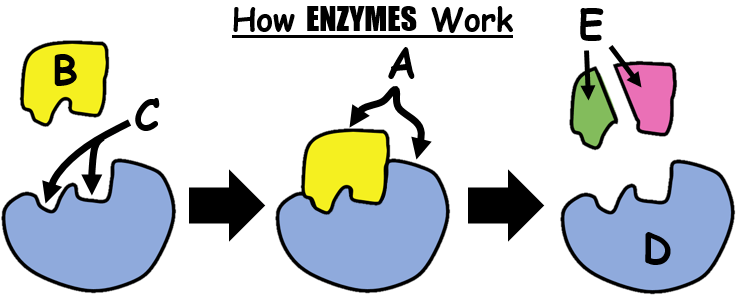
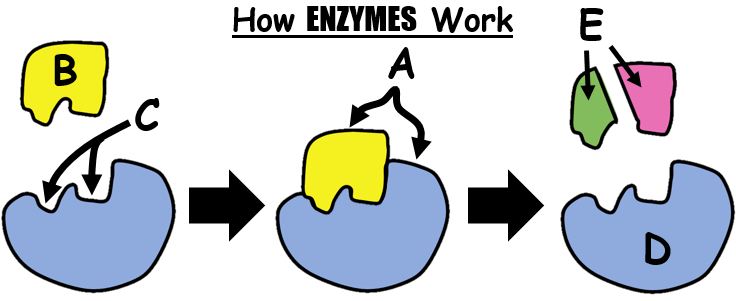
Structure = Function: Enzymes are specific to their Substrate (reactants). Active site of the enzymes fits together with the substrate(s)
Different reactions require different enzymes
4
2 Why do living things need chemical reactions?
Some reactions release energy; others require energy. Energy changes determine whether a chemical reaction will occur.
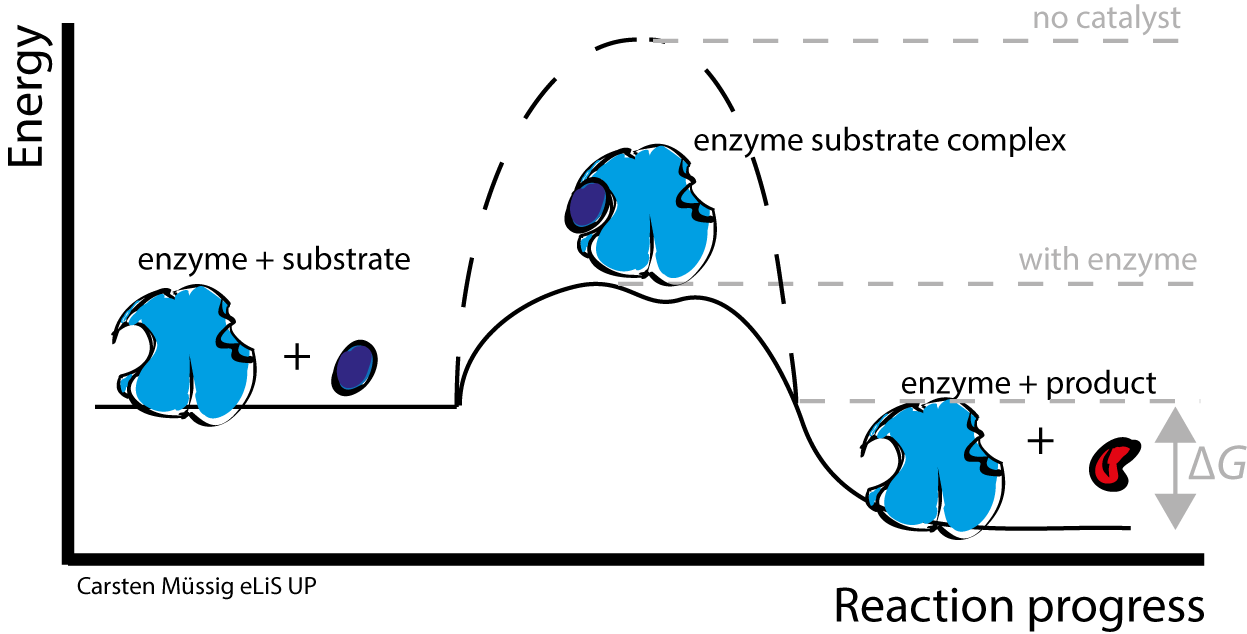
The energy needed to get a reaction started is called activation energy.
5
2 Why do living things need chemical reactions?
Enzymes work to lower activation energy. Enzymes are called biological catalysts.
6
Multiple Choice
What is the function of an enzyme?
to speed up chemical reactions in a cell
to receive messages
to carry molecules across membranes
to turn on or turn off genes
7
Multiple Choice
8
Multiple Choice
9
Multiple Choice
10
Multiple Choice
11
Multiple Choice
12
Multiple Choice
13
Means to make something. Taking 2 different monomers and putting them together to make a polymer
Synthesis
Means to split, divide, break something. Taking a polymer and splitting it apart.
Hydrolysis
14
This means the reaction is using WATER, or H2O to either combine or split the molecules.
Dehydration Reactions
15
In this, a water molecule (H20) is used to SPLIT a polymer into smaller molecules.
Hydrolysis Reaction
16
Lysis means to break apart.
Hydrolysis means to break polymers into monomers, by using H2O. It RELEASES energy to happen.
Hydrolysis
Synthesis means to BUILD!
This is the process of putting TOGETHER monomers to make polymers, by using H2O. It REQUIRES energy.
Dehydration Synthesis
Monomers to Polymers, and back....
17
Multiple Choice
18
Multiple Choice
Breaks polymers to form a monomers
19
Multiple Choice
20
Multiple Choice
A _________ reaction removes a molecule of water to bond molecules together to create a polymer.
hydrolysis
water
dehydration synthesis
magical
21
Multiple Choice
Which type of reaction is shown?
Dehydration Synthesis
Hydrolysis
22
Multiple Choice
What type of reaction is shown?
Dehydration synthesis
Hydrolysis
23
Multiple Choice
Which type of reaction is shown?
Dehydration Synthesis
Hydrolysis
24
Multiple Choice
Dehydration Synthesis
Hydrolysis
25
Multiple Choice
Dehydration Synthesis
Hydrolysis
26
Drag and Drop
27
Multiple Choice
The creating of Polymers
Dehydration synthesis
Hydrolysis
28
Multiple Choice
The breaking of Polymers
Dehydration synthesis
Hydrolysis
29
Multiple Choice
Hydrolisis _____ water
produces
requires
30
Multiple Choice
Dehydration Synthesis _____ water
produces
requires
31
Hotspot
Where is the water molecule?
32
Hotspot
Click on the hydrolysis reaction
33
Hotspot
Click on the dehydration synthesis reaction
Enzymes and their actions
By Kurt Trout
Show answer
Auto Play
Slide 1 / 33
SLIDE

Similar Resources on Wayground
28 questions
Homeostasis and Cells
Presentation
•
9th - 12th Grade
28 questions
Cellular Homeostasis
Presentation
•
9th - 12th Grade
27 questions
DE_Chem_1.2_Thermochemistry
Presentation
•
9th - 12th Grade
23 questions
Chemical Reactions - Chemical Changes and Conservation
Presentation
•
9th - 12th Grade
27 questions
Biology Unit 1 Review
Presentation
•
9th - 12th Grade
26 questions
Cell Organelles
Presentation
•
9th - 12th Grade
29 questions
EES Standard 2.5 Review
Presentation
•
9th - 12th Grade
25 questions
6.2 - Boxplots and Five Number Summaries
Presentation
•
9th - 11th Grade
Popular Resources on Wayground
24 questions
PBIS-HGMS Day 10
Quiz
•
6th - 8th Grade
10 questions
HCS SCI 03 Summer School Review 3
Quiz
•
3rd Grade
11 questions
Home Scope
Quiz
•
7th - 8th Grade
15 questions
HCS SCI 05 Summer School Assessment 3 Review
Quiz
•
5th Grade
35 questions
Lufkin Road Middle School Student Handbook & Policies Assessment
Quiz
•
7th Grade
18 questions
Geo 11.3 Area of Circles and Sectors
Quiz
•
9th - 11th Grade