Class #104: Energy and Phase Change
Presentation
•
Science
•
10th Grade
•
Practice Problem
•
Medium
+2
Standards-aligned
Judith Fiedler
Used 15+ times
FREE Resource
29 Slides • 23 Questions
1
Chemistry Class #104
2
AIM: Students will understand that changes in states
of matter involve changes in energy.
Class #104
2
3
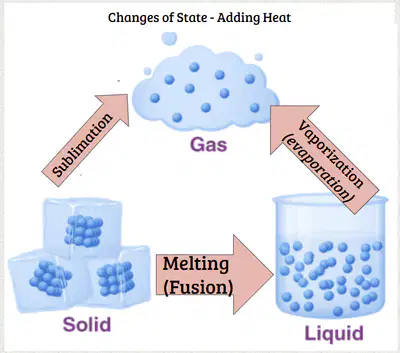
Melting
(Fusion)
Vaporization
Changes of State - Adding Heat
3
4
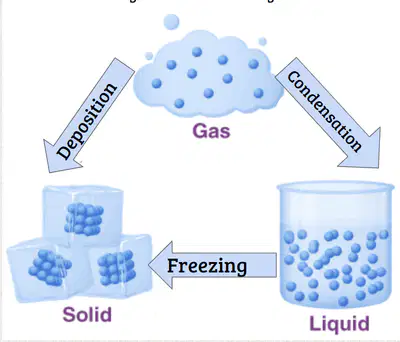
Condensation
Deposition
Changes of State - Removing Heat
4
5
Multiple Select
Which changes of state involve ADDING heat? (Choose 2!)
[HINT: look at your notes!]
Freezing
Fusion (Melting)
Condensation
Vaporization (Evaporation)
6
Multiple Select
Which changes of state involve REMOVING heat? (Choose 2!)
Condensation
Evaporation
Sublimation
Deposition
7
5
8
Heat
● Heat is a quantity of energy
● We cannot measure heat directly
●
We can only measure heat when
it is being TRANSFERRED from
one (hotter) object to another
(cooler) object
●
Units for measuring heat:
Joules (J)
Kilojoules (kJ)
6
9
Multiple Select
Which units can be used to measure heat energy? (Choose TWO)
degrees Celsius
(°C)
Joules (J)
Kilojoules (kJ)
Kelvin (K)
10
Gas
Solid
Liquid
How can we describe the difference in particle motion in
different states of matter?
11
Temperature
● Temperature is a measure of the average kinetic energy of a
substance’s particles
○ kinetic energy is the energy of MOTION
● Temperature tells us how fast the particles in a substance
are moving “on average”
Celsius (℃)
Kelvin (K)
●
Units for measuring temperature:
7
12
Temperature
● When we talk about a change in temperature (△T) we are
talking about a change in the average kinetic energy
(△KE) of the particles in a object/substance
△ = “change in”
● When the temperature of a substance is going DOWN, on
average it’s particles are starting to move _____________
● When the temperature of a substance is going UP, on average
it’s particles are starting to move _____________
slower
faster
8
13
Celsius
Kelvin
10
14
Multiple Choice
The energy involved in the movement of particles in a substance is
potential energy
kinetic energy
both potential and kinetic energy
15
Multiple Choice
Temperature is defined as the
total amount of kinetic energy in a substance
total amount of potential energy in a substance
average kinetic energy of the particles in a substance
average potential energy of the particles in a substance
16
Multiple Choice
Use your notes OR Table T for this question!
A piece of pizza straight out of the oven has a temperature of 425 °C . What is its temperature in Kelvin?
525K
698K
152
273K
17
Temperature (℃)
Time
-20
0
100
120
solid/liquid
liquid/gas
solid only
liquid only
gas only
Heating Curve
Heat is added at a constant rate
11
18
Temperature (℃)
Time
-20
0
100
120
liquid/solid
gas/liquid
solid only
liquid only
gas only
Cooling Curve
Heat is lost at a constant rate
12
19
Energy Changes
Temperature (℃)
Time
-20
0
100
120
Temperature Change
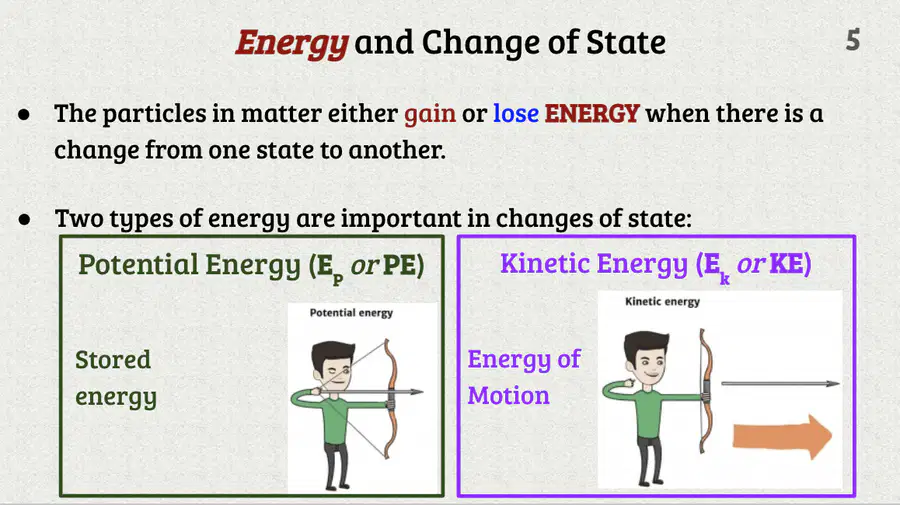
KE increases
KE increases
KE increases
NO
CHANGE
in KE
NO
CHANGE
in KE
20
Energy Changes
Temperature (℃)
Time
-20
0
100
120
PE increases
PE increases
NO PE
CHANGE
NO PE
CHANGE
NO PE
CHANGE
Phase Change
21
Energy Changes
Temperature (℃)
Time
-20
0
100
120
Temperature Change
Phase Change
KE decreases
PE decreases
PE decreases
KE decreases
KE decreases
22
For Heat problems:
● Temperature changes when there is a change in Kinetic
Energy
● Temperature change: △T
○ Final temperature - initial temperature
● Temperature does NOT change during a phase change
13
23
Multiple Choice
When the temperature of a substance is increasing, the potential energy of the substance
increases
decreases
stays the same
24
Multiple Choice
When the temperature of a substance is increasing, the kinetic energy of the substance
increases
decreases
stays the same
25
Multiple Choice
When a substance is changing from a solid to a liquid
the temperature increases
the temperature decreases
the temperature stays the same
26
Multiple Choice
When a substance is changing from a gas to a liquid
the potential energy increases
the potential energy decreases
the potential energy stays the same
27
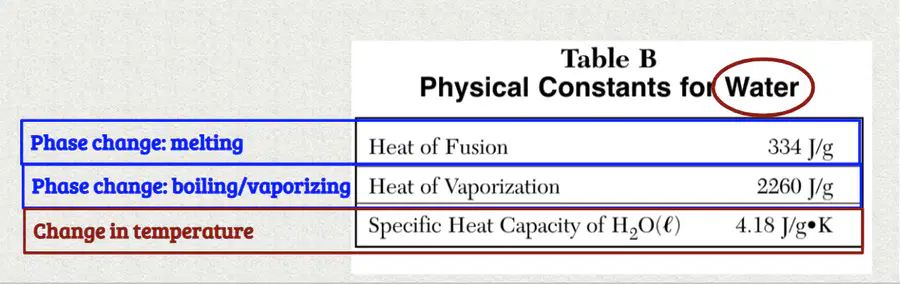
Physical Constants for Water
Phase change: melting
Phase change: boiling/vaporizing
Change in temperature
●
Energy requirements for change in phase or in temperature
●
Every substance has its own unique energy requirements!
●
These constants are ONLY for WATER
14
28
Specific Heat Capacity
●
The amount of energy needed to raise the TEMPERATURE of a
specific amount of a substance 1 Kelvin or 1℃
●
The specific heat capacity of water:
○
4.18 J of heat energy is LOST when 1 gram of water is COOLED
by one degree Kelvin
○
4.18 J of heat energy must be added to raise the temperature
of 1 gram of water by one degree Kelvin
15
29
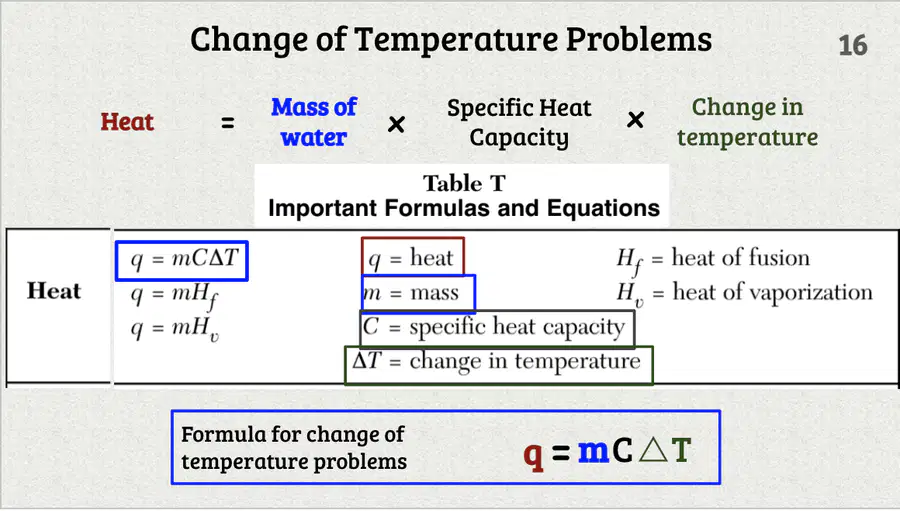
Change of Temperature Problems
Changing the Temperature
●
How many degrees (K or
℃) is the temperature
changing?
●
How much water do
you have by mass in
grams (g)?
●
How much heat energy
per gram (J/g) is needed
to change temperature?
Heat
needed
Specific
Heat
Capacity
x
=Mass of
x Number of
water
degrees
30
Change of Temperature Problems
16
31
Multiple Choice
Use Table T or your notes for this question!
What is the symbol in the formula for Specific Heat Capacity?
ΔT
m
C
q
32
A pot containing 250 g water at 20℃ is heated until the water
reaches a temperature of 80℃ . How much heat energy is
required?
mC
q = △T
m =
C =
=
△T Final temp - initial temp
17
33
Multiple Choice
Is the temperature changing in this problem
Yes
No
34
Multiple Choice
Looking at Table T, which equation is needed for this problem?
q=mHf
q=mCΔT
q=mHυ
35
Multiple Choice
The mass in this problem is
20∘C
80∘C
250g
36
Multiple Choice
The change in temperature is
20°C−80°C=−60°C
80°C−20°C =60°C
37
Multiple Choice
What is C in the formula and where can you find it?
C is the volume and it is in the question.
C is the temperature and it is on Table T.
C is the Specific Heat Capacity and it is on Table B.
38
A pot containing 250 g water at 20℃ is heated until the water
reaches a temperature of 80℃ . How much heat energy is
required?
mC
q = △T
m =
C =
=
△T
250 g
4.18 J/g•K
Final temp - initial temp = 80℃ - 20℃ = 60℃
17
39
A pot containing 250 g water at 20℃ is heated until the water
reaches a temperature of 80℃ . How much heat energy is
required?
mC
q = △T
m =
C =
=
△T
250 g
4.18 J/g•K
Final temp - initial temp = 80℃ - 20℃= 60℃
250 g
4.18 J/g•K
60℃
x
=
x
17
40
Fill in the Blanks
How much heat energy is required? Make sure to add the correct UNIT for heat!!
41
A beaker containing 250 g water at 80℃ is placed in the
refrigerator until the water cools to a temperature of 20℃ .
What is the change in heat energy in the water?
mC
q = △T
m =
C =
=
△T Final temp - initial temp
18
42
Fill in the Blanks
What is ΔT for this problem? (You cannot enter the unit for this problem - just enter the number value WITH the correct sign!)
Type answer...
43
A beaker containing 250 g water at 80℃ is placed in the
refrigerator until the water cools to a temperature of 20℃ .
What is the change in heat energy in the water?
mC
q = △T
m =
C =
=
△T
250 g
4.18 J/g•K
Final temp - initial temp = 20℃ - 80℃= - 60℃
18
44
Fill in the Blanks
What is the change in heat energy for this problem. Make sure to add the correct unit for heat!
45
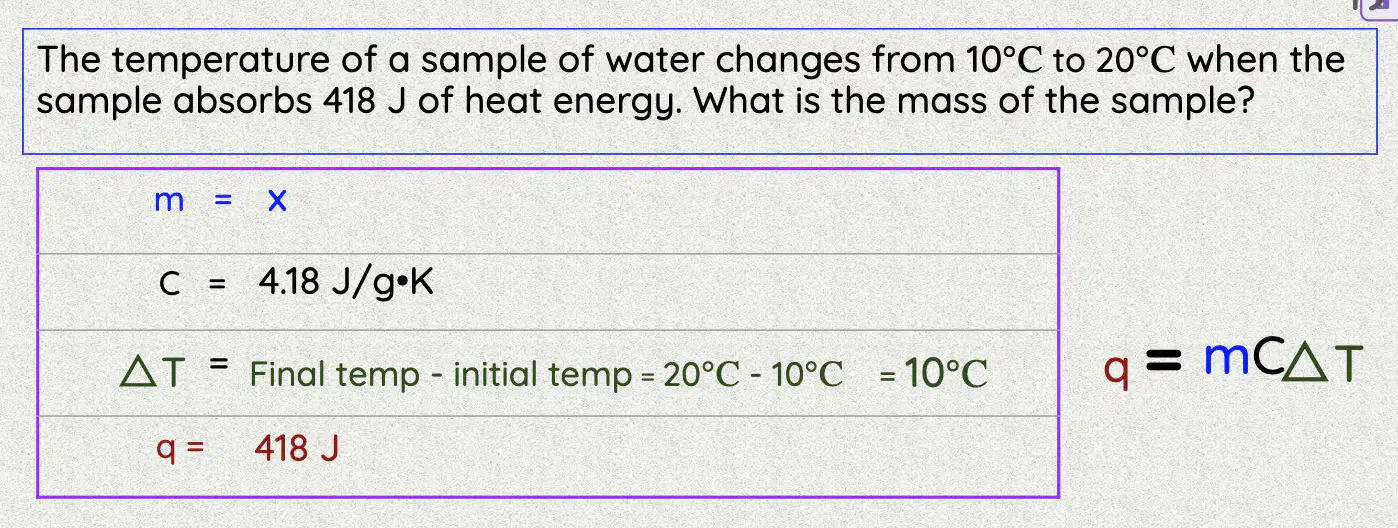
The temperature of a sample of water changes from 10℃ to 20℃ when the
sample absorbs 418 J of heat energy. What is the mass of the sample?
mC
q = △T
m =
C =
=
△T Final temp - initial temp
q =
19
46
Multiple Choice
What is the UNKNOWN in this problem? What are you supposed to find?
The unknown is q, the amount of heat energy.
The unknown is ΔT , the temperature change
The unknown is C, the Specific Heat Capacity of water
The unknown is m, the mass of the water.
47
The temperature of a sample of water changes from 10℃ to 20℃ when the
sample absorbs 418 J of heat energy. What is the mass of the sample?
mC
q = △T
m =
C =
=
△T
x
4.18 J/g•K
Final temp - initial temp = 20℃ - 10℃
= 10℃
418 J
q =
19
48
Fill in the Blanks
Use a piece of paper and a calculator to work out this problem. Record your answer below. Make sure to include the correct unit!!
49
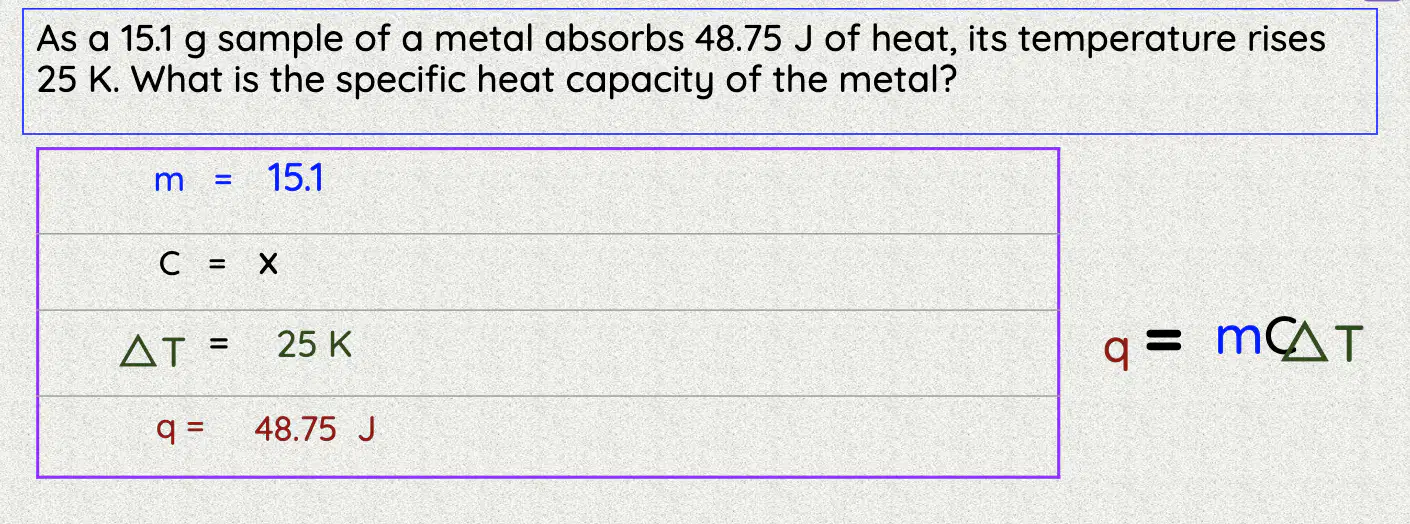
As a 15.1 g sample of a metal absorbs 48.75 J of heat, its temperature rises
25 K. What is the specific heat capacity of the metal?
mC
q = △T
m =
C =
=
△T
q =
20
50
Multiple Choice
What is the unknown in this problem? What is it asking you to find?
The mass, m, of the sample.
The change in heat, ΔT
The Specific Heat Capacity, C
The heat energy used - q
51
As a 15.1 g sample of a metal absorbs 48.75 J of heat, its temperature rises
25 K. What is the specific heat capacity of the metal?
mC
q = △T
m =
C =
=
△T
15.1
x
25 K
48.75 J
q =
20
52
Fill in the Blanks
Enter your answer below. The decimal point is given for you. Make SURE to add the correct unit! You can find the unit on Table B. You can't type the dot (⋅) in the unit. Type x instead!
Chemistry Class #104
Show answer
Auto Play
Slide 1 / 52
SLIDE

Similar Resources on Wayground
45 questions
Electronegativity
Presentation
•
10th Grade
44 questions
Chapter 20-22: Origins of Plant Life
Presentation
•
10th Grade
44 questions
G1 Sc CA 1 Revision
Presentation
•
KG
46 questions
Cladograms and Levels of Organization
Presentation
•
9th Grade
45 questions
Auaugst 19th Lesson
Presentation
•
9th - 10th Grade
45 questions
Metric Conversion & Scientific Notation
Presentation
•
9th Grade
49 questions
1 - Slope
Presentation
•
10th Grade
47 questions
KEANEKARAGAMAN HAYATI
Presentation
•
10th Grade
Popular Resources on Wayground
10 questions
Safety Day 2026 – Student Review
Quiz
•
9th Grade
21 questions
Continents and Oceans
Quiz
•
6th Grade
20 questions
Parts of Speech
Quiz
•
5th Grade
16 questions
Subject & Predicate
Quiz
•
5th Grade
25 questions
Multiplication Facts
Quiz
•
5th Grade
12 questions
Map Skills
Quiz
•
3rd Grade
22 questions
Continents and Oceans
Quiz
•
5th Grade
15 questions
Rounding Decimals
Quiz
•
5th Grade
Discover more resources for Science
10 questions
Exploring Chemical and Physical Changes
Interactive video
•
6th - 10th Grade
10 questions
Exploring the Electromagnetic Spectrum for Middle School Science
Interactive video
•
6th - 10th Grade
10 questions
Exploring Force and Motion Concepts
Interactive video
•
6th - 10th Grade
10 questions
Exploring Air Masses and Weather Fronts
Interactive video
•
6th - 10th Grade
10 questions
Exploring the States of Matter
Interactive video
•
6th - 10th Grade
10 questions
Exploring Forces: Net Force, Normal Force, Gravity, and Friction
Interactive video
•
6th - 10th Grade
10 questions
Differentiating Thermal Energy and Temperature
Interactive video
•
6th - 10th Grade
10 questions
Exploring the States of Matter and Thermal Energy
Interactive video
•
6th - 10th Grade