

The Reformation part 2

Presentation
•
Social Studies
•
9th - 12th Grade
•
Practice Problem
•
Hard

Travis Thorpe
FREE Resource
9 Slides • 0 Questions
1
The Protestant Reformation Part 1

2
Terms & Names
Indulgence Release from punishments due for a sin
Reformation 16th-century movement for religious reform, leading to the founding of new Christian churches
Lutheran Member of a Protestant church founded on the teachings of Martin Luther
Protestant Member of a Christian church founded on the principles of the Reformation
Anglican Relating to the Church of England

3
Terms & Names (continued)
Predestination Doctrine that God has decided all things beforehand, including which people will be saved
Calvinism Religious teachings based on the ideas of the reformer John Calvin
Theocracy Government controlled by religious leaders
Scientific Revolution New way of thinking about the natural world based on careful observation and a willingness to question
Scientific method Logical procedure for gathering and testing ideas

4

Terms & Names (continued)
Nicolaus Copernicus Astronomer who developed a heliocentric theory
Galileo Galilei Scientist who was forced by the Catholic Church to take back scientific ideas that contradicted the church’s view
Isaac Newton Scientist who discovered laws of motion and gravity
Robert Boyle Scientist considered to be the founder of modern chemistry
5

Intellectual effects/impact of the Reformation:
●Individuals could interpret scripture if Bibles could be mass printed.
●Artistic effects/impact of the Reformation: The Catholic Church patronized artists who created works with religious themes.
●Economic effects/impact of the Reformation: The growing middle class and the spread of ideas and goods led to the growth of trade systems and trade cities.
Religious effects/impact of the Reformation:
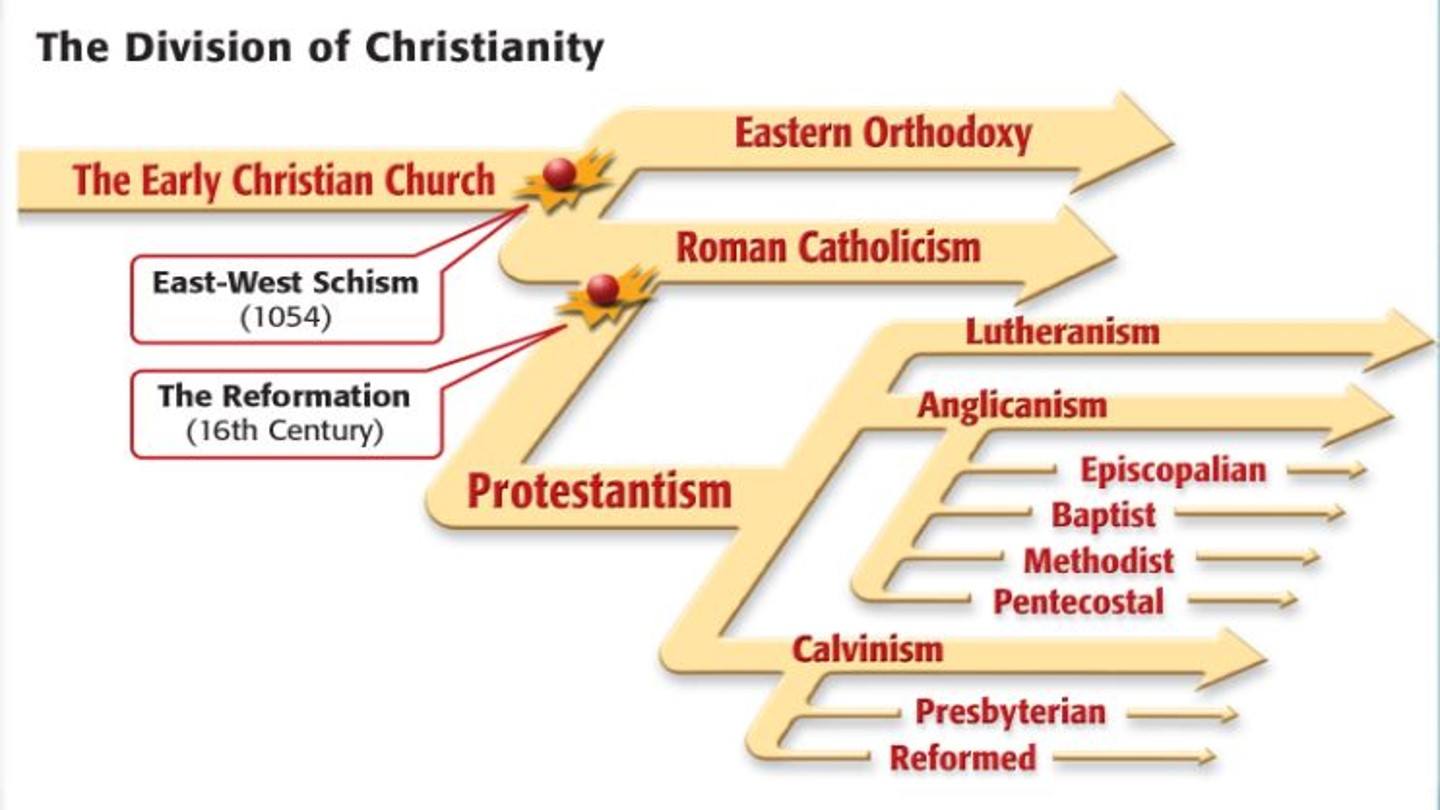
●New Protestant denominations formed as splits (or schisms) occurred in Christianity.
●Religious wars broke out in Europe between Catholics and Protestants in many European nations.
●The Catholic Church launched a Counter Reformation to address concerns about the Catholic Church.
John Calvin: started a new protestant branch called Calvinism, which gained popularity and spread in England and Scotland. Calvinism asserted predestination, an all-knowing God, and believed the Church should influence the monarchy.
6
What did Calvin teach?
Protestantism arose elsewhere in the 1530s under the leadership of John Calvin. Calvin taught that people are sinful by nature. He also taught predestination, the idea that God determines beforehand who will be saved. The religion based on Calvin’s teachings is called Calvinism. Calvin created a theocracy in Geneva, Switzerland. It was government run by religious leaders. It had strict rules of behavior.
Protestants in Holland, France, and Switzerland adopted Calvin’s ideas. In France, his followers were called Huguenots. Conflict between them and Catholics often turned into violence. In 1572, mobs killed about 12,000 Huguenots.

7

8
9

The Protestant Reformation Part 1
Show answer
Auto Play
Slide 1 / 9
SLIDE
Similar Resources on Wayground

7 questions
The Second Agricultural Revolution
Presentation
•
9th - 12th Grade
8 questions
Sustainable Environments
Presentation
•
9th - 12th Grade
8 questions
The Feudal System
Presentation
•
KG
7 questions
Unit 4: WWI Intro Lesson & Concept Checkpoint #4
Presentation
•
9th - 12th Grade
6 questions
Branches of Govt
Presentation
•
KG - 12th Grade
11 questions
The Atlantic Slave Trade
Presentation
•
9th - 12th Grade
7 questions
Unit 5 Agriculture
Presentation
•
9th - 12th Grade
Popular Resources on Wayground
10 questions
Safety Day 2026 – Student Review

Quiz
•
9th Grade
21 questions
Continents and Oceans
Quiz
•
6th Grade
20 questions
Parts of Speech
Quiz
•
5th Grade
16 questions
Subject & Predicate
Quiz
•
5th Grade
25 questions
Multiplication Facts
Quiz
•
5th Grade
12 questions
Map Skills
Quiz
•
3rd Grade
22 questions
Continents and Oceans
Quiz
•
5th Grade
15 questions
Rounding Decimals
Quiz
•
5th Grade
Discover more resources for Social Studies
10 questions
Exploring the Age of Exploration: Key Events and Figures

Interactive video
•
6th - 10th Grade
9 questions
Exploring Ancient Mesopotamia and Its Civilizations
Interactive video
•
10th Grade
20 questions
Chapter 8 Test "Types of Business Organizations"
Quiz
•
12th Grade
39 questions
Unit 7 Key Terms
Quiz
•
11th Grade - University
10 questions
Debating the Legacy of Christopher Columbus
Interactive video
•
6th - 10th Grade
38 questions
Unit 6 Key Terms
Quiz
•
11th Grade - University
27 questions
World Geography - Q1 9week Test
Quiz
•
9th Grade
22 questions
U3T2 Vocab FAC: Domestic Policy
Quiz
•
10th Grade