

Quantum Theory and the Atom

Presentation
•
Chemistry
•
11th Grade
•
Practice Problem
•
Easy
Standards-aligned

Calvin Huck
Used 67+ times
FREE Resource
16 Slides • 10 Questions
1

2
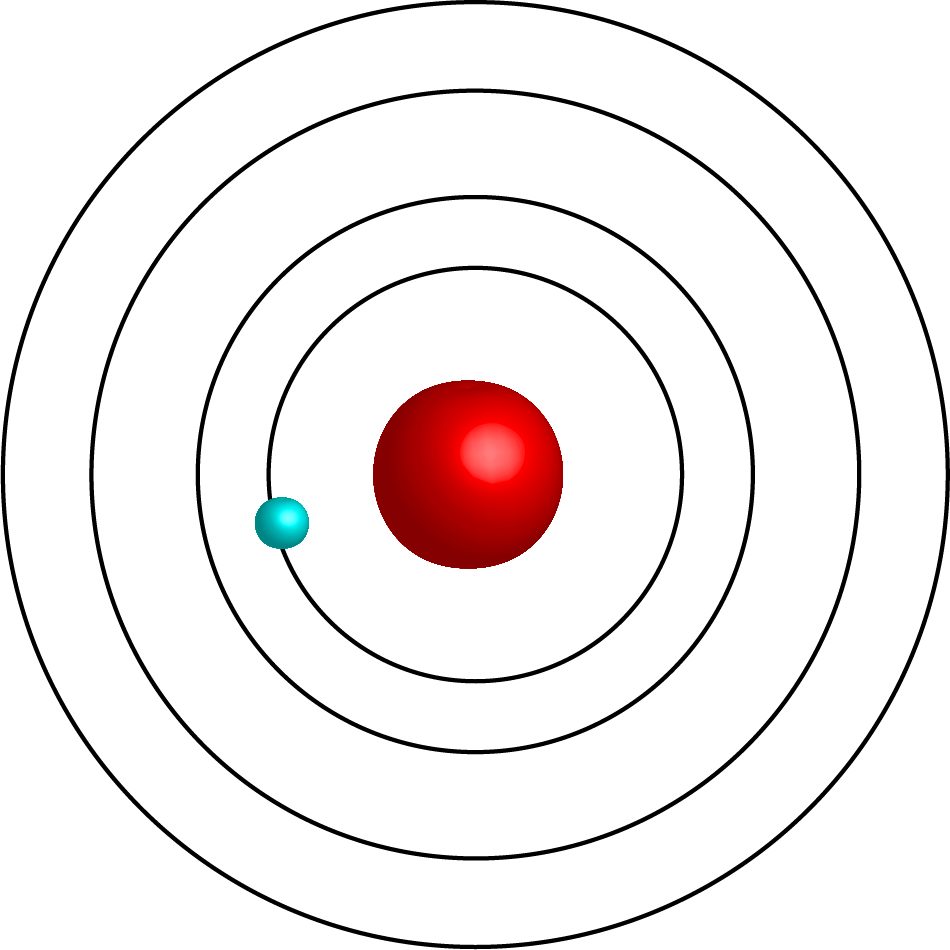
Niels Bohr, A Danish physicist working in Rutherford's laboratory in 1913 proposed a quantum model for the hydrogen atom that seemed to answer the question about why the emission spectrum generated by hydrogen was discontinuous and only made up of certain frequencies.
3
Bohr proposed the hydrogen atom has only certain allowable energy states. The lowest allowable state of an atom is called its ground state. When an atom gains energy, it is said to be in an excited state.

4
Multiple Choice
The lowest allowable energy state is called the
excited state
ground state
orbital state
5
Bohr related the hydrogen atom's energy to the electron in the atom. He suggested that the electron moves around the nucleus in only certain allowable circular orbits. The smaller the orbit, the lower the atom's energy state. Conversely, the larger the orbit, the higher the energy state.

6
Bohr assigned a number, n, called a quantum number, to each orbit. For the first orbit, the one closest to the nucleus, he referred to it as n=1. For the second, n=2, the third n=3, etc. When energy is added to the atom from an outside force, the electron moves to a higher energy orbit.

7
Multiple Choice
When energy is added to an atom from an outside source, an electron will move to a higher orbit.
True
False
8
When energy is added to an atom, it moves from a ground state to an excited state. The excited state is not the natural state and an atom will release energy in the form of a photon of light to go back to the ground state.

9
Multiple Choice
When is an excited state, and electron will release energy in the form of a __________ of light and move back to the ground state.
proton
neutron
photon
10
Bohr's model works for the hydrogen atom, but failed to explain the emission spectrum of other elements. It also did not fully account for the chemical behavior of atoms. It did lay the groundwork for atomic models that would come later.
11
In 1924, a French graduate student in physics named Louis de Broglie (1892-1987) proposed an idea that eventually accounted for the fixed energy levels of Bohr's model.
De Broglie had been thinking that Bohr's quantitized electron orbits had characteristics similar to those of waves. He reflected on the fact that light has both wave and particle characteristics. He proposed that particles, including electrons, could also behave like waves.
12

13
The de Broglie equation predicts that all moving particles have wave characteristics. The wavelength is too small to be seen or detected.

14
Multiple Choice
The de Broglie model of the atom states that moving particles have
wave-like properties
orbitals
sublevels
15
German theoretical physicist Werner Heisenberg (1901-1976) showed that it is impossible to take any measurements without disturbing the object.
The Heisenberg uncertainty principle states that it is fundamentally impossible to know precisely both velocity and position of a particle at the same time.
16
Multiple Choice
The Heisenberg Uncertainty Principal states that it is
impossible to know the location and velocity of a particle at the same time.
possible to know the location and velocity of a particle at the same time.
impossible to know the orbital and electron is in.
17
The wave function predicts a three-dimensional region around the nucleus, called an atomic orbital, which describes the electron's probable location. A atomic orbital is like a fuzzy cloud in which the density at a given point is proportional to the probability of finding the electron at that point. The cloud has no definite boundary and the electron can be found at a considerable distance from the nucleus.

18
The quantum mechanical model assigns four quantum numbers to atomic orbitals. The first one is the principal quantum number (n) and indicates the size and energy of atomic orbitals. Each major energy level is called a principal energy level.
Principal energy levels contain energy sublevels. The first energy level has 1 sublevel, the second energy level contains 2 sublevels, the third has 3 sublevels, and the fourth has 4 sublevels.
19
Orbitals and sublevels are areas where electrons can be found. Sublevels are labeled s, p. d, and f according to the shapes of the atom's orbitals. All orbitals are spherical, and all p orbitals are dumbbell-shaped.

20

21
Multiple Choice
The s sublevel has a
spherical shape
dumbbell shape
oblong shape
22
Multiple Choice
The p sublevel has a
spherical shape
dumbell shape
oblong shape
23
Multiple Choice
The first energy level has
1 sublevel
2 sublevels
3 sublevels
4 sublevels
24
Multiple Choice
The second energy level has
one sublevel
two sublevels
three sublevels
four sublevels
25
26
Multiple Choice
The fourth energy level has
one sublevel
two sublevels
three sublevels
four sublevels
Show answer
Auto Play
Slide 1 / 26
SLIDE
Similar Resources on Wayground

20 questions
The Nervous System
Presentation
•
11th - 12th Grade
21 questions
Best Method: Solving Systems of Equations
Presentation
•
7th - 10th Grade
21 questions
Cold War Intro
Presentation
•
KG
19 questions
Graphing Sine and Cosine
Presentation
•
11th Grade
18 questions
Hukum dasar kimia & stoikiometri
Presentation
•
11th Grade
18 questions
EXPLANATION TEXT
Presentation
•
11th Grade
20 questions
Defining the Atom
Presentation
•
11th Grade
20 questions
How to Budget
Presentation
•
11th - 12th Grade
Popular Resources on Wayground
10 questions
Safety Day 2026 – Student Review

Quiz
•
9th Grade
21 questions
Continents and Oceans
Quiz
•
6th Grade
20 questions
Parts of Speech
Quiz
•
5th Grade
16 questions
Subject & Predicate
Quiz
•
5th Grade
25 questions
Multiplication Facts
Quiz
•
5th Grade
12 questions
Map Skills
Quiz
•
3rd Grade
22 questions
Continents and Oceans
Quiz
•
5th Grade
15 questions
Rounding Decimals
Quiz
•
5th Grade
Discover more resources for Chemistry
20 questions
electron configurations and orbital notation
Quiz
•
9th - 12th Grade
20 questions
Periodic Table Trends
Quiz
•
11th Grade
50 questions
Unit 3: Atomic Assault Summative Review
Quiz
•
11th Grade
20 questions
Physical or Chemical Change/Phases
Quiz
•
8th Grade - University
15 questions
Periodicity Module Exam Practice Quiz
Quiz
•
9th - 12th Grade
15 questions
Electron Configurations and Orbital Notation
Quiz
•
11th Grade
8 questions
Label Energy Diagram
Quiz
•
9th - 12th Grade
20 questions
Naming Covalent Compounds
Quiz
•
11th Grade