

Organic Chemistry

Presentation
•
Biology, Science
•
9th - 12th Grade
•
Medium
+1
Standards-aligned

Teresa Schlueter
Used 41+ times
FREE Resource
39 Slides • 26 Questions
1
by Teresa Schlueter
2
The study of carbon compounds.
Carbon
the backbone of biological molecules

3

Carbon has 4 valence electrons (outer shell electrons)
Allows for several types of covalent bonds.
4

able to form chains
able to form rings

5

6
Multiple Choice

7
Fill in the Blanks
How many valency does carbon have
Type answer...
8
Multiple Choice
9
Multiple Choice

How many chemical bonds can each carbon atom form?
one
two
three
four
10
Monomers
small units that can join together to form polymers
Polymers
large compounds formed from combinations of many monomers

11
Monomers to polymers
monomers join together by dehydration sysnthesis

12
13
Multiple Choice
A single unit that can bond to other single units to form a polymer is a:
Lego
Monounits
Monopoly
Monomer
14
Multiple Choice
Monomers bond to other monomers through this process:
Hydrolysis
Dehydration synthesis
Gluation
Freezing
15
Multiple Choice
A very large organic molecule made up of chains of smaller molecules is called a
monomer
polymer
saturated hydrocarbon
substituted hydrocarbon
16
Multiple Choice
17
Multiple Choice
Polymer's split apart to form ________, by __________.
monomers, hydrolysis
monomers, dehydration synthesis
amino acids, hydrolysis
amino acids, dehydration synthesis
18
Carbohydrates
Lipids
Proteins
Nucleic acids

19
Multiple Choice
20

21
Elements
C
H
O
Monomer
C, H, O in a 1-2-1 ratio

22
Carbohydrates
Function(s)
energy
storage
structure
Examples
glucose
starch
glycogen
23
Function(s)
energy
storage
structure

24
Examples
glucose
starch
glycogen
sucrose

25
Unusual Information
Monosaccharide
simple sugar
glucose

26
Unusual Information
Disaccharide
2 simple sugars
sucrose

27
Unusual Information
Polysaccharide
many simple sugars
starch/glycoge

28
Multiple Choice
The monomer Glucose/Monosaccharides make up the polymer....
Proteins
Lipids
Nucleic Acids
Carbohydrates
29
Multiple Choice
30
Multiple Choice

This molecule could be the building block of...
nucleic acids
proteins
lipids
polysaccharides
waxes
31

32
Elements
C
H
Monomer
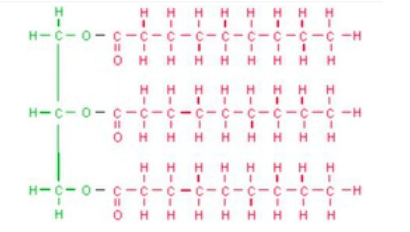
Glycerol
3 Carbons
1 alcohol
3 fatty acid chain

33
Function(s)
store energy
biological membranes
waterproof covering
hormones
structural support

34
Examples
fats
oils
waxes
steroids
corn oil
hormones

35
Unusual Information
Saturated
Each C in fatty acid chain has single bond with another C

36
Unusual Information
Monounsaturated
Have 1 C in fatty acid chain with a double bond to another C

37
Unusual Information
Polyunsaturated
2 or more C in fatty acid chain have double bond with another C

38
Multiple Choice

39
Multiple Choice
The monomer Fatty acids make up the polymer....
Proteins
Lipids
Nucleic Acids
Carbohydrates
40
Multiple Choice
41

42
Elements
C
H
N
O
Phosphate (PO4)

43
Monomer
Nucleotides
5 carbon sugar
phosphate group
nitrogenous base

44
Function(s)
store and transmit genetic information
biological membranes
blueprint for making proteins

45
Examples
Deoxyribonucleic acid
DNA
RIbonucleic Acid
RNA


46
Unusual Information
in charge of characteristics of life
at least 2 nucleotides combined by a covalent bonds

47
Multiple Choice
48
Multiple Choice

49
Multiple Choice
The monomer Nucleotides make up the polymer....
Proteins
Lipids
Nucleic Acids
Carbohydrates
50

51
Elements
C
H
N
O

52
Monomer
Amino Acids
Amino group (NH)
Carboxyl group (COOH)
H off central C
R-group

53
Function(s)
controls rate of reactions for life processes
forms bones and muscles

54
Function(s)
transports substances in / out of cells
helps fight diseases

55
Examples
Collagen
Carotene
Enzymes
Hemoglobin

56
Unusual Information
more than 20 amino acids (aa) formed in nature
bind to other aa by binding amino group to carboxyl group

57
Unusual Information
form poly peptide chains
Fold into complex shapes

58
Multiple Choice
59
Multiple Choice

60
Multiple Choice

61

62
Multiple Choice
63
Multiple Choice
64
Multiple Choice
65
Multiple Choice
by Teresa Schlueter
Show answer
Auto Play
Slide 1 / 65
SLIDE
Similar Resources on Wayground

64 questions
Final Exam Review
Presentation
•
9th Grade - University
58 questions
Digestive System
Presentation
•
9th - 11th Grade
57 questions
Unit 6 Origin of Life - DAY 1
Presentation
•
9th - 12th Grade
61 questions
Physical Science Semester II Exam Review
Presentation
•
8th - 11th Grade
60 questions
CH 5 - LESSON 5.1 - 5.3
Presentation
•
9th - 12th Grade
60 questions
Willowridge Genetic Mutations
Presentation
•
8th - 10th Grade
59 questions
無題のプレゼンテーション
Presentation
•
9th Grade - University
65 questions
Bonds Formulas & Reactions
Presentation
•
9th - 12th Grade
Popular Resources on Wayground
10 questions
Safety Day 2026 – Student Review

Quiz
•
9th Grade
21 questions
Continents and Oceans
Quiz
•
6th Grade
20 questions
Parts of Speech
Quiz
•
5th Grade
16 questions
Subject & Predicate
Quiz
•
5th Grade
25 questions
Multiplication Facts
Quiz
•
5th Grade
12 questions
Map Skills
Quiz
•
3rd Grade
22 questions
Continents and Oceans
Quiz
•
5th Grade
15 questions
Rounding Decimals
Quiz
•
5th Grade
Discover more resources for Biology
20 questions
Cell organelles and functions
Quiz
•
10th Grade
20 questions
Cell Transport
Quiz
•
9th - 12th Grade
25 questions
photosynthesis and cellular respiration
Quiz
•
9th Grade
20 questions
Cell Cycle
Quiz
•
9th Grade
8 questions
DNA vs. RNA
Presentation
•
9th - 12th Grade
14 questions
Ecological Succession: Primary and Secondary
Quiz
•
9th Grade
20 questions
Macromolecules
Quiz
•
10th Grade
20 questions
Characteristics of Life
Quiz
•
9th - 10th Grade