

Unit 6 Origin of Life - DAY 1

Presentation
•
Biology
•
9th - 12th Grade
•
Practice Problem
•
Hard
+8
Standards-aligned

Morgan Slevin
Used 1+ times
FREE Resource
29 Slides • 28 Questions
1

2
3
Multiple Choice
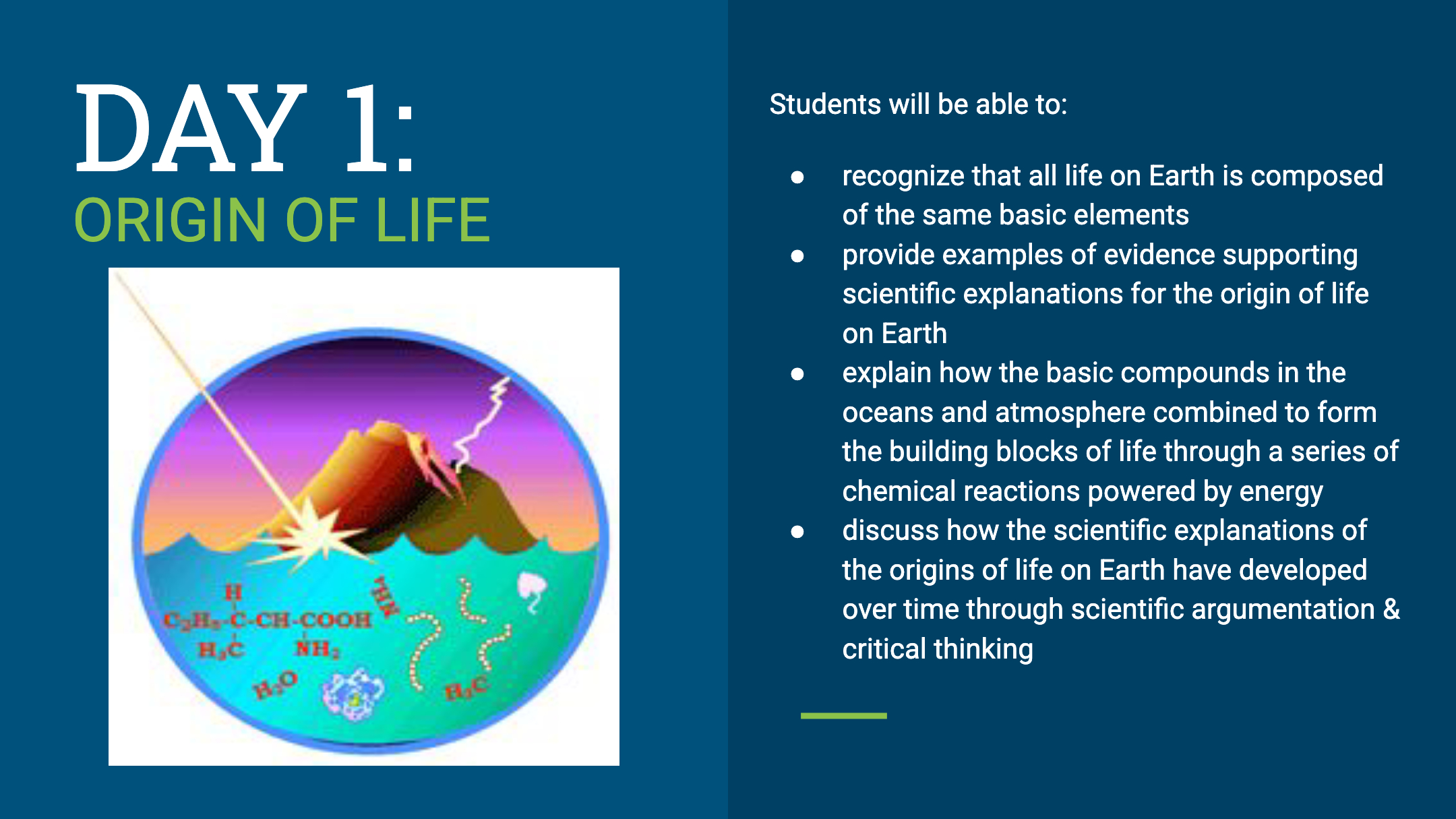
Which of the following is a key component in scientific explanations for the origin of life on Earth?
Basic elements found in living organisms
The presence of dinosaurs
Modern technology
Human civilization
4
Open Ended
Why is it important to study the origin and history of life on Earth?
5

6
Open Ended
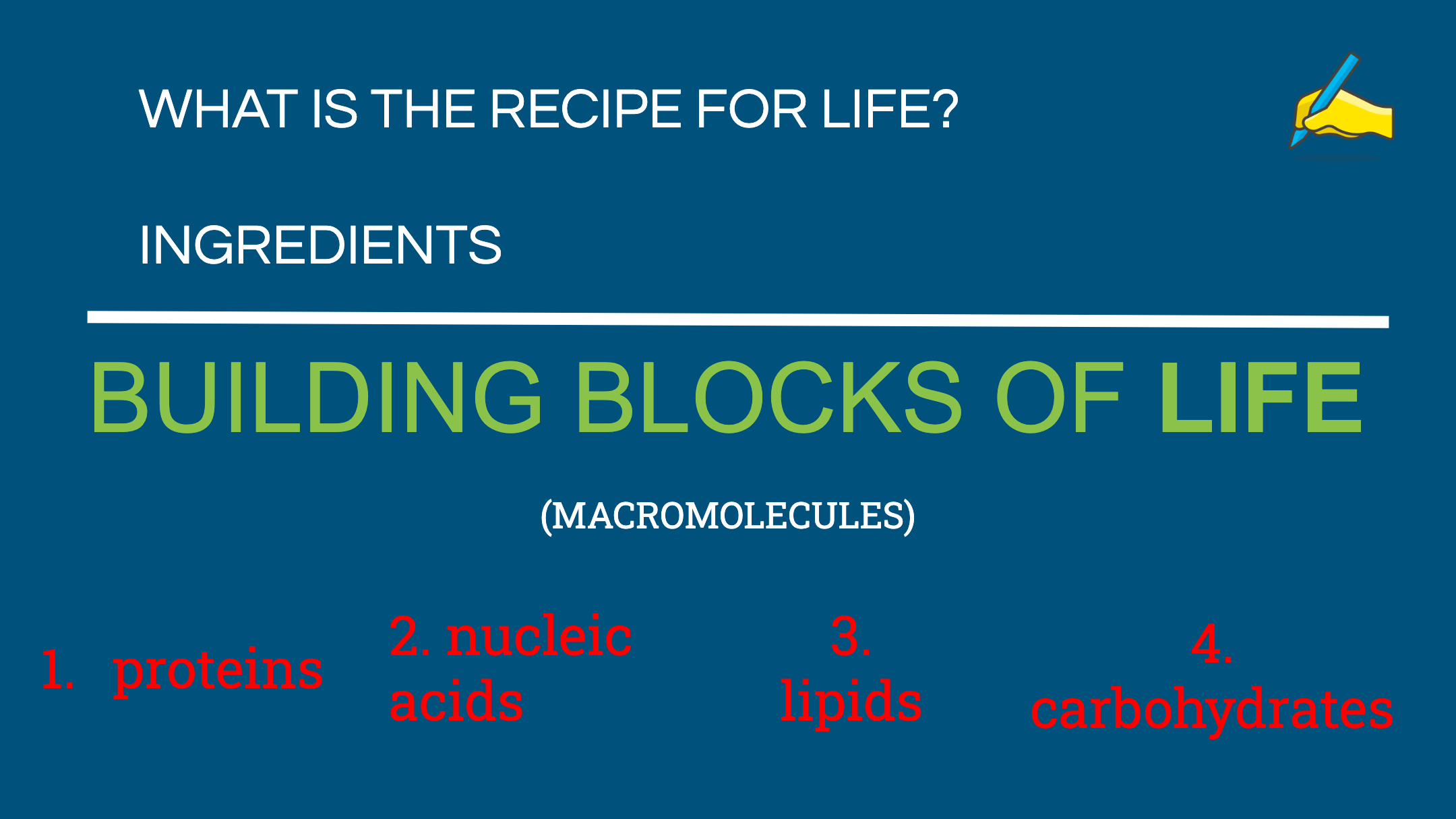
What is the recipe for life?
7
8
Multiple Choice
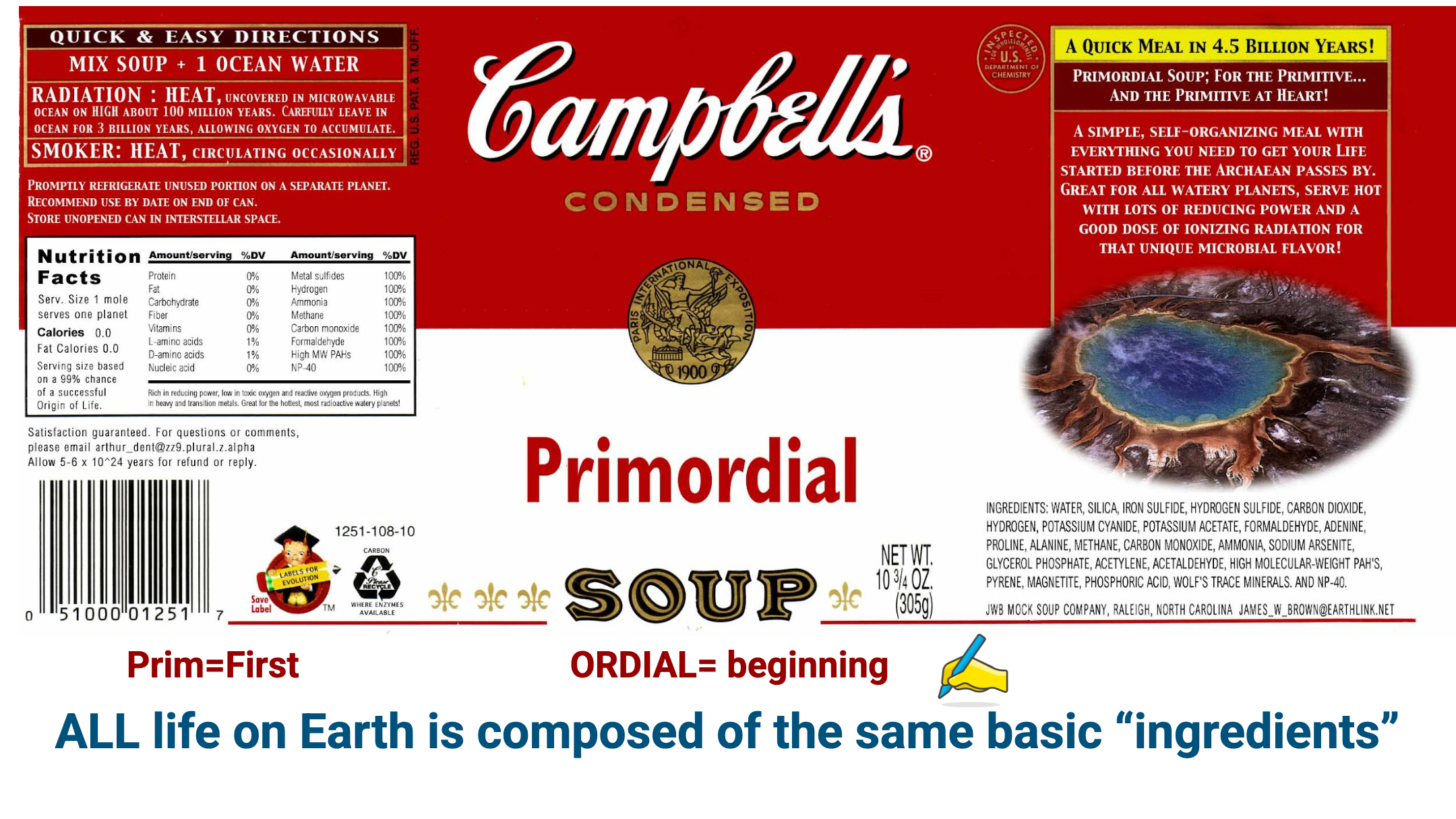
Based on the concept of 'primordial soup,' what basic ingredients were thought to be present on early Earth that contributed to the origin of life?
Water, silica, hydrogen sulfide, carbon dioxide
Proteins, nucleic acids, lipids, carbohydrates
Vitamins, minerals, enzymes, hormones
Sugars, starches, fats, oils
9
10
11
12
Open Ended
Why is it significant that all life on Earth is composed of the same basic 'ingredients'?
13
Multiple Choice
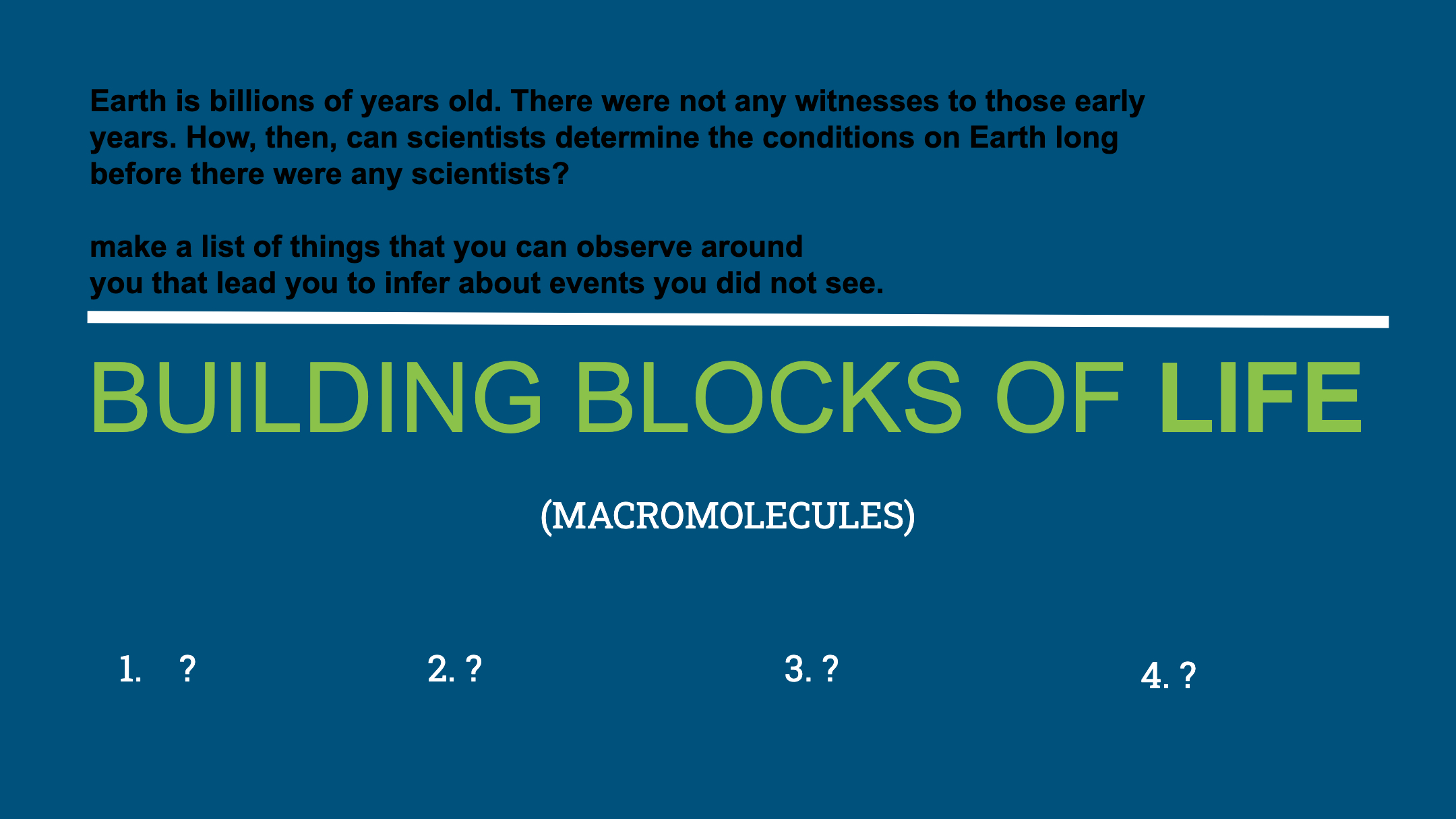
Which of the following are considered the building blocks of life?
Proteins, nucleic acids, lipids, carbohydrates
Water, oxygen, carbon dioxide, nitrogen
Vitamins, minerals, enzymes, hormones
Sugars, starches, fats, oils
14
15
Multiple Choice
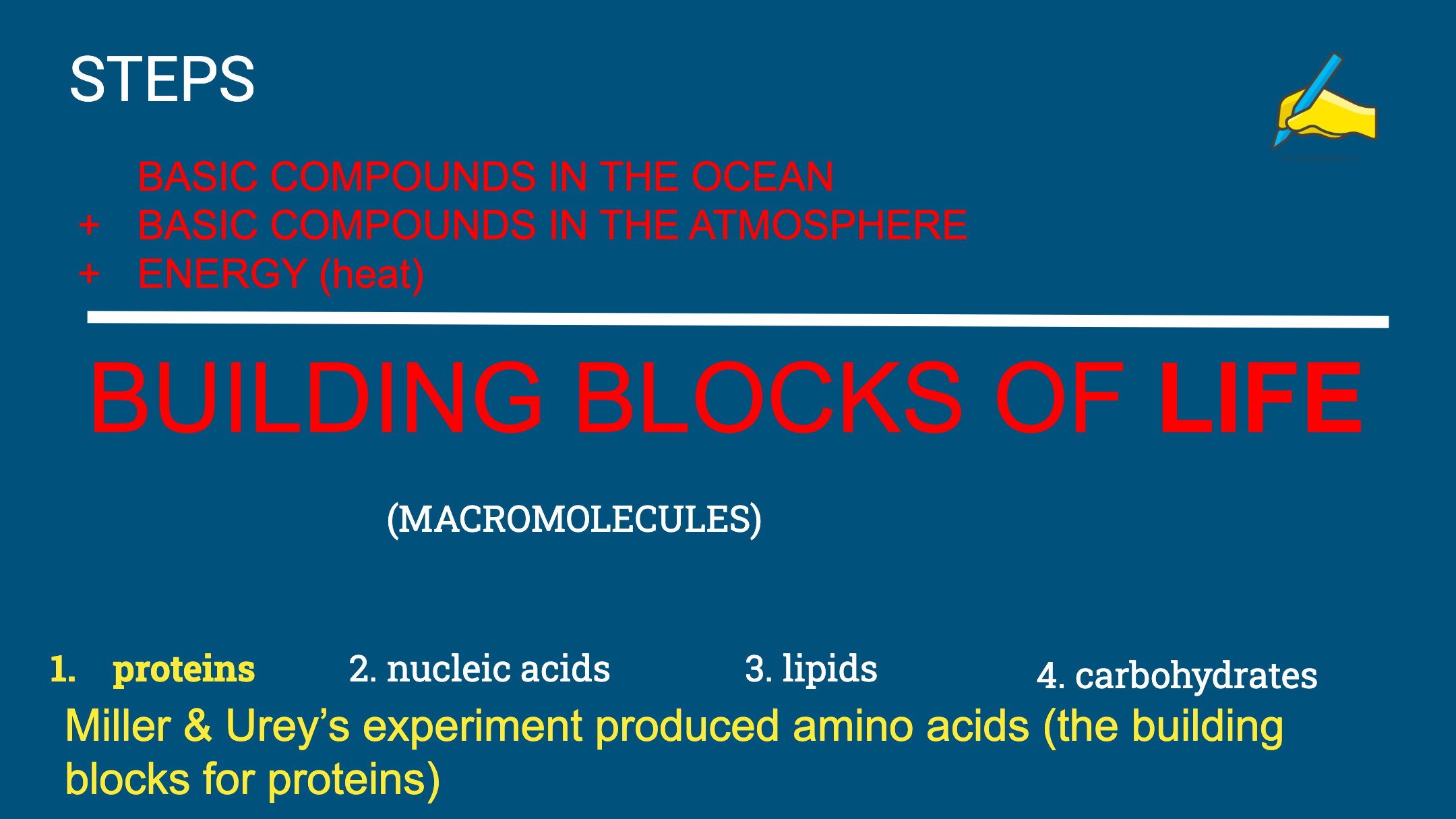
Which of the following steps are necessary for the formation of the building blocks of life according to the Miller & Urey experiment?
Basic compounds in the ocean, basic compounds in the atmosphere, energy (heat)
Photosynthesis, respiration, fermentation
Cell division, mutation, adaptation
Protein synthesis, DNA replication, cell signaling
16
Fill in the Blanks
Fill in the blank: Miller & Urey’s experiment produced
17
18
Multiple Choice
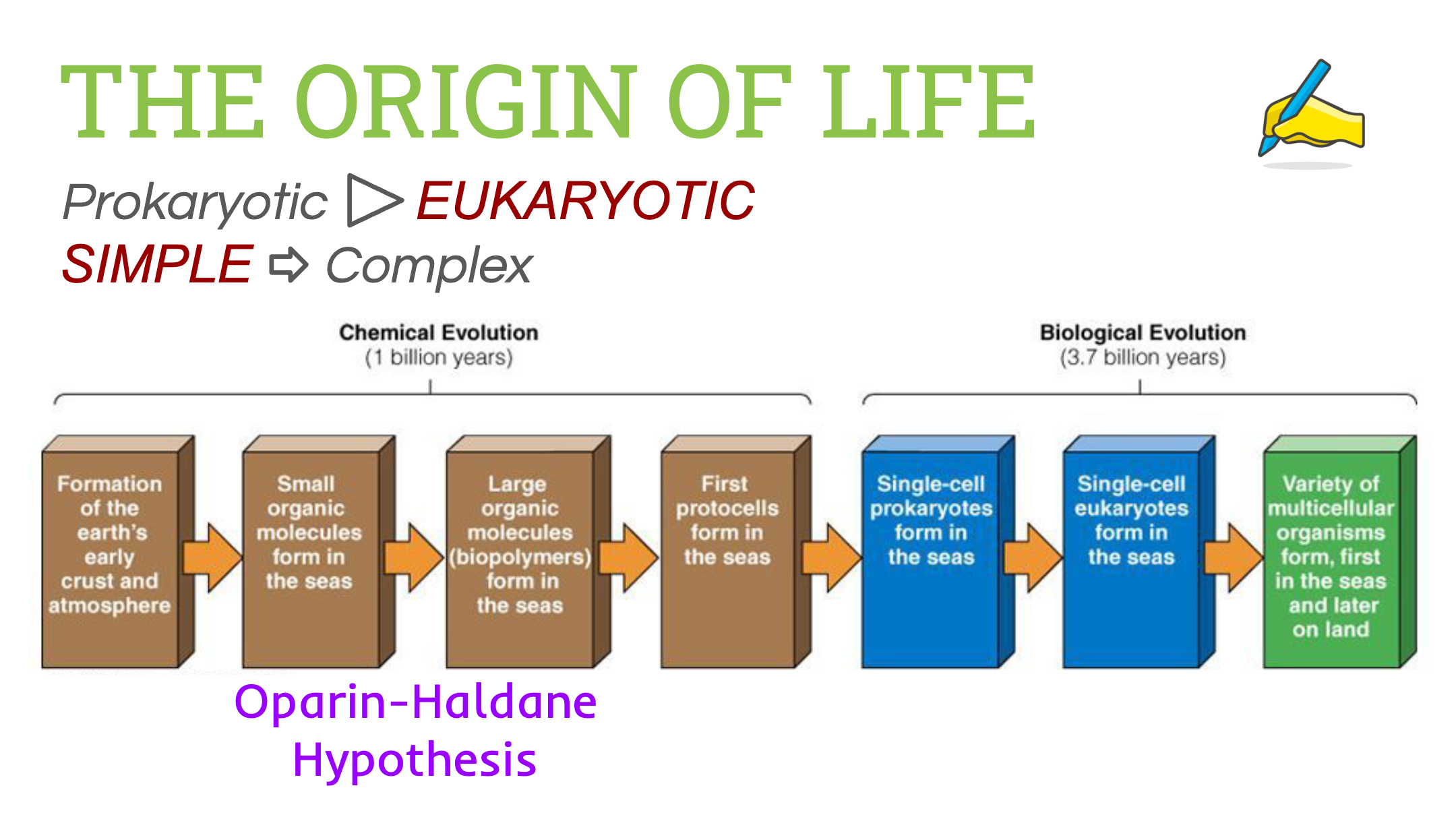
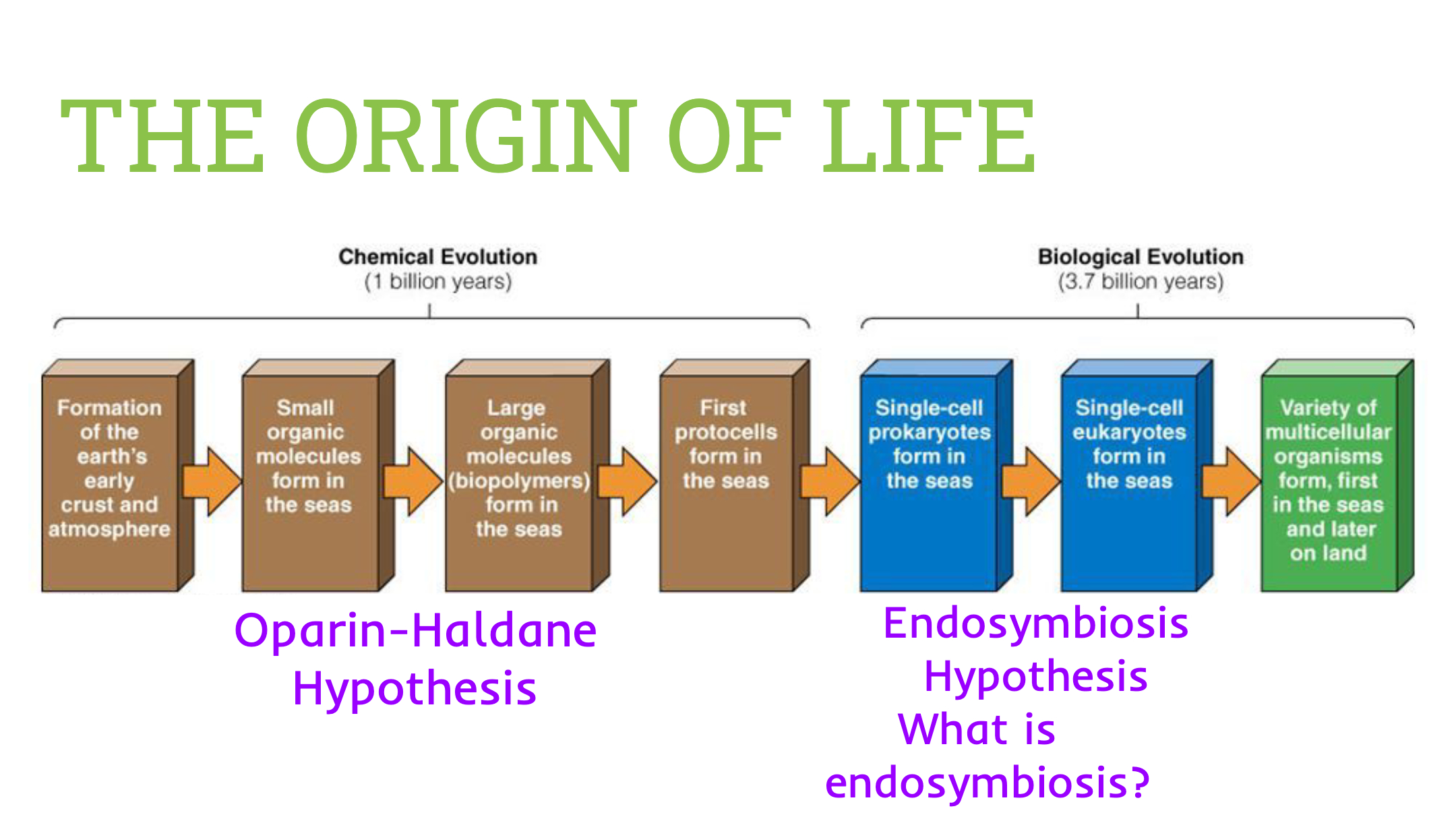
Which hypothesis explains the sequence of chemical and biological evolution leading to the origin of life on Earth?
Darwin’s Theory
Oparin-Haldane Hypothesis
Cell Theory
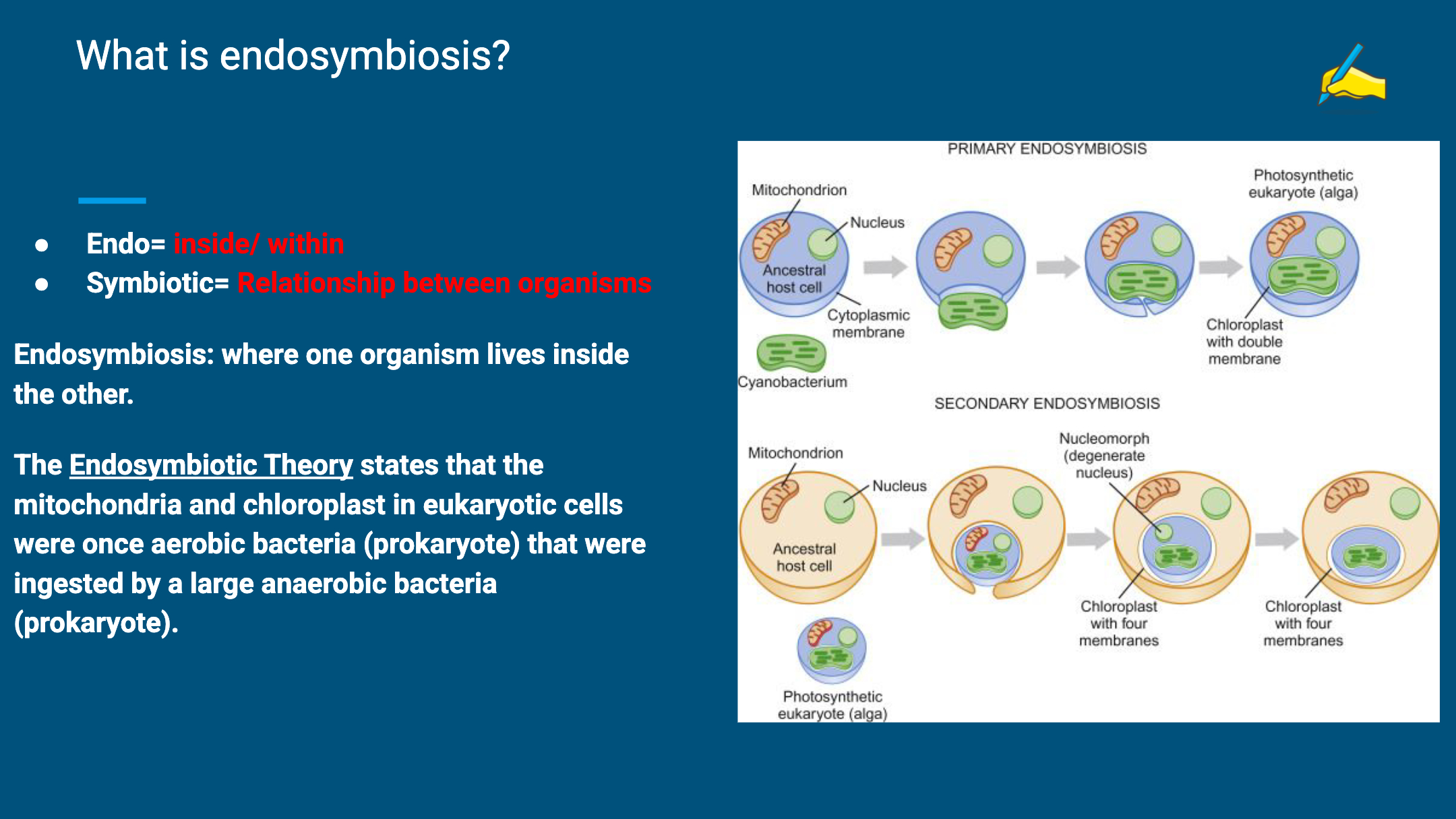
Endosymbiotic Theory
19
20
Open Ended
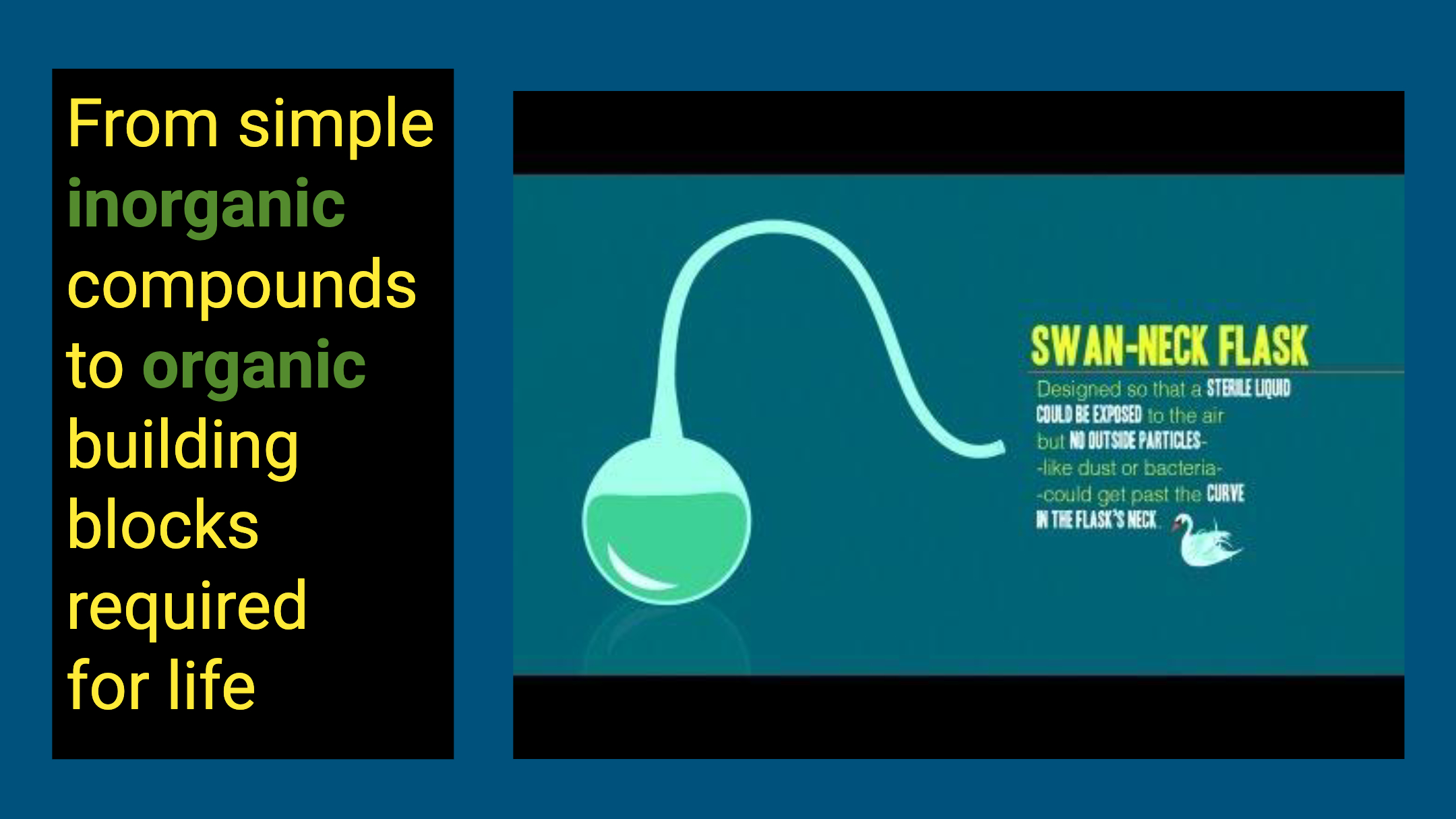
Describe the transition from inorganic compounds to organic building blocks as illustrated by the swan-neck flask experiment.
21

22
Multiple Select
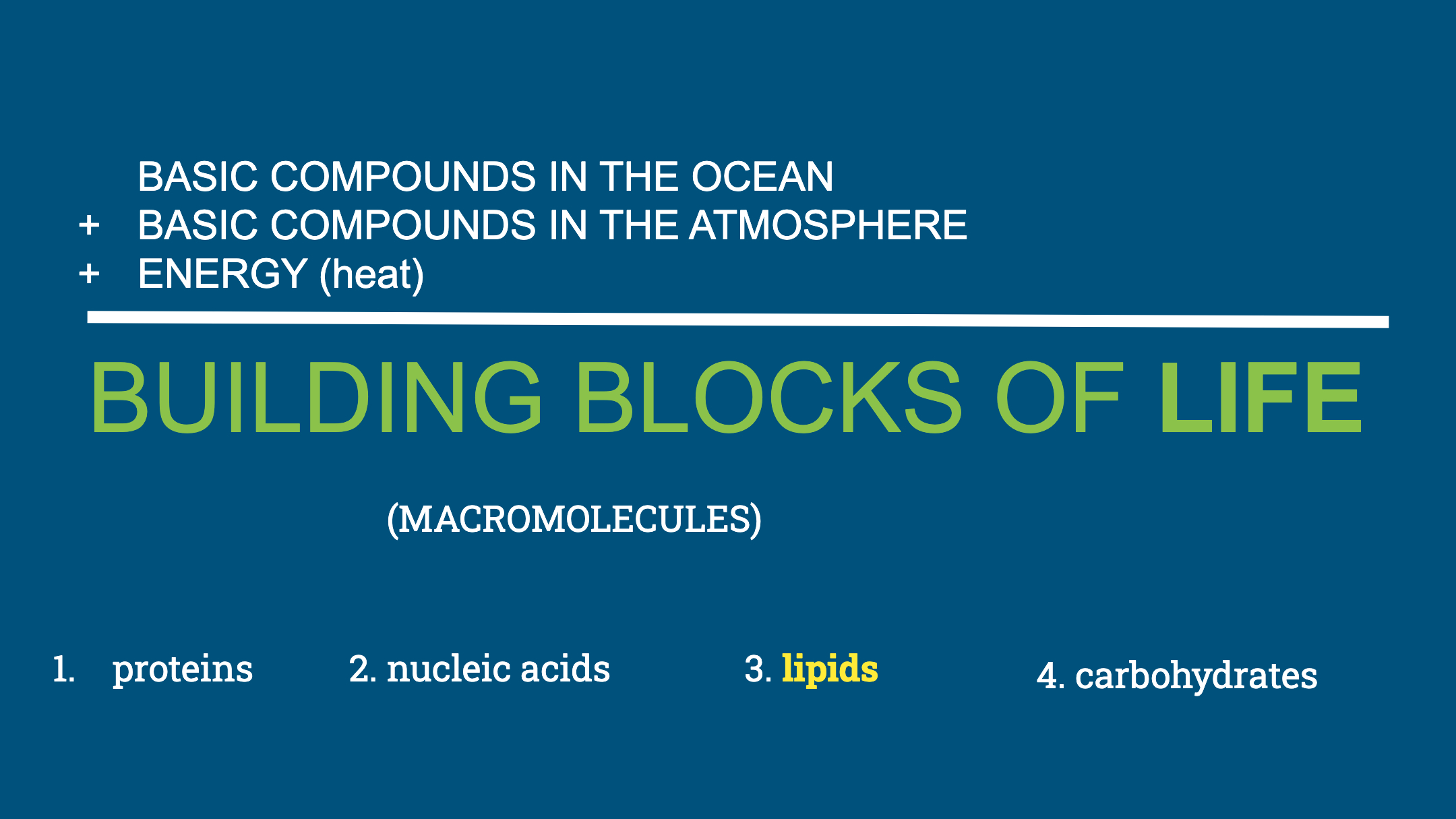
Which of the following are considered macromolecular building blocks of life?
Proteins
Nucleic acids
Lipids
Water
23
24
Fill in the Blanks
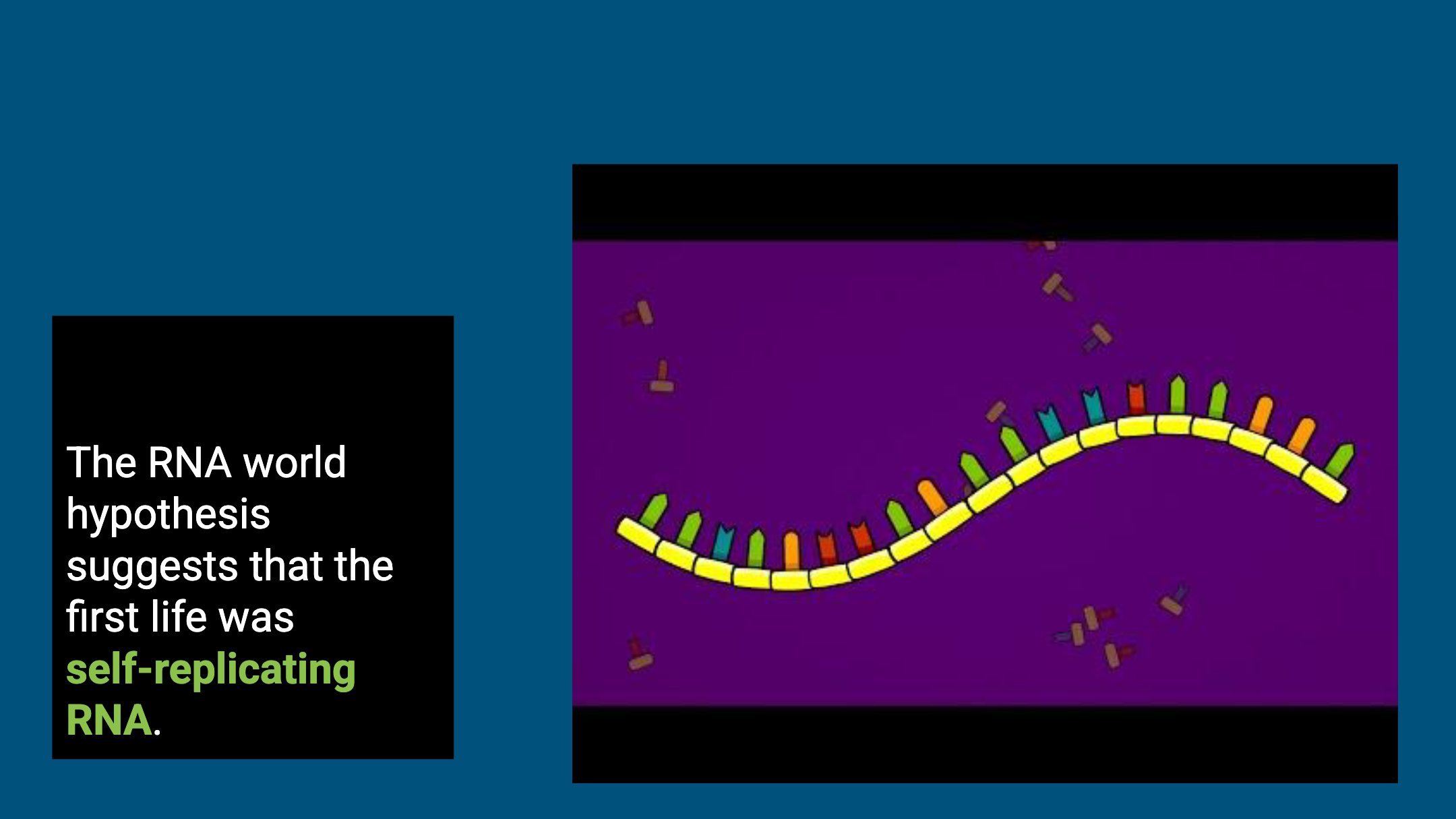
The RNA world hypothesis suggests that the first life was
25
26
Open Ended
Explain how energy from the environment contributed to the formation of macromolecules essential for life.
27
28
Multiple Choice
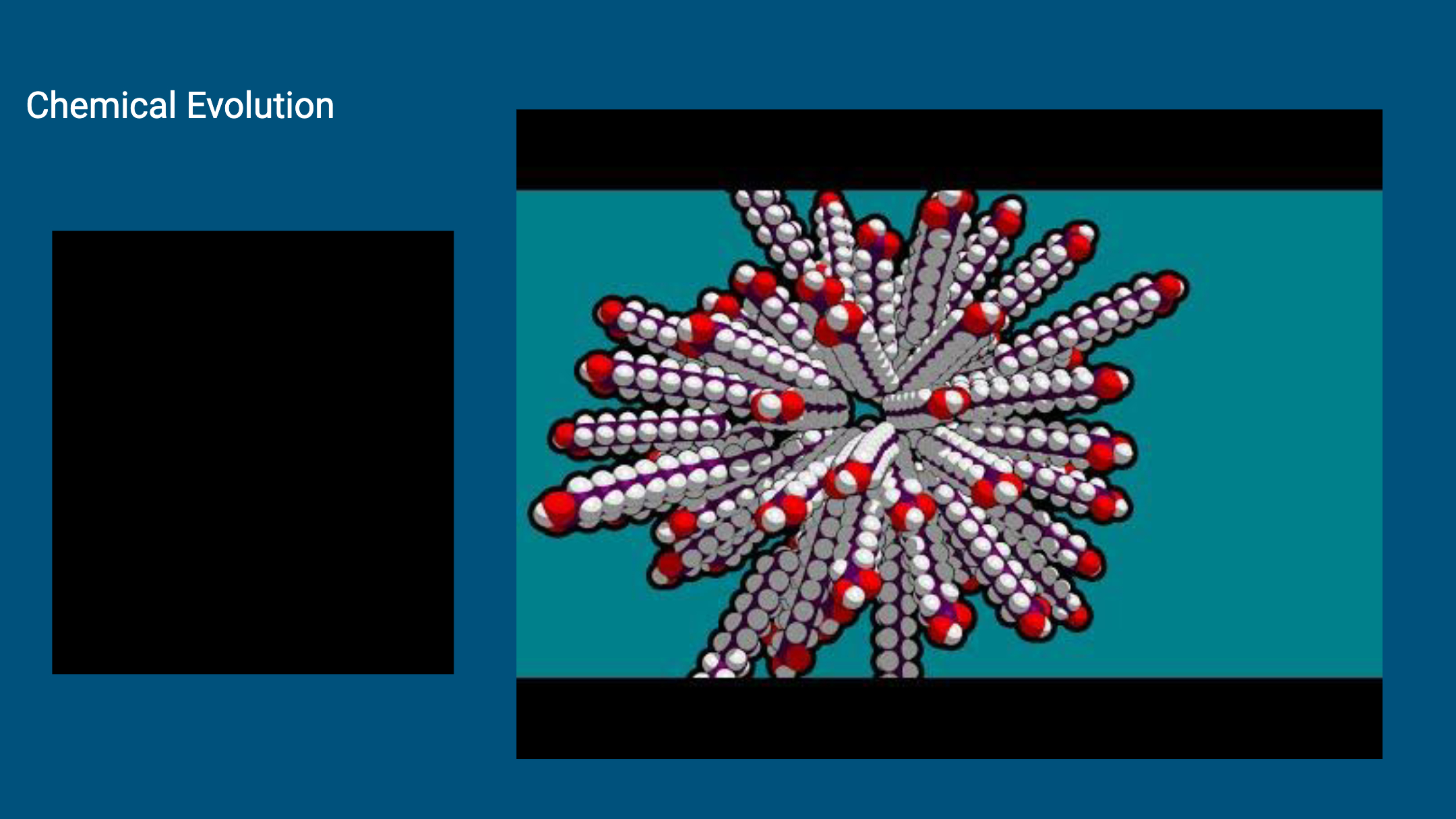
What is the significance of chemical evolution in the context of the origin of life?
It explains the formation of multicellular organisms.
It describes the process by which simple molecules formed complex organic compounds.
It is related to the discovery of DNA.
It focuses on the evolution of eukaryotic cells.
29
30
Multiple Choice
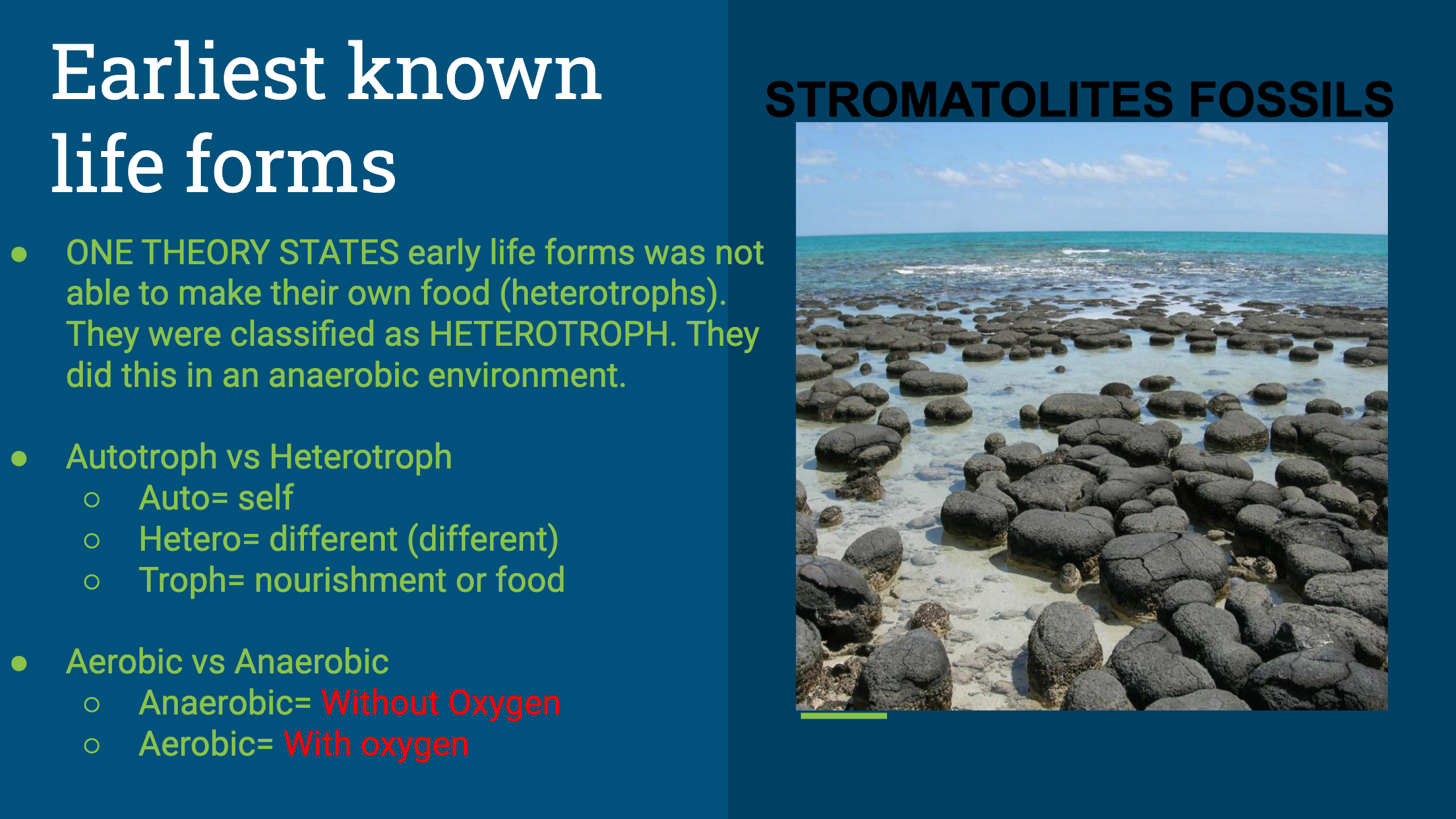
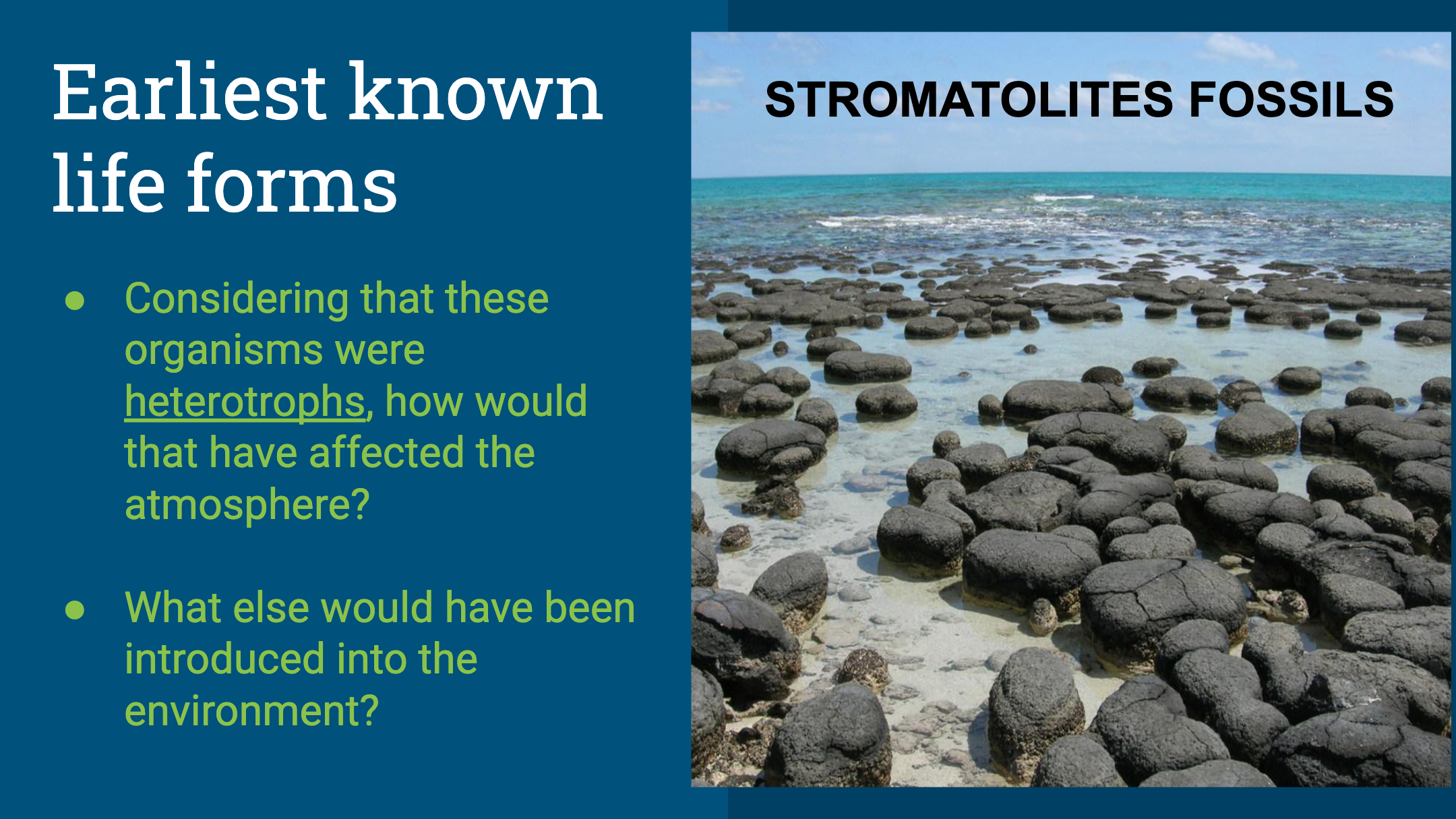
Which of the following statements best describes the earliest known life forms according to one theory?
They were autotrophs and produced their own food in an aerobic environment.
They were heterotrophs and relied on other sources for food in an anaerobic environment.
They were autotrophs and lived in an anaerobic environment.
They were heterotrophs and produced their own food in an aerobic environment.
31
32
Open Ended
Considering that these organisms were heterotrophs, how would that have affected the atmosphere?
33
34
Multiple Select
Which of the following steps are part of the chemical evolution leading to the origin of life?
Formation of multicellular organisms
Formation of small organic molecules in the seas
Formation of single-cell eukaryotes
Formation of the earth's early crust and atmosphere
35
36
Fill in the Blanks
Endosymbiosis is a process where one organism lives
37
38
Open Ended
List the following in order in which they occurred to get from no life to life: Complex biomolecules, prokaryotes, inorganic molecules, eukaryotes, simple biomolecules.
39
40
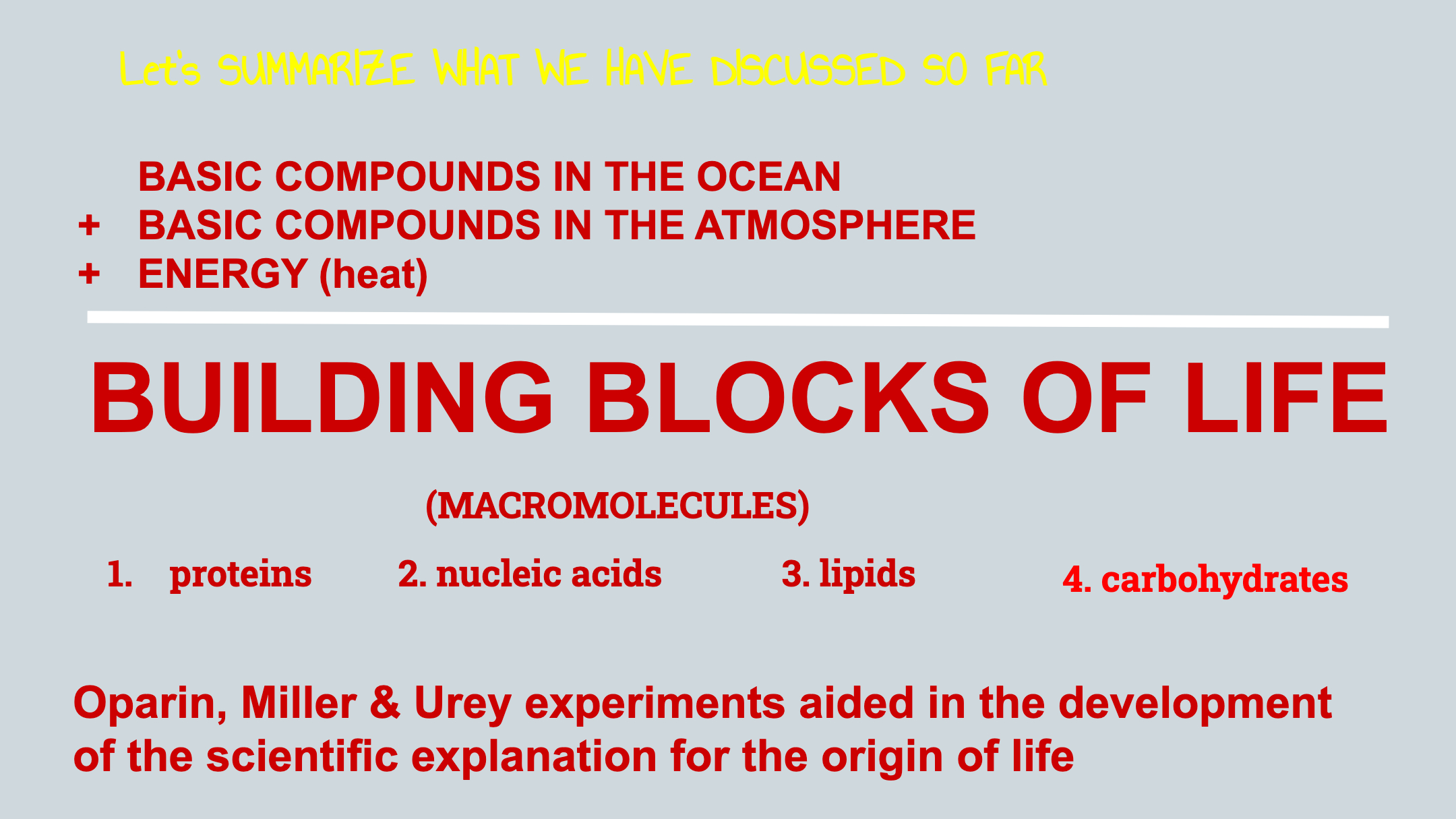
Multiple Select
Which of the following are considered building blocks of life (macromolecules)?
Proteins
Nucleic acids
Lipids
Carbohydrates
41
42
Fill in the Blanks
Fill in the blank: The Miller-Urey experiment demonstrated that
43
Open Ended
Explain how the Miller-Urey experiment supports the hypothesis of chemical evolution in the origin of life.
44
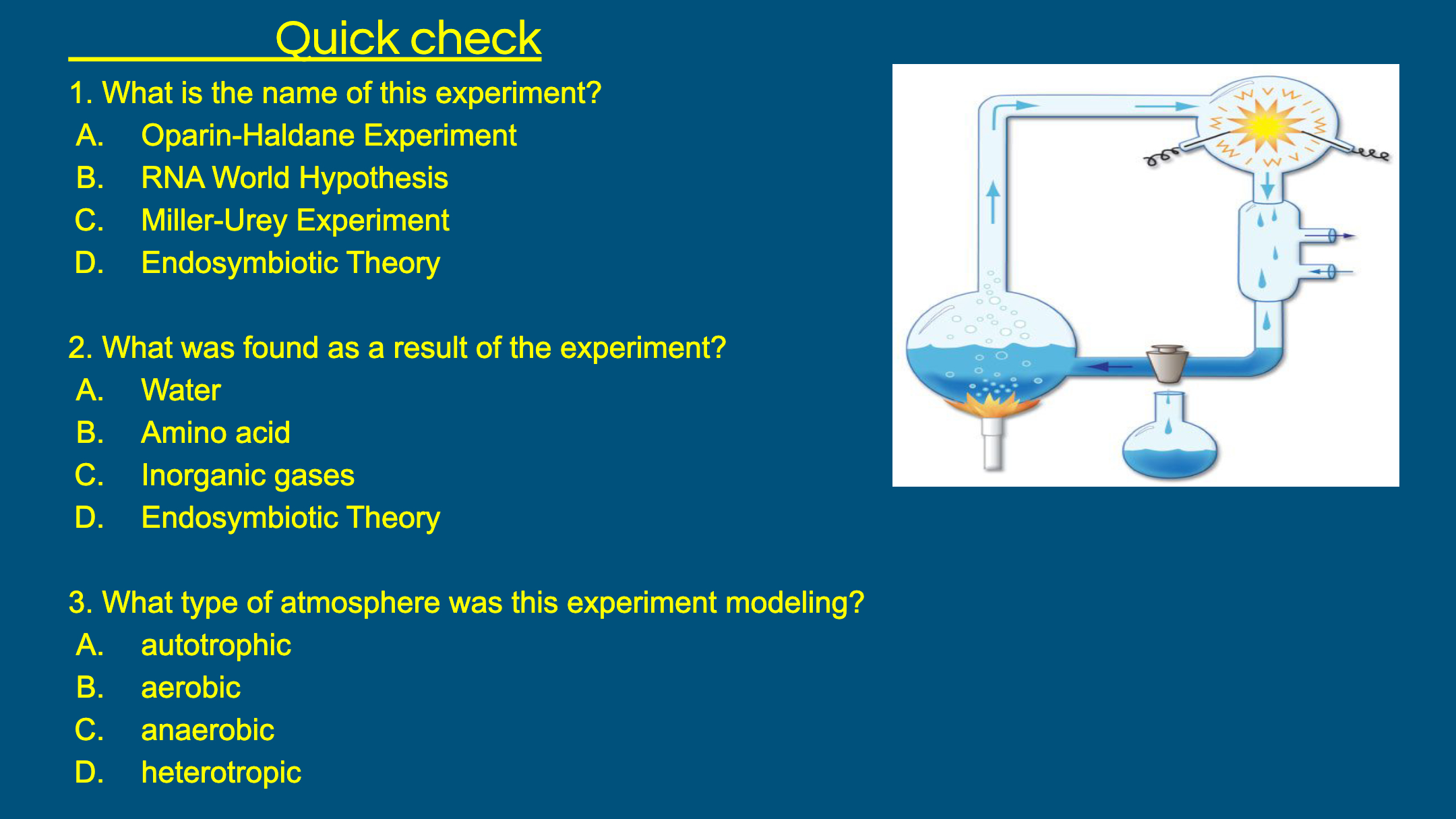
Multiple Choice
What type of atmosphere was this experiment modeling?
autotrophic
aerobic
anaerobic
heterotropic
45
Multiple Choice
What was found as a result of the experiment?
Water
Amino acid
Inorganic gases
Endosymbiotic Theory
46
Multiple Choice
What is the name of this experiment?
Oparin-Haldane Experiment
RNA World Hypothesis
Miller-Urey Experiment
Endosymbiotic Theory
47
48

49
50
Multiple Choice
Which molecule came first in the origin of life: DNA or RNA?
DNA
RNA
Both at the same time
Neither
51
52
53
54
55

56
Multiple Choice
Which of the following statements best summarizes how the basic compounds in the oceans and atmosphere contributed to the origin of life on Earth?
They combined to form the building blocks of life through a series of chemical reactions powered by energy.
They remained unchanged and did not interact with each other.
They were destroyed by external forces and did not contribute to life.
They only existed in the atmosphere and not in the oceans.
57
Open Ended
How did life begin?
Show answer
Auto Play
Slide 1 / 57
SLIDE
Similar Resources on Wayground

51 questions
photo & cell notes 25
Presentation
•
9th - 12th Grade
53 questions
Quizizz Slides: Genetics Part 2
Presentation
•
9th - 12th Grade
50 questions
Family Members
Presentation
•
9th - 12th Grade
57 questions
Mitosis vs Meiosis
Presentation
•
9th - 12th Grade
51 questions
2.1.1 The Engineering Design Process
Presentation
•
9th - 12th Grade
Popular Resources on Wayground
10 questions
Safety Day 2026 – Student Review

Quiz
•
9th Grade
21 questions
Continents and Oceans
Quiz
•
6th Grade
20 questions
Parts of Speech
Quiz
•
5th Grade
16 questions
Subject & Predicate
Quiz
•
5th Grade
25 questions
Multiplication Facts
Quiz
•
5th Grade
12 questions
Map Skills
Quiz
•
3rd Grade
22 questions
Continents and Oceans
Quiz
•
5th Grade
15 questions
Rounding Decimals
Quiz
•
5th Grade
Discover more resources for Biology
20 questions
Cell organelles and functions
Quiz
•
10th Grade
20 questions
Cell Transport
Quiz
•
9th - 12th Grade
25 questions
photosynthesis and cellular respiration
Quiz
•
9th Grade
20 questions
Cell Cycle
Quiz
•
9th Grade
8 questions
DNA vs. RNA
Presentation
•
9th - 12th Grade
14 questions
Ecological Succession: Primary and Secondary
Quiz
•
9th Grade
20 questions
Macromolecules
Quiz
•
10th Grade
20 questions
Characteristics of Life
Quiz
•
9th - 10th Grade