

Chapter 3 and 4 Lecture

Presentation
•
Chemistry
•
University
•
Hard

Luis Bello
Used 2+ times
FREE Resource
45 Slides • 3 Questions
1
Chapter 3 and 4 Lecture
by Luis Bello
2
Chapter 3 Matter and Energy
Presenter Dr. Luis Bello

3
•3.3 Classifying Matter According to Its State: Solid, Liquid, and Gas
•3.4 Classifying Matter According to Its Composition: Elements, Compounds, and Mixtures
•3.5 Differences in Matter: Physical and Chemical Properties
•3.6 Changes in Matter: Physical and Chemical Changes
•3.7 Conservation of Mass: There Is No New Matter
•3.8 Energy
•3.9 Energy and Chemical and Physical Change
•3.1Temperature: Random Motion of Molecules and Atoms
•3.1Temperature Changes: Heat Capacity
•3.1Energy and Heat Capacity Calculations
4

5

6

7

8

9

10

11

12

13

14

15

16

17

18

19

20

21

22

23

24
Heat Capacity Definition
Specific heat is defined by the amount of heat needed to raise the temperature of 1 gram of a substance 1 degree Celsius (°C).
25

26

27
Chapter 4. Atoms and Elements
Presenter: Dr. Luis Bello
Source: Boundless Chemistry. Provided by: Boundless Learning. Located at: https://www.boundless.com/chemistry/textbooks/boundless-chemistry-textbook/. License: CC BY-SA: Attribution-ShareAlike

28
Chapter 4. Atoms and Elements
4.2 Indivisible: The Atomic Theory
4.3 The Nuclear Atom
4.4 The Properties of Protons, Neutrons, and Electrons
4.5 Elements: Defined by Their Numbers of Protons
4.6 Looking for Patterns: The Periodic Law and the Periodic Table
4.7 Ions: Losing and Gaining Electrons
4.8 Isotopes: When the Number of Neutrons Varies
4.9 Atomic Mass: The Average Mass of an Element’s Atoms
29
Early Ideas about Atoms
30
Multiple Choice
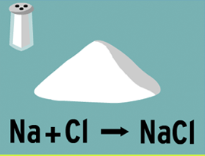
When sodium and chlorine combine to form sodium chloride, sodium chloride is the:
Originator
Reactant
Product
Produce
31
32

33

34

35

36
Periodic Table – Royal Society of Chemistry
You can open this webpage in a new tab.
37

38

39
Isotopes
40

41

42
Calculating Average Atomic Mass
43
The average atomic mass of an element is the sum of the masses of its isotopes, each multiplied by its natural abundance (the decimal associated with the percent of atoms of that element that are of a given isotope).
Average atomic mass = f1M1 + f2M2 + … + fnMn where f is the fraction representing the natural abundance of the isotope and M is the mass number (weight) of the isotope.
44

45

46
Multiple Choice
Do the following atoms belong to the same element? Explain Aluminum-27 An atom with 14 protons and 13 neutrons
Yes because they have the same number of protons
Yes because they have the same mass
No because they have different number of protons
No because they have different number of neutrons
47
Multiple Choice

How did Rutherford discover the proton?
Cathode Ray Tube
Gold Foil Experiment
Planetary Model
Plum Pudding Model
48

Chapter 3 and 4 Lecture
by Luis Bello
Show answer
Auto Play
Slide 1 / 48
SLIDE
Similar Resources on Wayground

47 questions
Elkhorn History Images
Presentation
•
KG
40 questions
Colligative Properties
Presentation
•
University
46 questions
Electrons in Atoms and the Periodic Table
Presentation
•
University
43 questions
200 Research Methods
Presentation
•
University
44 questions
PHYSICAL FITNESS
Presentation
•
University
43 questions
Chemical Quantities Lesson
Presentation
•
University
43 questions
English 1 UNIT 4 GENERAL ACTIVITY
Presentation
•
University
44 questions
AEF1 - File 3A - Simple Present (+ and -) Lesson
Presentation
•
University
Popular Resources on Wayground
10 questions
HCS SCI 03 Summer School Review 4

Quiz
•
3rd Grade
11 questions
HSMS - Standard Response Protocol
Quiz
•
6th - 8th Grade
16 questions
1.1-1.2 Quiz Review
Quiz
•
9th - 12th Grade
12 questions
Exponent Expressions
Quiz
•
6th Grade
20 questions
Adding and Subtracting Integers
Quiz
•
6th - 7th Grade
11 questions
Northeast States
Quiz
•
3rd - 4th Grade
10 questions
Characterization
Quiz
•
3rd - 7th Grade
10 questions
Common Denominators
Quiz
•
5th Grade