Unit 1 and 2 Review
Presentation
•
Physics
•
9th - 12th Grade
•
Practice Problem
•
Medium
Standards-aligned
Katherine Johnson
Used 55+ times
FREE Resource
8 Slides • 16 Questions
1
​

2
Unit 1: Velocity 101
3
Multiple Choice
Which of the following dot diagrams shows an object that is accelerating
A
B
Neither object is accelerating
You can not tell from the dot diagram
4
Unit 1: Acceleration 101
5
Multiple Choice
An leftward moving object experiences a rightward acceleration. Which statement best describes what happens to the object's motion?
The object begins to speed up.
The object experiences no change in motion.
The object begins to slow down.
Not enough information given to predict the motion.
6
Unit 1 Kinematic Equations
NOTE: You'll mainly use the 1st equation
7
Multiple Choice
A car with an initial velocity of 16.0 meters per second east slows uniformly to 6.0 meters per second east in 4.0 seconds. What is the acceleration of the car during this 4.0-second interval?
2.5 m/s2 west
2.5 m/s2 east
4.0 m/s2 west
4.0 m/s2 east
8
Multiple Choice
The speed of a car is increased uniformly from 11 meters per second to 19 meters per second in 4 seconds. The acceleration of the car during this interval is
1.0 m/s2
2.0 m/s2
4.0 m/s2
8.0 m/s2
9
Unit 1: Position vs. Time Graphs
NOTE: Mainly used to use slope (Velocity) to describe motion.
10
Multiple Choice
Which graph shows the object standing still?
A
B
C
D
11
Multiple Choice
A baseball player with a lead off of 2nd must run back to base when the pitcher sees he is not on base and attempts to get him out. Which graph best represents the baseball player running back to 2nd base?
Graph 1
Graph 2
Graph 3
Graph 4
12
Unit 1: Velocity vs. Time Graphs
NOTE: Used for both for calculating slope (Acceleration) and describing motion.
13
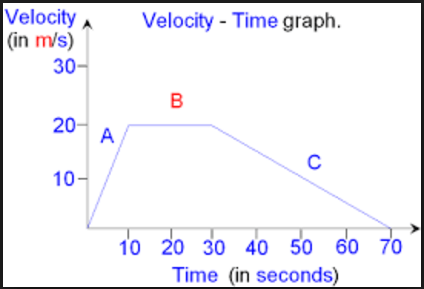
Multiple Choice
This is a velocity-time graph. What is the object doing in segment C?
Positive acceleration
Negative acceleration
Constant Velocity
Not moving
14
Multiple Choice
During which interval is the object traveling at a constant velocity?
B to C
D to E
F to G
it traveling at a constant velocity during all of the intervals shown.
15
Multiple Choice
The graph below represents the relationship between velocity and time for an object moving along a straight line. What is the magnitude of the object’s acceleration?
5.0 m/s2
8.0 m/s2
20 m/s2
10 m/s2
16
Multiple Choice
A car that was initially at rest, speeds up with a constant acceleration. Which of the following graphs best represents this scenario?
Graph 1
Graph 2
Graph 3
Graph 4
17
18
Multiple Choice
Which best describes the vertical motion of a projectile, assuming no air resistance?
Acceleration of -10 m/s2
Accelerations of -5 m/s2
An increasing acceleration every second
Constant velocity
19
Multiple Choice
Which best describes the horizontal motion of a projectile, assuming no air resistance?
Acceleration of -10 m/s2
Acceleration of -5 m/s2
An increasing acceleration every second
Constant velocity
20
Multiple Choice
A projectile with mass m is fired with initial horizontal velocity vx from height h above level ground. Which change would have resulted in a greater time of flight for the projectile? [Neglect friction.]
decreasing the mass to m/2
decreasing the height to h/2
increasing the initial horizontal velocity to 2vx
increasing the height to 2h
21
Unit 2: Angled Launch
NOTE: You mainly need to know ideal angle and motion characteristics (i.e. velocities at top and accelerations.)
22
Multiple Choice
A ball is thrown with a velocity of 35 meters per second at an angle of 30.° above the horizontal. Which quantity has a magnitude of zero when the ball is at the highest point in its trajectory?
the vertical acceleration of the ball
the momentum of the ball
the vertical component of the ball’s velocity
the horizontal component of the ball’s velocity
23
Multiple Choice
A soccer ball is kicked into the air from level ground with an initial speed of 20. meters per second and returns to ground level. At which angle above the horizontal should the ball be kicked in order for the ball to travel the greatest total horizontal distance?
15°
30°
45°
75°
24
Multiple Choice
A ball is thrown across the field in a parabolic path. At the highest height, describe the motion of the ball.
The ball is still moving horizontally, but at rest vertically.
The ball completely stops moving.
The ball is still moving vertically, but at rest horizontally.
Not enough information to know.
​

Show answer
Auto Play
Slide 1 / 24
SLIDE

Similar Resources on Wayground
20 questions
Big Bang Review
Presentation
•
9th - 11th Grade
21 questions
Newton's 2nd Law
Presentation
•
8th - 12th Grade
19 questions
Ser/Estar
Presentation
•
9th - 12th Grade
19 questions
Surplus and Shortage
Presentation
•
9th - 12th Grade
19 questions
Points, Lines, Planes
Presentation
•
9th - 12th Grade
18 questions
Quantitative vs Qualitative observations
Presentation
•
9th - 12th Grade
20 questions
Solving equations
Presentation
•
9th - 12th Grade
17 questions
Nuclear Decay
Presentation
•
9th - 12th Grade
Popular Resources on Wayground
10 questions
Safety Day 2026 – Student Review
Quiz
•
9th Grade
21 questions
Continents and Oceans
Quiz
•
6th Grade
20 questions
Parts of Speech
Quiz
•
5th Grade
16 questions
Subject & Predicate
Quiz
•
5th Grade
25 questions
Multiplication Facts
Quiz
•
5th Grade
12 questions
Map Skills
Quiz
•
3rd Grade
22 questions
Continents and Oceans
Quiz
•
5th Grade
15 questions
Rounding Decimals
Quiz
•
5th Grade
Discover more resources for Physics
20 questions
Position vs. Time Graphs
Quiz
•
9th Grade
10 questions
Exit Check 5.1 - Forms of Energy
Quiz
•
9th Grade
11 questions
Electricity Explained
Interactive video
•
9th - 12th Grade
87 questions
25-26 Unit 1.2 Review - Radioactivity & Earth's Age
Quiz
•
8th - 10th Grade
15 questions
Position vs. Time and Velocity vs. Time Graphs
Quiz
•
10th - 12th Grade
18 questions
Quiz #8 Practice: Forces on an Incline
Quiz
•
9th Grade
25 questions
Newton's Laws of Motion
Quiz
•
9th Grade