
TCI 11.Intro Political Developments in the Early Republic
Presentation
•
History, Social Studies
•
8th Grade
•
Practice Problem
•
Easy
Elizabeth McKee
Used 56+ times
FREE Resource
11 Slides • 5 Questions
1
TCI 11.Intro Political Developments in the Early Republic
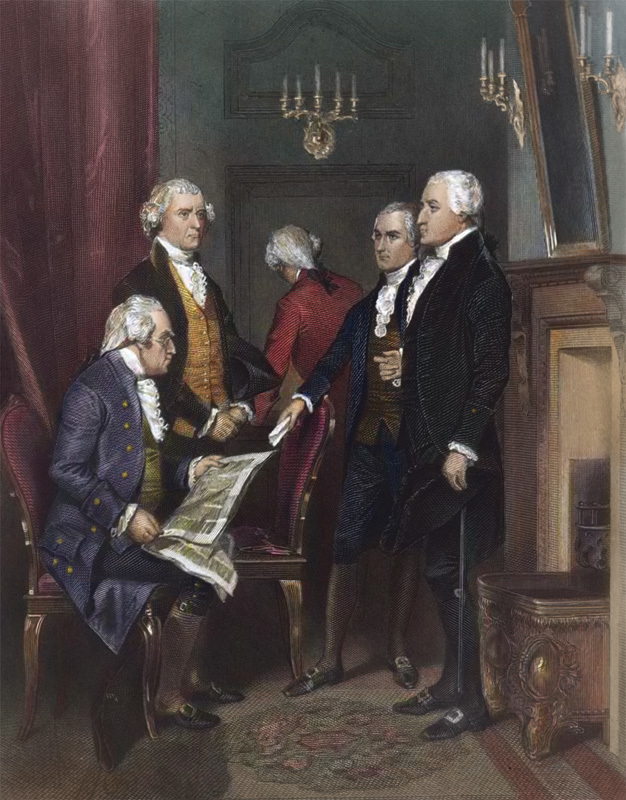
George Washington meets with his close advisers, Henry Knox, Thomas Jefferson, and Alexander Hamilton.
2
How did the Federalist and Republican visions for the United States differ?
3
After the American Revolution, leaders worked to guide the government formed under the Constitution. Look at the illustration of the four important leaders in the government. On the far right stands George Washington, who had been lured out of retirement to serve as the nation's first president. Seldom has a leader seemed more reluctant to take power. “My movements to the chair of government,” he wrote on leaving home, “will be accompanied by feelings not unlike those of a culprit who is going to the place of his execution. ”
4
Henry Knox sits opposite Washington. During the American Revolution, Henry Knox, a bookseller in Boston, became a general and Washington's close friend and adviser. When Washington became president in 1789, he made Knox his secretary of war.
5
Two more important leaders in the early government were Alexander Hamilton and Thomas Jefferson. Hamilton, who stands beside the president, served as Washington's secretary of the treasury. Jefferson, who stands behind Knox, served as secretary of state. He managed relations between the United States and other countries.
6
Washington chose Hamilton and Jefferson for these positions because of all they had in common. Both were patriots who had served their country during the war. Both also had brilliant minds.
However, for all they had in common, the two men were opposites in many ways. Hamilton dressed with great care, while Jefferson was sloppy with clothes. Hamilton was a doer who moved from task to task, but Jefferson was a thinker who took time to explore ideas.
7
As you will discover, Hamilton and Jefferson soon became political rivals. Their conflicting visions about the role of government eventually gave rise to the nation's first political parties and continue to influence America today.
8
Hail, Columbia
1. Listen the the following song and read the lyrics as you listen.
• The song you are about to hear is called "Hail, Columbia."
• It was first performed at George Washington's inauguration in 1789.
2. Then, after you listen to the song, you will answer the corresponding questions on the next slide:
*What are three adjectives that describe the song’s mood?
* How do you think Washington’s swearing in as president united the country?
9
10
Open Ended
1. What are three adjectives that describe the song’s mood?
11
Open Ended
2. How do you think Washington’s swearing in as president united the country?
12
Fair and Free Elections
1. Listen to the following song and read the lyrics as you listen.
• The next song is a campaign song from the 1800 presidential election. This song was sung by members of the Republican party, one of the nation’s first political parties.
2. Then, after you listen to the song, you will answer the corresponding questions on the following slides:
* What are three adjectives that describe the song’s mood?
* According to the lyrics, what were some of the issues of the 1800 presidential election?
*In what ways do you think the nation changed between Washington’s inauguration in 1789 and the election of 1800?
13
14
Open Ended
1. What are three adjectives that describe the song’s mood?
15
Open Ended
2. According to the lyrics, what were some of the issues of the 1800 presidential election?
16
Open Ended
3. In what ways do you think the nation changed between Washington’s inauguration in 1789 and the election of 1800?
TCI 11.Intro Political Developments in the Early Republic
George Washington meets with his close advisers, Henry Knox, Thomas Jefferson, and Alexander Hamilton.
Show answer
Auto Play
Slide 1 / 16
SLIDE

Similar Resources on Wayground
13 questions
Reconstruction's End
Presentation
•
8th Grade
9 questions
Holocaust Video Review
Presentation
•
8th Grade
14 questions
Colonial Government Review-22
Presentation
•
8th Grade
14 questions
Careers
Presentation
•
8th Grade
14 questions
Lesson 3 Secession and War
Presentation
•
8th Grade
12 questions
Reform Movements
Presentation
•
8th Grade
14 questions
John Brown's Raid
Presentation
•
8th Grade
12 questions
Rosa Parks
Presentation
•
8th Grade
Popular Resources on Wayground
10 questions
Safety Day 2026 – Student Review
Quiz
•
9th Grade
21 questions
Continents and Oceans
Quiz
•
6th Grade
20 questions
Parts of Speech
Quiz
•
5th Grade
16 questions
Subject & Predicate
Quiz
•
5th Grade
25 questions
Multiplication Facts
Quiz
•
5th Grade
12 questions
Map Skills
Quiz
•
3rd Grade
22 questions
Continents and Oceans
Quiz
•
5th Grade
15 questions
Rounding Decimals
Quiz
•
5th Grade
Discover more resources for History
15 questions
Unit 3 - Part 1 Road to Revolution
Quiz
•
8th Grade
25 questions
WWII Assessment
Quiz
•
8th Grade
25 questions
The American Revolution
Quiz
•
7th - 10th Grade
15 questions
The Bill of Rights
Quiz
•
8th - 12th Grade
18 questions
American Revolution Review
Quiz
•
8th Grade
14 questions
Weekly Wrap Up #3: CE.1a/e -Fundamental Principles
Quiz
•
8th Grade
15 questions
Ancient Rome
Quiz
•
7th - 10th Grade
16 questions
Students of Civics Unit 2: The Constitution
Quiz
•
7th - 11th Grade