

Electrical Conductors, Insulators, and Ways to Charge

Presentation
•
Science
•
8th Grade
•
Practice Problem
•
Medium
Standards-aligned

Valene Roelfs
Used 174+ times
FREE Resource
13 Slides • 8 Questions
1
Electrical Conductors, Insulators,
and Ways to Charge

2
3
Electrical Conductors
An electrical conductor is a material in which charges can move easily. Most metals are good conductors because their electrons are free to move. Conductors are used to make wires. Copper, aluminum, and mercury are good conductors.

4
Electrical Insulators
An electrical insulator is a material in which charges cannot move easily. Insulators do not conduct charges very well because their electrons cannot flow freely. Insulation around wires are made of insulators. Plastic, rubber, glass, wood, and air are good insulators.

5
Multiple Choice
6
Multiple Select
7
Multiple Select
8
Copy this chart onto page 94 of your notebook.

9
Electric Charge
All matter is made up of very small particles called atoms. Atoms are made of even smaller particles called protons, neutrons, and electrons.

10
Multiple Choice
11
12

13
Friction
Charging by friction happens when electrons are "wiped" from one object to another. If you use a cloth to rub a plastic ruler, electrons move from the cloth to the ruler. The ruler gains electrons and becomes negatively charged. At the same time, the cloth loses electrons and becomes positively charged.

14
Conduction
Charging by conduction happens when electrons move from one object to another by direct contact. Suppose you touch an uncharged piece of metal with a positively charged glass rod. Electrons from the metal will move to the glass rod. The metal loses electrons and becomes positively charged.

15
Induction
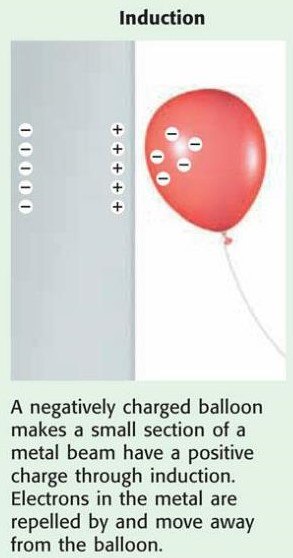
Charging by induction happens when charges in an uncharged metal object are rearranged without direct contact with a charged object. Suppose you hold a metal object near a positively charged object. The electrons in the metal are attracted to and move toward the positively charged object. This movement induces an area of negative charge on the surface of the metal.
16
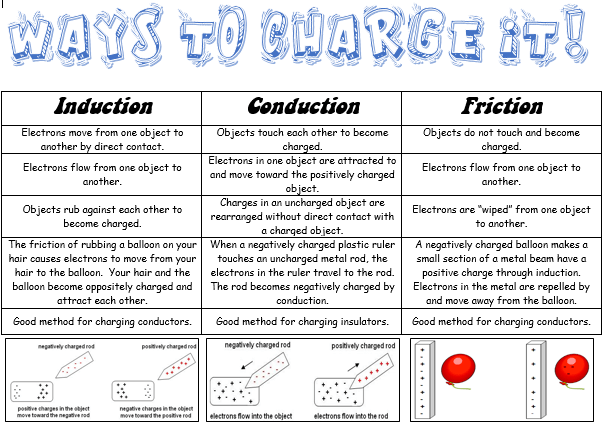
Find this worksheet. It is with your extra pages for unit 2.
These are not in the correct order. Label each one with an "I" for induction, a "C" for conduction, or a "F" for friction.
(you could also choose to color code them instead)
17
Fill in the Blanks
18
Fill in the Blanks
19
Fill in the Blanks
20
Check your answers!
Cut and glue these notes onto
page 95 in your notebook.

21
Multiple Select
Electrical Conductors, Insulators,
and Ways to Charge
Show answer
Auto Play
Slide 1 / 21
SLIDE


