5-4 Rational Functions
Presentation
•
Mathematics
•
9th - 12th Grade
•
Medium
+2
Standards-aligned
Alyson Foley
Used 8+ times
FREE Resource
31 Slides • 12 Questions
1
5-4 Rational Functions
Take notes!
2
A rational function is a function whose rule can be written as a ratio of two polynomials.
3
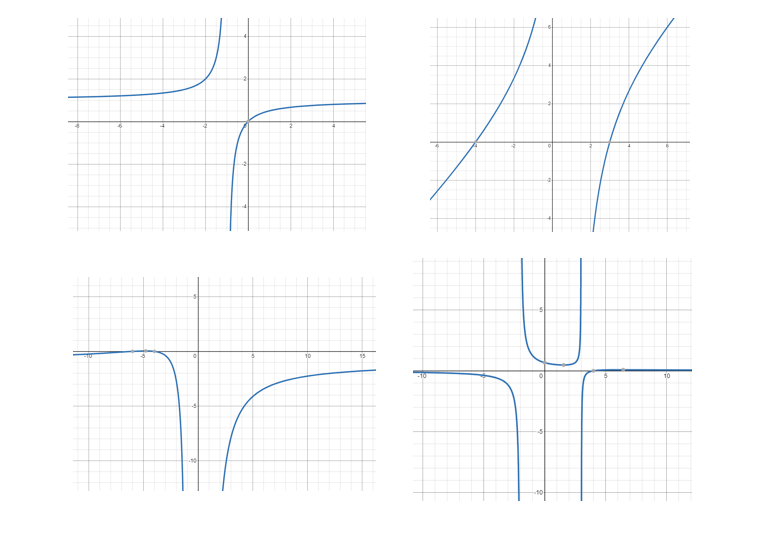
These are some of the rational functions you can see in this chapter!
4
A discontinuous function is a function whose graph has one or more gaps or breaks. Many rational functions are discontinuous.
5
A continuous function is a function whose graph has no gaps or breaks. This means you can draw the entire thing without picking up your pencil. The functions we have looked at before this (linear, quadratic, polynomial, exponential, logarithmic) are all continuous.
6
Multiple Choice
The pictured graph is
discontinuous
continuous
7
Multiple Choice
The pictured graph is
discontinuous
continuous
8
Multiple Choice
The pictured graph is
discontinuous
continuous
9
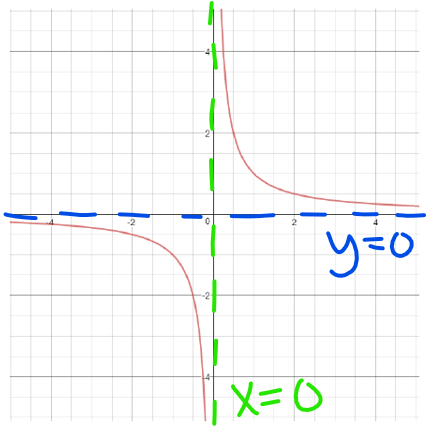
The rational parent function is f(x)=x1 .
Its graph is a hyperbola, which has two separate branches.
10
Reminder: an asymptote is an imaginary line that the graph will approach but never touch.
11
Like logarithmic and exponential functions, rational functions may have asymptotes.
The parent function has a vertical asymptote at x=0.
The parent function has a horizontal asymptote at y=0.
12
The vertical asymptote at x=0 means the branches of this function will get really close but never actually touch the y-axis.
13
The domain of this function is all x's except for x=0, since there is an asymptote at x=0.
The graph is undefined at x=0! Remember that word??
14
The domain can be written multiple ways:
(−∞,0)∪(0,∞) (interval notation from left to right)
{x: x=0} (all x's except 0)
15
16
17
The "union" in the middle of the interval notation just means there are multiple pieces of this domain.
18
The horizontal asymptote at y=0 means the branches of this function will get really close but never actually touch the x-axis.
19
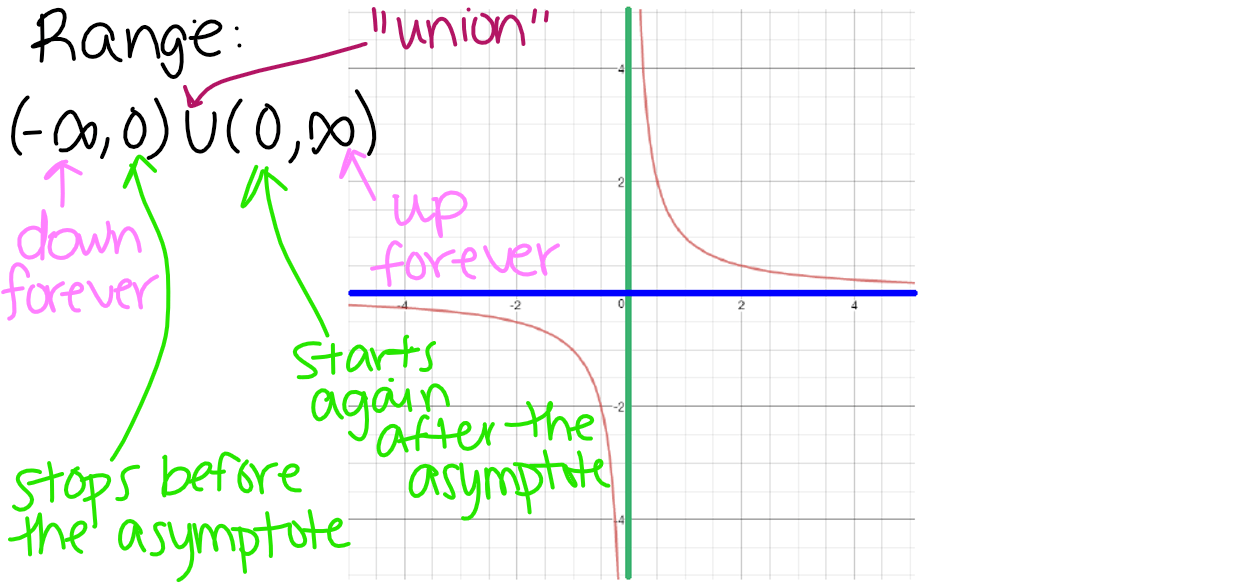
The range of this function is all y's except for y=0, since there is an asymptote at y=0.
20
The range can be written multiple ways:
(−∞,0)∪(0,∞) (interval notation from bottom to top)
{y: y=0} (all y's except 0)
21
22
23
24
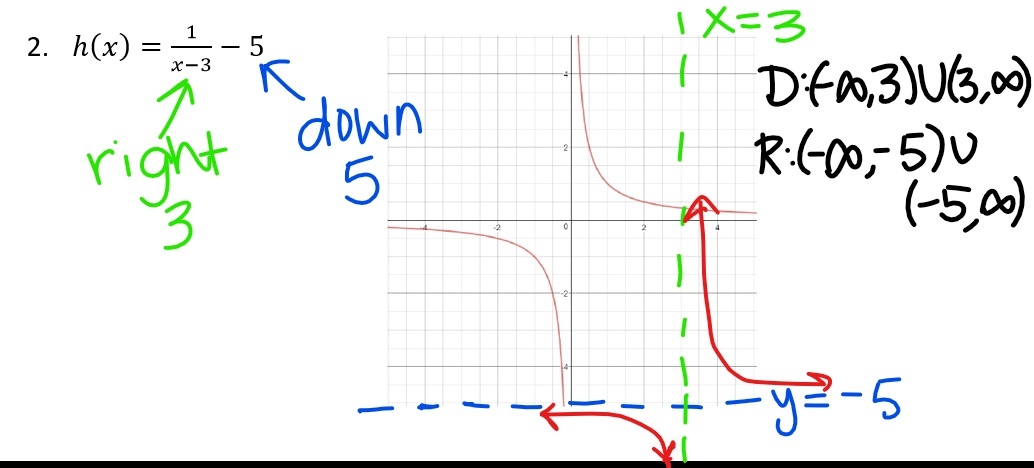
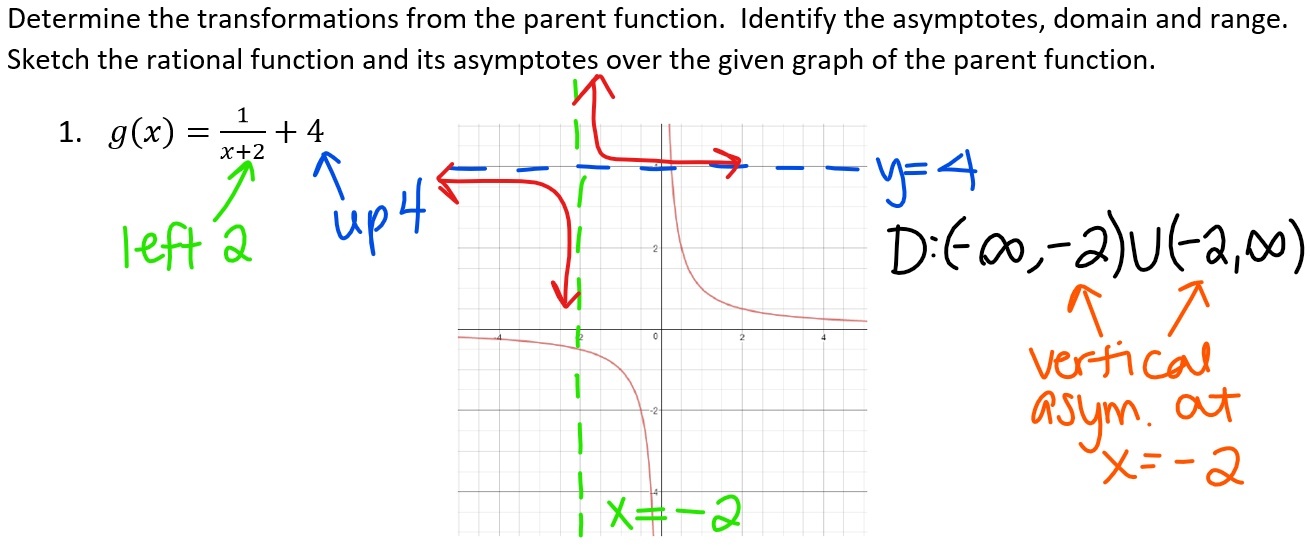
When you transform the rational parent function, the asymptotes move too!
25
26
27
28
Multiple Choice
Select one of the transformations in
h(x)=x−31−5 .right 3
down 3
up 3
left 3
29
Multiple Choice
Select one of the transformations in
h(x)=x−31−5 .right 5
down 5
up 5
left 5
30
31
Multiple Choice
What x-value is not included in the domain of
h(x)=x−31−5 ?3
5
1
-5
-3
32
Multiple Choice
What y-value is not included in the range of
h(x)=x−31−5 ?3
5
1
-5
-3
33
34
Make sure you write this down.
35
Multiple Select
Select all true statements. You should have just taken notes on this on the last slide.
Setting the numerator equal to zero gives us the vertical asymptotes.
Setting the numerator equal to zero gives us the zeros.
Setting the denominator equal to zero gives us the vertical asymptotes.
Setting the denominator equal to zero gives us the zeros.
Setting the denominator equal to zero gives us the horizontal asymptotes.
36
37
Examples
f(x)=x2−4x3 has no horizontal asymptote
g(x)=4x36x2−6 has a horizontal asymptote at y=0
j(x)=3x2+8x+52x2−7x−4 has a horizontal asymptote at y=2/3
38
Multiple Choice
True or False:
If the degree of the numerator is smaller than the degree of the denominator, the horizontal asymptote is y=0.
You should have just taken notes on this.
True
False
39
Multiple Choice
True or False:
If the degree of the numerator is greater than the degree of the denominator, the horizontal asymptote is y= the leading coefficient of the numerator divided by the leading coefficient of the denominator.
True
False
40
Multiple Choice
True or False:
If the degree of the numerator is greater than the degree of the denominator, the horizontal asymptote is y=1.
True
False
41
Multiple Choice
True or False:
If the degree of the numerator is the same as the degree of the denominator, the horizontal asymptote is y= the leading coefficient of the numerator divided by the leading coefficient of the denominator.
True
False
42
If a rational function has the same factor in the numerator and denominator, they cancel and there is a hole at that x-value in the graph (instead of a vertical asymptote or zero).
43
Please please please make sure you have taken notes on everything in this presentation. I know it's a lot but having these notes will be very useful as you learn how to graph these functions!
5-4 Rational Functions
Take notes!
Show answer
Auto Play
Slide 1 / 43
SLIDE

Similar Resources on Wayground
35 questions
Unit 8: Introduction to Quadratics Review
Presentation
•
9th - 12th Grade
34 questions
11.4 Matrix Algebra
Presentation
•
9th - 12th Grade
37 questions
Energy and Energy Transformations
Presentation
•
9th - 12th Grade
36 questions
E2 T2 ¿Reflexivo o no?
Presentation
•
9th - 12th Grade
36 questions
Lab Safety Rules
Presentation
•
9th - 12th Grade
40 questions
Plant Systems
Presentation
•
9th - 12th Grade
38 questions
Into to Parts of Circles
Presentation
•
9th - 12th Grade
34 questions
Finding Missing Sides and Angles Using Trig Ratios
Presentation
•
9th - 12th Grade
Popular Resources on Wayground
10 questions
Safety Day 2026 – Student Review
Quiz
•
9th Grade
21 questions
Continents and Oceans
Quiz
•
6th Grade
20 questions
Parts of Speech
Quiz
•
5th Grade
16 questions
Subject & Predicate
Quiz
•
5th Grade
25 questions
Multiplication Facts
Quiz
•
5th Grade
12 questions
Map Skills
Quiz
•
3rd Grade
22 questions
Continents and Oceans
Quiz
•
5th Grade
15 questions
Rounding Decimals
Quiz
•
5th Grade
Discover more resources for Mathematics
12 questions
Absolute Value Equations
Quiz
•
9th Grade
20 questions
Function or Not a Function
Quiz
•
8th - 9th Grade
11 questions
Slope from 2 points
Quiz
•
8th - 9th Grade
10 questions
Exploring the Basics of Exponents
Interactive video
•
6th - 10th Grade
10 questions
Solving Absolute Value Equations
Quiz
•
9th Grade
20 questions
Unit 5 Test RSC (25-26)
Quiz
•
10th Grade
18 questions
SB 12.2 Write in point slope form
Quiz
•
9th Grade
12 questions
Identify Rigid Transformations
Quiz
•
8th - 12th Grade