Enzymes L3
Presentation
•
Biology
•
12th Grade
•
Practice Problem
•
Medium
+1
Standards-aligned
Emma Dawes
Used 6+ times
FREE Resource
12 Slides • 20 Questions
1
Enzymes L3
2
Multiple Choice
Organelles that make proteins by putting together chains of amino acids.
Mitochondria
Lysosomes
Ribsomes
Chloroplast
3
Multiple Choice
All amino acids have a ...
ether group & carboxyl group
amino group & hydroxide group
amino group & carboxyl group
ether group & hydroxide group
4
Multiple Choice
If a amino acid is Non-polar it is
Hydrophobic
Hydrophilic
5
Multiple Choice
6
Multiple Choice
7
8
Multiple Choice
What is a cofactor (L1)?
A carbohydrate side chain that activates an enzyme.
A non-protein that is bound to an enzyme and is required for catalysis.
A requirement for the hydrolysis of urease.
A non-protein that is not attached to the enzyme structure.
9
Multiple Select
Which are cofactors?
A catalase molecule
Coenzymes
Polypeptides
Prosthetic groups
10
11
Poll
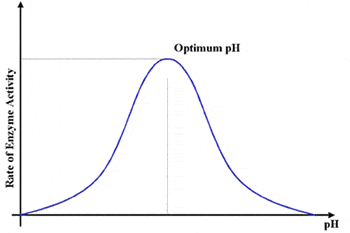
Which environmental factors do you think might affect enzyme action?
Temperature
Moisture availabilty
Substrate concentration
pH
Salinity
12
13
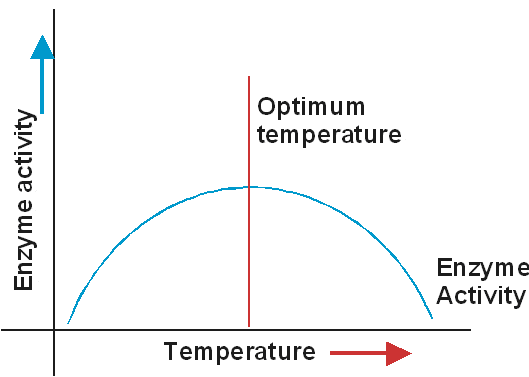
The optimum temperature range varies for different enzymes.
14
15
Multiple Select
What conditions do you think would be optimal for the action of pepsin?
37 - 42 degrees Celsius
32 - 36 degrees Celsius
pH 1.5 - 2.0
pH 4.5 - 7.0
16
Vm is the maximum level of enzyme activity and cannot be exceeded.
17
Multiple Choice
Vm is reached when...
maximum temperature is reached.
The pH is optimal.
Roughly 50% of enzymes are bound to substrate.
the enzyme is saturated.
18
19
Poll
Can you confidently explain what a cofactor is?
Yes!
Not sure
No.
20
Enzyme Inhibitors
chemicals which bind to an enzyme to suppress its activity
21
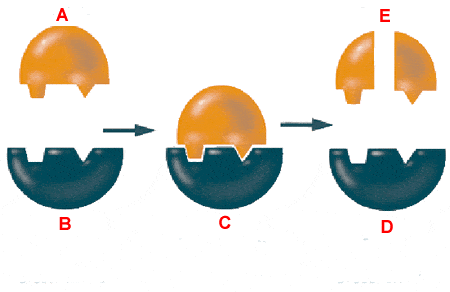
Reversible inhibitors either bind to an active site (competitive inhibitors), or to another site on the enzyme (non-competitive inhibitors).
22
23
24
Multiple Choice
You are given a reaction and are told it is at “saturation.” To determine if this is true, you should add _______ and see if the reaction rate _______.
ATP; increases
more substrate; increases
a competitive inhibitor; decreases
a downstream product; decreases
a noncompetitive inhibitor; decreases
25
Multiple Choice
26
Multiple Choice
27
Multiple Choice
28
Multiple Choice
29
Multiple Choice
30
Multiple Choice
31
Multiple Choice
32
Multiple Choice
Enzymes L3

Show answer
Auto Play
Slide 1 / 32
SLIDE

Similar Resources on Wayground
25 questions
Neuromuscular Function
Presentation
•
12th Grade
25 questions
Case study 4.3
Presentation
•
12th Grade
26 questions
AMDM UNIT 1 Review
Presentation
•
12th Grade
25 questions
Elements Compounds and Mixtures
Presentation
•
12th Grade
24 questions
Prob/Stats 3.1.3 Probability Notation
Presentation
•
12th Grade
21 questions
Gene Cloning
Presentation
•
12th Grade
24 questions
1.10 Niche and Competition
Presentation
•
KG
Popular Resources on Wayground
10 questions
Safety Day 2026 – Student Review
Quiz
•
9th Grade
21 questions
Continents and Oceans
Quiz
•
6th Grade
20 questions
Parts of Speech
Quiz
•
5th Grade
16 questions
Subject & Predicate
Quiz
•
5th Grade
25 questions
Multiplication Facts
Quiz
•
5th Grade
12 questions
Map Skills
Quiz
•
3rd Grade
22 questions
Continents and Oceans
Quiz
•
5th Grade
15 questions
Rounding Decimals
Quiz
•
5th Grade
Discover more resources for Biology
20 questions
Cell Transport
Quiz
•
9th - 12th Grade
8 questions
DNA vs. RNA
Presentation
•
9th - 12th Grade
16 questions
Epithelial tissues
Quiz
•
11th - 12th Grade
15 questions
DNA Structure and Replication
Quiz
•
9th - 12th Grade
20 questions
Ecological Succession Review
Quiz
•
9th - 12th Grade
3 questions
Enzymes & Energy
Quiz
•
9th - 12th Grade
38 questions
Mitosis & Meiosis
Quiz
•
9th - 12th Grade
37 questions
DNA/RNA practice part 2
Quiz
•
9th - 12th Grade