

Orbital Notation

Flashcard
•
Science
•
6th - 8th Grade
•
Hard

Barbara White
FREE Resource
Student preview

18 questions
Show all answers
1.
FLASHCARD QUESTION
Front
Electron Configuration Noun
[uh-lek-tron kon-fig-yuh-rey-shuhn]
Back
Electron Configuration
The specific arrangement of electrons in the orbitals of an atom, dictating its chemical properties and stability.
Example: This diagram shows the order in which electrons fill the energy levels and orbitals around an atom's nucleus, following the diagonal arrows from top to bottom.

2.
FLASHCARD QUESTION
Front
Orbital Noun
[or-bi-tl]
Back
Orbital
A region of space around an atom's nucleus where there is a high probability of finding an electron.
Example: This diagram shows an s-orbital, the simplest type of electron orbital, as a sphere, representing the region where an electron is most likely found.

3.
FLASHCARD QUESTION
Front
Sublevel Noun
[sub-lev-uhl]
Back
Sublevel
A group of orbitals within a principal energy level that all have the same characteristic shape and energy.
Example: This diagram shows that a main energy shell (like shell 3) is split into smaller groups called sublevels (3s, 3p, 3d).

4.
FLASHCARD QUESTION
Front
Principal Energy Level Noun
[prin-suh-puhl en-er-jee lev-uhl]
Back
Principal Energy Level
The main energy level occupied by an electron, indicating its relative distance and energy from the atom's nucleus.
Example: This diagram shows that electrons exist in specific energy levels, or shells (E₁, E₂, etc.), at different distances from the atom's nucleus.

5.
FLASHCARD QUESTION
Front
Ground State Noun
[ground steyt]
Back
Ground State
The lowest possible energy arrangement of electrons within an atom, representing its most stable electronic configuration.
Example: This image shows an atom in its ground state (right), where the electron is in the lowest possible energy level, closest to the nucleus.

6.
FLASHCARD QUESTION
Front
Excited State Noun
[ik-sahy-tid steyt]
Back
Excited State
A temporary, higher-energy state of an atom that occurs when an electron absorbs energy and moves to a higher orbital.
Example: An electron absorbs energy to jump from its normal, lower-energy 'ground state' orbit to a temporary, higher-energy 'excited state' orbit further from the nucleus.

7.
FLASHCARD QUESTION
Front
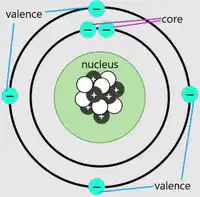
Valence Electrons Noun
[vey-luhns uh-lek-trons]
Back
Valence Electrons
The electrons located in the outermost principal energy level of an atom, which are primarily involved in chemical bonding.
Example: This Bohr model of an oxygen atom shows electrons in shells; the six electrons in the outermost shell are the valence electrons.



Access all questions and much more by creating a free account
Create resources
Host any resource
Get auto-graded reports

Continue with Google

Continue with Email

Continue with Classlink

Continue with Clever
or continue with

Microsoft
%20(1).png)
Apple

Others
Already have an account?



