
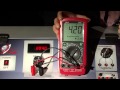
Measuring Voltage and Current Concepts

Interactive Video
•
Physics, Science, Mathematics
•
9th - 10th Grade
•
Practice Problem
•
Hard

Patricia Brown
FREE Resource
Read more
10 questions
Show all answers
1.
MULTIPLE CHOICE QUESTION
30 sec • 1 pt
Which of the following is NOT a circuit element introduced in the experiment?
Capacitor
Resistor
Galvanometer
Inductor
2.
MULTIPLE CHOICE QUESTION
30 sec • 1 pt
What is the primary function of a multimeter in a circuit?
To connect circuit elements
To measure resistance, current, and potential difference
To supply power
To amplify signals
3.
MULTIPLE CHOICE QUESTION
30 sec • 1 pt
Which part of the multimeter is used for measuring potential difference?
The current part
The power supply part
The potential difference part
The resistance part
4.
MULTIPLE CHOICE QUESTION
30 sec • 1 pt
When measuring resistance with a multimeter, what is the first step?
Set the power supply
Adjust the multimeter
Select the correct range
Connect the cables
5.
MULTIPLE CHOICE QUESTION
30 sec • 1 pt
What is the error percentage of the multimeter when measuring resistance?
5%
0.5%
1%
2%
6.
MULTIPLE CHOICE QUESTION
30 sec • 1 pt
In voltage measurement, why is it important to connect the black cable to the low potential terminal?
To ensure accurate readings
To prevent short circuits
To increase voltage
To decrease resistance
7.
MULTIPLE CHOICE QUESTION
30 sec • 1 pt
What happens to precision when measuring voltage in larger ranges?
Precision becomes unpredictable
Precision remains the same
Precision decreases
Precision increases
Access all questions and much more by creating a free account
Create resources
Host any resource
Get auto-graded reports

Continue with Google

Continue with Email

Continue with Microsoft
or continue with

%20(1).png)
Apple

Others
By signing up, you agree to our Terms of Service & Privacy Policy
Already have an account?

