
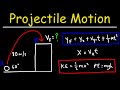
Projectile Motion and Energy Concepts

Interactive Video
•
Physics, Science
•
9th - 12th Grade
•
Practice Problem
•
Hard

Emma Peterson
FREE Resource
Read more
10 questions
Show all answers
1.
MULTIPLE CHOICE QUESTION
30 sec • 1 pt
What is the initial speed of the ball launched in the projectile motion problem?
60 m/s
100 m/s
80 m/s
120 m/s
2.
MULTIPLE CHOICE QUESTION
30 sec • 1 pt
Which angle is the ball launched at in the projectile motion problem?
60 degrees
45 degrees
90 degrees
30 degrees
3.
MULTIPLE CHOICE QUESTION
30 sec • 1 pt
What is the height of the building the ball lands on?
150 meters
250 meters
200 meters
100 meters
4.
MULTIPLE CHOICE QUESTION
30 sec • 1 pt
Which equation is used to find the time of flight in the kinematic approach?
y = y0 + v0t + 1/2 at^2
v^2 = u^2 + 2as
s = ut + 1/2 at^2
v = u + at
5.
MULTIPLE CHOICE QUESTION
30 sec • 1 pt
What is the horizontal component of velocity (Vx) when the ball strikes the building?
40 m/s
30 m/s
20 m/s
50 m/s
6.
MULTIPLE CHOICE QUESTION
30 sec • 1 pt
What is the vertical component of velocity (Vy) just before the ball hits the building?
-39.698 m/s
-49.698 m/s
-19.698 m/s
-29.698 m/s
7.
MULTIPLE CHOICE QUESTION
30 sec • 1 pt
What theorem is used to calculate the final speed of the projectile?
Einstein's theorem
Pythagorean theorem
Archimedes' theorem
Newton's theorem
Access all questions and much more by creating a free account
Create resources
Host any resource
Get auto-graded reports

Continue with Google

Continue with Email

Continue with Microsoft
or continue with

%20(1).png)
Apple

Others
Already have an account?

