
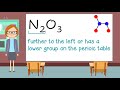
Naming Covalent Compounds Challenge

Interactive Video
•
Chemistry
•
6th - 10th Grade
•
Practice Problem
•
Medium

Ethan Morris
Used 8+ times
FREE Resource
Read more
10 questions
Show all answers
1.
MULTIPLE CHOICE QUESTION
30 sec • 1 pt
Which element is written first when naming covalent compounds?
The element with the higher group number
The element with the lower atomic number
The element with the lower group number
The element with the higher atomic number
2.
MULTIPLE CHOICE QUESTION
30 sec • 1 pt
If both elements are in the same group, which one is named first?
The element closer to the bottom of the column
The element closer to the top of the column
The element with the lower atomic number
The element with the higher atomic number
3.
MULTIPLE CHOICE QUESTION
30 sec • 1 pt
What suffix is used for the second element in a covalent compound?
-ine
-ite
-ide
-ate
4.
MULTIPLE CHOICE QUESTION
30 sec • 1 pt
What is the Greek prefix for three atoms?
Penta
Hexa
Tri
Tetra
5.
MULTIPLE CHOICE QUESTION
30 sec • 1 pt
Which of the following compounds is commonly referred to by its common name?
Carbon dioxide
Dihydrogen monoxide
Nitrogen trihydride
Sulfur hexafluoride
6.
MULTIPLE CHOICE QUESTION
30 sec • 1 pt
What is the correct name for the compound N2O3?
Nitrogen trioxide
Dinitrogen trioxide
Nitrogen dioxide
Dinitrogen dioxide
7.
MULTIPLE CHOICE QUESTION
30 sec • 1 pt
How is CO2 named using the rules for covalent compounds?
Monocarbon dioxide
Carbon dioxide
Carbon monoxide
Carbon trioxide
Access all questions and much more by creating a free account
Create resources
Host any resource
Get auto-graded reports

Continue with Google

Continue with Email

Continue with Microsoft
or continue with

%20(1).png)
Apple

Others
By signing up, you agree to our Terms of Service & Privacy Policy
Already have an account?

