
CELL TRANSPORT ASSESSMENT
Authored by Jel Gelera
Science
9th Grade
NGSS covered
Used 7+ times


AI Actions
Add similar questions
Adjust reading levels
Convert to real-world scenario
Translate activity
More...
Content View
Student View
45 questions
Show all answers
1.
MULTIPLE CHOICE QUESTION
30 sec • 1 pt
The major functions of the cell membrane do not include …
A. separation of the fluid environments inside and outside of the cell
B. maintaining homeostasis by regulating the passing of materials into and out of the cell
C. recognition, signaling, and communication between different cells
D. production of proteins used to construct the cell wall
2.
MULTIPLE CHOICE QUESTION
30 sec • 1 pt
The cell membrane contains channels and pumps that help move materials from one side of the membrane to the other. What are these channels and pumps made up of?
carbohydrates
lipids
proteins
nucleic acids
3.
MULTIPLE CHOICE QUESTION
30 sec • 1 pt
The diffusion of water across a selectively permeable membrane is called …
endocytosis
osmosis
pinocytosis
osmotic pressure
4.
MULTIPLE CHOICE QUESTION
30 sec • 1 pt
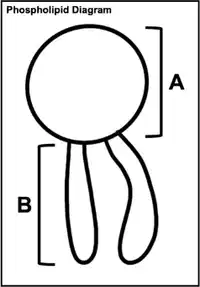
What letter on the phospholipid diagram indicates the hydrophobic region of the phospholipid?
letter A
letter B
5.
MULTIPLE CHOICE QUESTION
30 sec • 1 pt
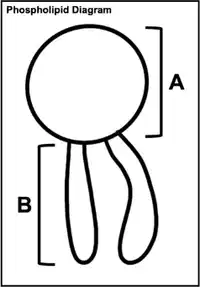
Which letter on the diagram indicates the hydrophilic region of the phospholipid?
letter A
letter B
6.
MULTIPLE CHOICE QUESTION
30 sec • 1 pt
What is the main difference between passive transport and active transport?
Passive transport occurs primarily in single-celled organisms, while active transport occurs primarily in multicellular organisms.
Passive transport requires cell energy and active transport does not require cell energy.
Passive transport never requires cell membrane proteins, while active transport requires membrane proteins.
Passive transport does not require cell energy and active transport requires cell energy.
7.
MULTIPLE CHOICE QUESTION
30 sec • 1 pt
What will occur if a cell is placed in a hypotonic solution?
Solutes will move into the cell from the surrounding solution.
Water will move into the cell from the surrounding solution.
Water will move out of the cell into the surrounding solution
none of the above
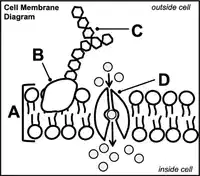
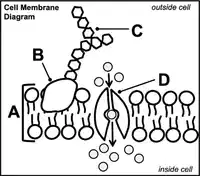
Access all questions and much more by creating a free account
Create resources
Host any resource
Get auto-graded reports

Continue with Google

Continue with Email

Continue with Microsoft
or continue with

%20(1).png)
Apple

Others
Already have an account?



