
Trilobites and Fossil Evidence
Authored by CARIN CRUZ
English
2nd Grade
CCSS covered
Used 2+ times


AI Actions
Add similar questions
Adjust reading levels
Convert to real-world scenario
Translate activity
More...
Content View
Student View
32 questions
Show all answers
1.
MULTIPLE CHOICE QUESTION
30 sec • 1 pt

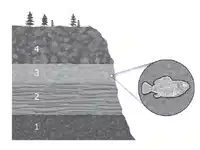
Trilobites are marine organisms that became extinct about 250 million years ago. There were as many as 25,000 species of trilobites, and their fossils are found all over the world, in mountains, deserts, grasslands, and rolling hills. Based on the information given, you can conclude that —
trilobites could live in many different habitats and ecosystems
some of the 25,000 species of trilobites lived on land
trilobite fossils formed mostly in high mountain areas
the locations where the fossils are found were once under water
Answer explanation
Trilobites were marine organisms, and their fossils are found in diverse locations. This suggests that these areas were once underwater, as trilobites lived in marine environments.
Tags
CCSS.RI.4.1
CCSS.RI.5.1
CCSS.RI.6.1
CCSS.RL.4.1
CCSS.RL.5.1
2.
MULTIPLE CHOICE QUESTION
30 sec • 1 pt

Refer to the diagram titled 'Forest Food Chain.' Which animals in the food chain are herbivores?
The hawk and the weasel
The caterpillar, the hawk, and the field mouse
The caterpillar and the rabbit
The caterpillar, the weasel, and the fox
Answer explanation
Herbivores are animals that eat plants. In the food chain, the caterpillar and the rabbit are the only herbivores, as they consume plant material, while the other animals listed are carnivores or omnivores.
3.
MULTIPLE CHOICE QUESTION
30 sec • 1 pt

Which of the following plant leaves are BEST adapted to water environments?
Kelp and Water lily
Kelp and Oak tree
Water lily and Oak tree
Kelp, Water lily, and Oak tree
Answer explanation
Kelp and water lily are aquatic plants with adaptations like buoyant structures and broad leaves to thrive in water environments, while oak trees are terrestrial and not suited for such conditions.
4.
MULTIPLE CHOICE QUESTION
30 sec • 1 pt
Lemonade is a solution that can be made by dissolving powdered lemonade mix in a pitcher of water. If the powdered lemonade mix is seen sinking to the bottom of the pitcher of water, what is the most likely explanation for this?
The pitcher needs ice in it for the lemonade mix to dissolve in the water.
Not enough time has passed for the lemonade mix to dissolve in the water.
The lemonade mix must be stirred into the water for it to dissolve.
The lemonade mix was not able to dissolve and form a solution with the water this time.
Answer explanation
The lemonade mix must be stirred into the water for it to dissolve. Simply adding the mix without stirring will cause it to sink instead of dissolving, as it needs agitation to properly integrate into the water.
5.
MULTIPLE CHOICE QUESTION
30 sec • 1 pt

What item is most likely described by its physical properties in the chart?
A. A strawberry
B. A bowling ball
C. A beach ball
D. A paper clip
Answer explanation
A beach ball is typically described by its physical properties such as size, shape, and material. Unlike the other options, it is inflatable, lightweight, and colorful, making it the most likely item to be described in a chart of physical properties.
6.
MULTIPLE CHOICE QUESTION
30 sec • 1 pt

What physical properties do all of the objects have in common?
A. Physical state and relative density
B. Temperature and relative density
C. Physical state and magnetism
D. Mass and temperature
Answer explanation
All objects share the same physical state (solid, liquid, gas) and relative density, which measures how dense they are compared to one another. This makes option A the correct choice, as temperature and magnetism are not universally applicable.
7.
MULTIPLE CHOICE QUESTION
30 sec • 1 pt
A plastic tub is filled halfway with water, and a rubber duck is placed on top of the water to float, demonstrating how waves in water transfer energy. How could this model be improved?
A larger rubber duck could be used.
The tub could be filled with less water.
Air could be blown through a straw toward the surface of the water to create waves to move the rubber duck.
The tub could be filled with deeper water.
Answer explanation
Blowing air through a straw creates waves, effectively demonstrating energy transfer in water. This method enhances the model by actively generating movement, unlike the other options which do not improve wave generation.
Access all questions and much more by creating a free account
Create resources
Host any resource
Get auto-graded reports

Continue with Google

Continue with Email

Continue with Microsoft
or continue with

%20(1).png)
Apple

Others
Already have an account?

