Search Header Logo
Cells, Traits and Adaptations 1

Cells, Traits and Adaptations 1

Assessment

Presentation

•

Science

•

8th Grade

•

Easy

•
NGSS
MS-LS1-2, MS-LS4-2, MS-LS4-4

+13

Standards-aligned

Created by

Kim Tran

Used 5+ times

FREE Resource

10 Slides • 53 Questions

1

​Cells, Traits, and Adaptations

By Kim Tran

2

​All living things are composed of cells
media

3

Nucleus: CONTROLS the cell, contains the cell's DNA
media

4

​Mitochondria: Break down food and releases energy
media

5

Cell Membrane: REGULATES what enters and exits the cell​
media
Cell Wall: provides SUPPORT, PROTECTION, and, MAINTAIN SHAPE. (only plant cells)

6

Cytoplasm: provide shape, structure, and movement for cell. Filled with fluid.
media

7

Chloroplast: absorbs sunlight and produces glucose (sugar) during photosynthesis (only plant cells)
media

8

Vacuole: STORES food, water, and waste material
media

9

Multiple Choice

The brain or "control center" of the cell. 
1
Mitochondria
2
Cell Membrane
3
Cytoplasm
4
Nucleus

10

Multiple Choice

Question image

What is the function of a chloroplast?

1

makes proteins for animal cells

2

allows materials in and out of the cell

3

provides structure and support

4

absorbs sunlight for photosynthesis

11

Multiple Choice

Question image

What organelle is this??

1

cell wall

2

chloroplast

3

mitochondria

4

nucleus

5

cell membrane

12

Multiple Choice

Question image

I make proteins for the cell. What am I?

1

ribosome

2

cell membrane

3

nucleus

4

chloroplast

13

Multiple Choice

This organelle stores water, and is very big in plant cells

1

nuclolus

2

ribosomes

3

golgi bodies

4

vacuoles

14

Multiple Choice

The _____________ is a gel-like fluid that fills plant and animal cells. It holds the organelles in place and gives each cell its shape.

1

Cytoplasm

2

Cell Membrane

3

Cell Wall

4

Chloroplast

15

Multiple Choice

Question image

What is the organelle shown?

1

Plant

2

Ribosomes

3

ER

4

Chloroplast

16

Multiple Choice

Question image

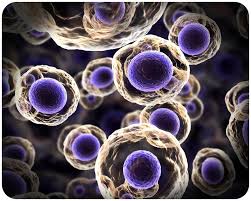
What type of cell is shown?

1

Prokaryotic (Bacteria)

2

Eukaryotic (Plant or Animal)

17

Multiple Choice

What can only be found in plant cells?
1
Cell membrane
2
Vacuole
3
Chloroplast
4
Mitochondrion

18

Multiple Choice

Question image
The two kinds of cells are Prokaryotes and Eukaryotes. How are they different?
1
Prokaryotes have a nucleus.
2
Eukaryotes have a nucleus.
3
Prokaryotes are plant cells.
4
There is no difference.

19

Multiple Choice

Question image
Directs all cell activities through the DNA located there.
1
Lysosomes
2
Nucleus
3
ribosomes
4
Mitochondria

20

Multiple Choice

Question image
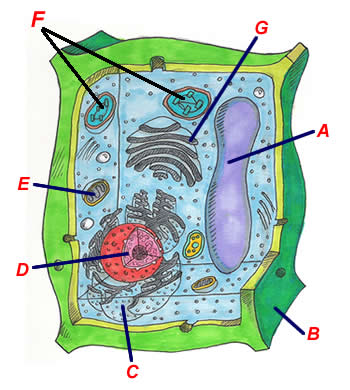
What is the function of the organelle labeled "F"?
1
Use sun energy to make food
2
Break food down for energy
3
Contains DNA
4
Protects the cell

21

Multiple Choice

Sharks are born with gills.

1

inherited from parents

2

acquired

22

Multiple Choice

A humpback whale watches its friend slap the water with its tail and copies it.

1

natural instinct

2

learned behavior

23

Multiple Choice

Humpback whales grow to be as big as two school buses.

1

inherited from their parents

2

acquired trait

24

Multiple Choice

What is an inherited trait?
1
A behavior that an organism obtains from experiences.
2
Characteristics passed from parents to offspring.
3
A natural behavior that an organism inherits.

25

Multiple Choice

What is a learned behavior?
1
Characteristics passed from parents to offspring.
2
A natural behavior that an organism inherits.
3
A behavior that an organism obtains from experiences.

26

Multiple Choice

Instinct, inherited trait, or learned behavior?


Curly hair

1

Instinct

2

Inherited trait

3

Learned behavior

27

Multiple Choice

Question image
B = brown fur  b = white fur
In the punnett square, what is the probability for white fur? 
1
0%
2
25%
3
50%
4
75%

28

Multiple Choice

Which of the following allele pairs is heterozygous?

1

RR

2

Qq

3

ss

29

Multiple Choice

Question image
What allele combination should go in the missing box?
1
AA
2
Aa
3
aa
4
none of these

30

media

31

media

32

Multiple Choice

Which of the following is a structural adaptation?

1

Feathers

2

Predation

3

Migration

4

Hibernation

33

Multiple Select

Which internal adaptation allows a bird to fly?

1

Feathers

2

Wings

3

Hollow Bones

4

Beaks

34

Multiple Choice

Question image

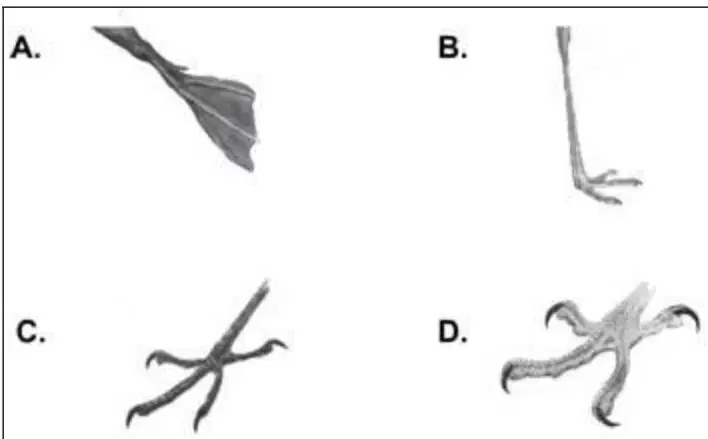
Which bird's foot is BEST adapted to swimming?

1

Picture A

2

Picture B

3

Picture C

4

Picture D

35

Multiple Choice

Question image

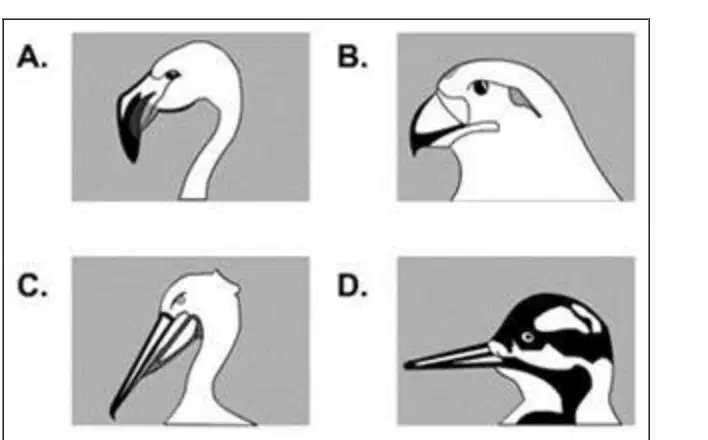
Which beak is best adapted to tear meat?

1

Picture A

2

Picture B

3

Picture C

4

Picture D

36

Multiple Choice

Question image

Adaptations help animals ___________.

1

survive

2

get food

3

protect themselves

4

all of the above

37

Multiple Choice

Question image
The ears of this fox are an example of...
1
A behavioral adaptation
2
Poor breeding
3
A structural adaptation
4
Plastic surgery gone horribly wrong

38

Multiple Choice

An example of a STRUCTURAL adaptation is...

1

a turtle hiding inside its shell

2

The spikes on a porcupine fish

3

a rabbit burrowing underground

4

a viper biting when threatened

39

Multiple Choice

Question image
The colors & patterns on a turtles shell help it blend in with the forest floor.  This is:
1
hibernation.
2
behavior.
3
migration.
4
camouflage.

40

Multiple Choice

An example of a behavioral adaptation is
1
The long neck of a giraffe
2
Penguins huddling together for warmth
3
A camel's hump used to store water
4
A polar bear's white fur used for camouflage

41

Multiple Choice

An animal's color or pattern that helps it blend into its surroundings
1
Environment 
2
Mimicry
3
Camouflage

42

Multiple Choice

A monkey has a long tail to help it swing from branch to branch.

1

Behavioral Adaptation

2

Physical/Structural Adaptation

43

Multiple Choice

A black bear hibernates during the winter months.

1

Behavioral Adaptation

2

Physical/Structural Adaptation

44

Multiple Choice

A penguin is white on its belly and black on its back so it harder to see underwater from above and below.

1

Behavioral Adaptation

2

Physical/Structural Adaptation

45

Multiple Choice

An owl is mostly nocturnal meaning it hunts and is active at night.

1

Behavioral Adaptation

2

Physical/Structural Adaptation

46

Multiple Choice

When an animal looks like another animal it is called ______________.
1
camouflage
2
mimicry
3
warning coloration
4
protective resemblance

47

Multiple Choice

Whos is the father of Genetics?

1

Watson

2

Crick

3

Mendel

4

Mr. Morris

48

Multiple Choice

Question image

Look at this picture of a human mother. Which of the following traits is most likely to be passed to her child?

1

pink dyed hair

2

pierced ears

3

brown eyes

49

Multiple Choice

A turtle decides to tuck itself into its shell to escape enemies.

1

Internal Structural

2

External Structural

3

Behavioral

50

Multiple Choice

The physical features of an organism that help it survive.
1
Extinction
2
Behavioral Adaptation
3
Structural Adaptation
4
Physiological Adaptation

51

Multiple Choice

The way an organism acts in order to help it survive.
1
Structural Adaptation
2
Physiological Adaptation
3
Mimicry
4
Behavioral Adaptation

52

Multiple Choice

A relatively long distance journey or individuals on a seasonal basis.
1
Mimicry
2
Migration
3
Learned Behavior
4
Extinction

53

Multiple Choice

An adaptation that allows an organism to perform special functions within the body.
1
Mimicry
2
Migration
3
Learned Behavior
4
Physiological Adaptation

54

Multiple Choice

Birds flying south for the winter is a ____ adaptation.

1

structural

2

behavioral

3

functional

55

Multiple Choice

Question image

Hibernation, migration, and dormancy or all examples of ___________ adaptations.

1

behavioral

2

physical

3

special

4

environmental

56

Multiple Choice

Question image
Which feature of a rose helps it grow without being eaten by large animals?
1
flowers with bright colors
2
sharp thorns
3
small seeds
4
deep roots

57

Multiple Choice

An example of a behavioral adaptation is
1
The long neck of a giraffe
2
Penguins huddling together for warmth
3
A camel's hump used to store water
4
A polar bear's white fur used for camouflage

58

Multiple Choice

An owl is mostly nocturnal meaning it hunts and is active at night.
1
Behavioral Adaptation
2
Structural Adaptation
3

Functional Adaptation

59

Multiple Choice

Parrots have special feet, with two toes on the front and back to help them cling to branches.
1
Behavioral Adaptation
2
Structural Adaptation
3

Functional Adaptation

60

Multiple Choice

Question image

protects and supports plant cells

1

cell wall

2

cell membrane

3

mitochrondria

4

cytoplasm

61

Multiple Choice

Question image

storage area for the cell

1

vacuole

2

cytoplasm

3

chloroplast

4

cell wall

62

Multiple Choice

Question image

controls what enters and leaves the cell

1

cell membrane

2

cell wall

3

endoplasmic reticulum

4

golgi body

63

Multiple Select

Click all the boxes that are adaptations.

1

Bear hibernating

2

Gills in fish

3

Water in a pond

4

The wings of a bird

5

The temperature of the earth

pattern-tertiary
​Cells, Traits, and Adaptations

By Kim Tran

Show answer

Auto Play

Slide 1 / 63

SLIDE